
Finding B2B opportunities in India is not simply a matter of finding a large number of businesses.
India has a huge and diverse business ecosystem, but companies do not have equal relevance to every product or service. A manufacturer selling industrial equipment, a SaaS company, a logistics provider and a financial-services firm may all need completely different target markets.
The practical challenge is therefore market selection: identifying where the right businesses are concentrated before investing heavily in prospecting and outreach.
➡️ India Business Landscape Report 2026
For a comprehensive overview of India’s business ecosystem, explore our India Business Landscape Report 2026.
Start With the Business Universe
The first step is understanding the overall market.
India’s MSME ecosystem alone contains millions of registered enterprises across trading, services and manufacturing. The Ministry of MSME’s dashboard provides a useful starting point for understanding this business universe.
But the total number of businesses is only the starting point.
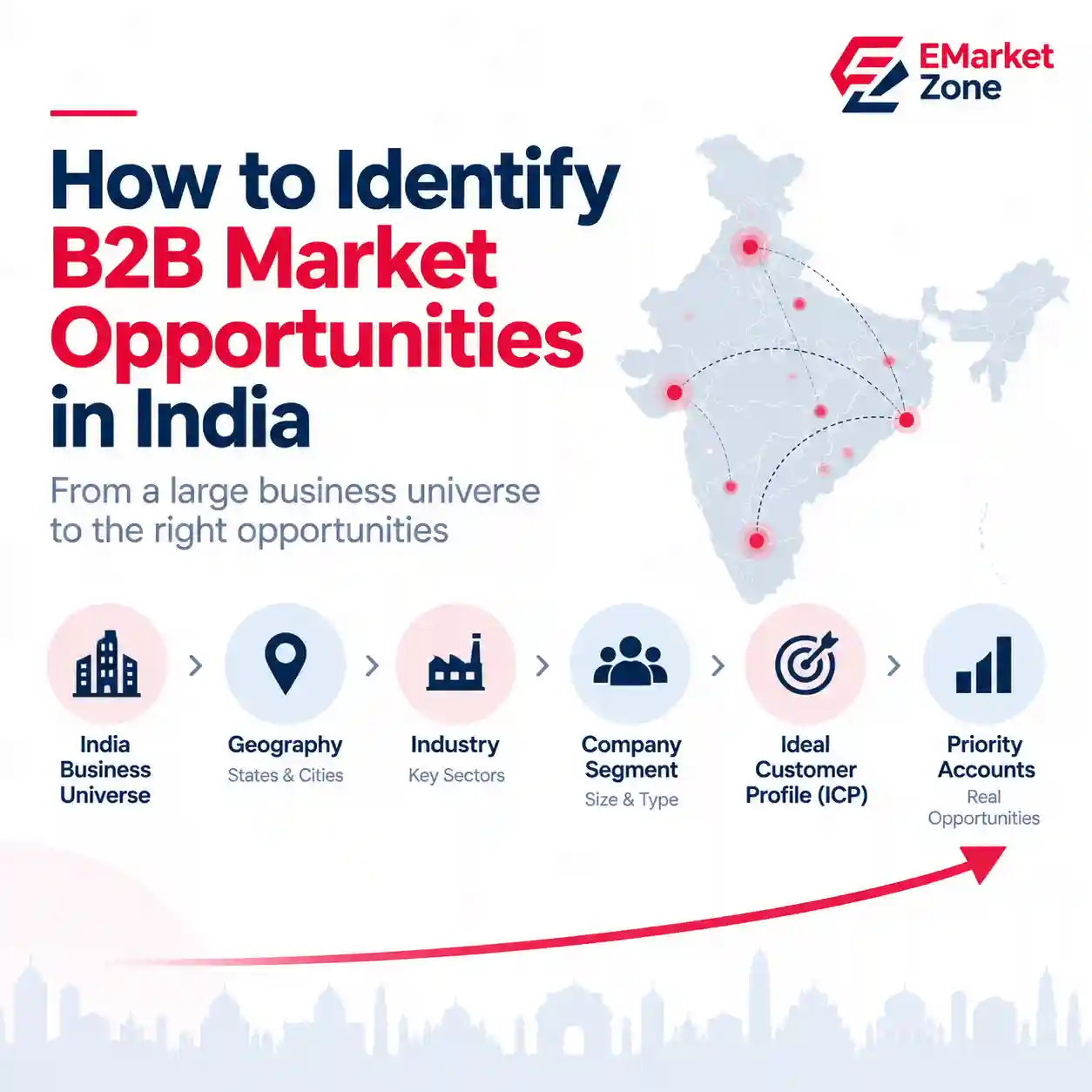
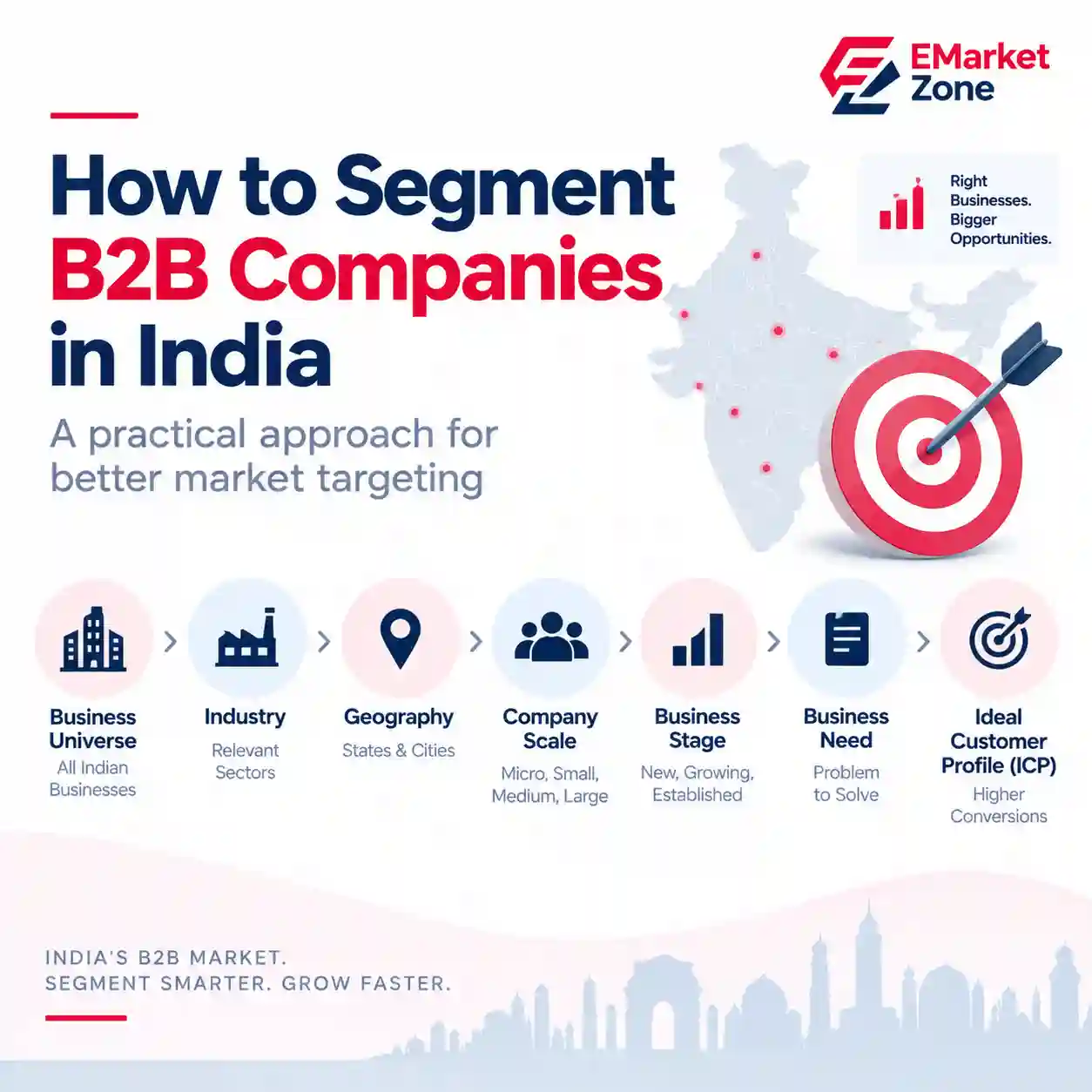
A company should then progressively narrow the market using factors such as:
Geography → Industry → Company Type → Company Scale → Business Stage → Business Need
This turns a broad business population into a more manageable addressable market.
Geography Is the First Major Filter
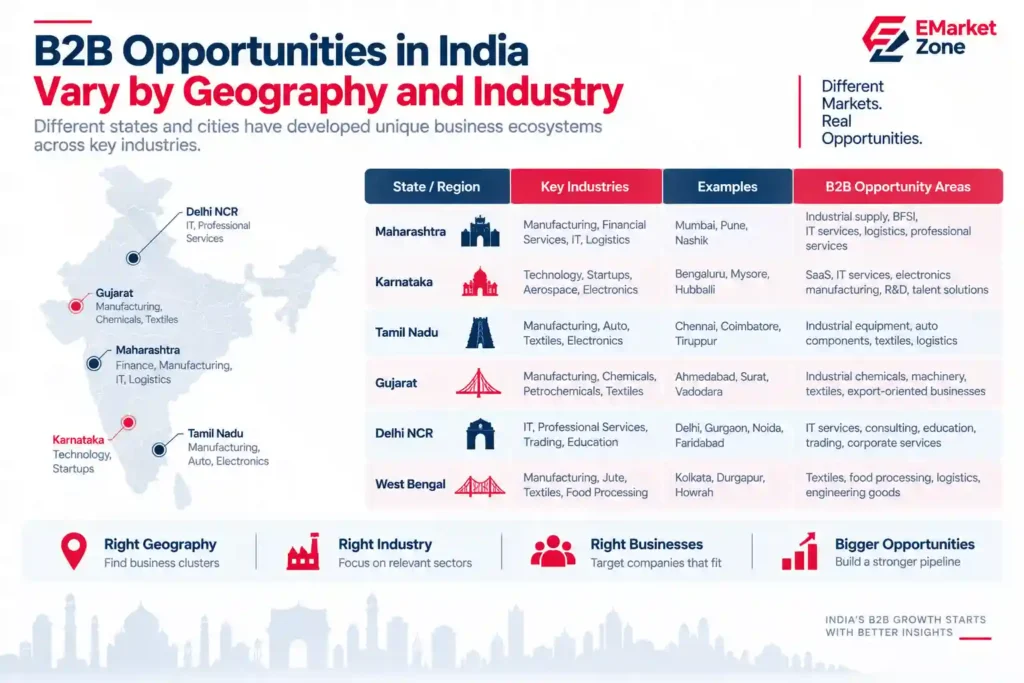
India’s B2B opportunity varies considerably by geography.
Different states and cities have developed distinct commercial ecosystems. Mumbai has a strong corporate and financial-services base, Bengaluru has a major technology ecosystem, Chennai has significant manufacturing activity, while Ahmedabad and other industrial centres have their own specialized business networks.
This does not mean one geography is universally better than another.
The relevant question is:
Where are the businesses that fit my product or service concentrated?
A logistics company may prioritize manufacturing and trading clusters. A technology provider may focus on cities with higher concentrations of digitally mature companies. An industrial supplier may need to identify specific manufacturing clusters rather than target an entire state.
For a detailed geographic analysis, see EMarket Zone’s India B2B Market Opportunity Report 2026.
Industry Changes the Opportunity
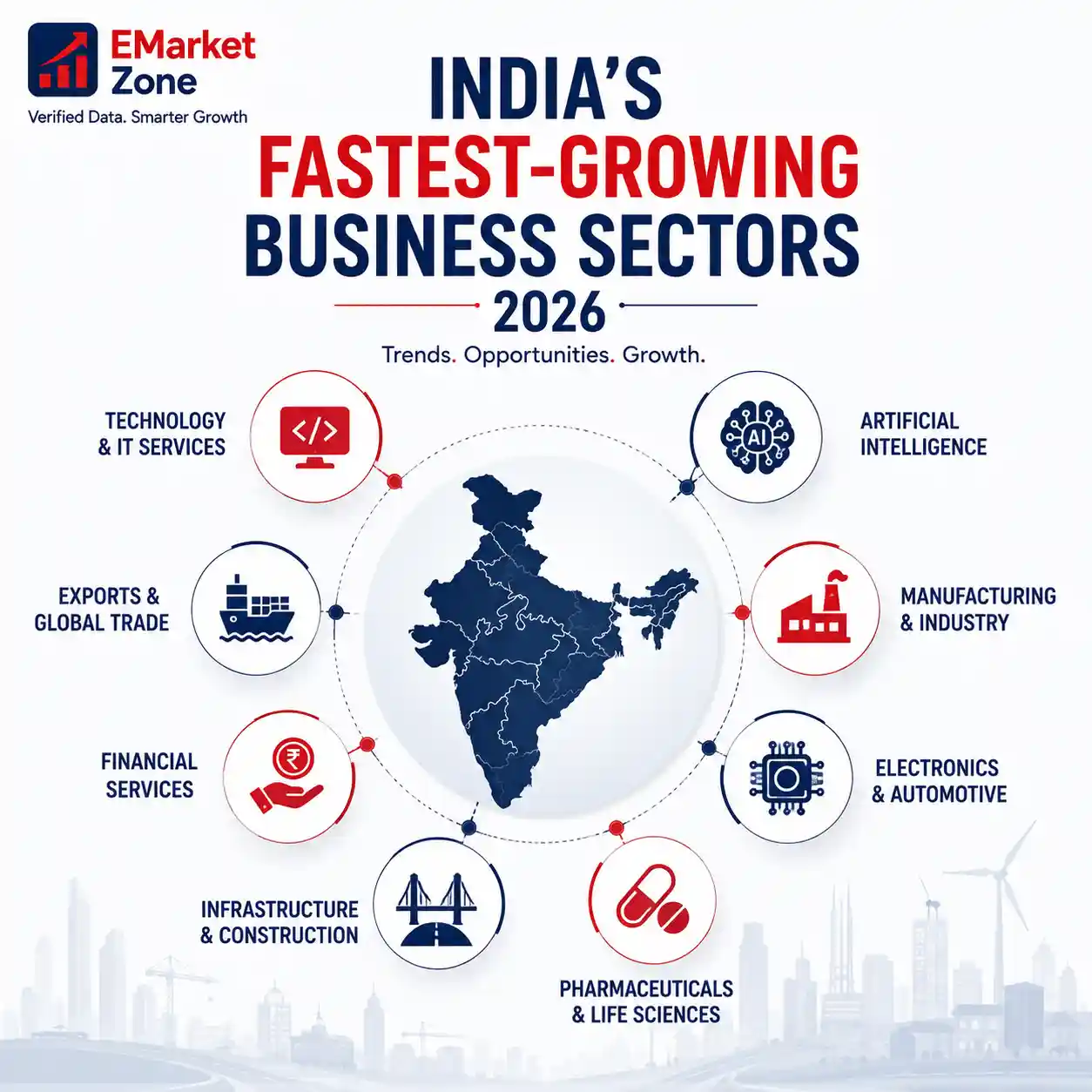
The next filter is industry.
A market containing 100,000 businesses is not necessarily more useful than one containing 20,000 businesses if the smaller market has significantly stronger customer fit.
Consider a company selling warehouse-management software. Its potential market is unlikely to be “all Indian businesses.” It may be more relevant to:
• Manufacturers
• Distributors
• Wholesalers
• Logistics companies
• Large retailers
The same principle applies across B2B categories.
Industry analysis helps determine who has the problem your product solves.
Company Size Adds Another Layer
Two companies in the same industry may still represent very different commercial opportunities.
A small business may have:
• Faster decision-making
• Lower budgets
• Shorter sales cycles
• Higher price sensitivity
A larger company may have:
• Larger potential contracts
• Multiple decision-makers
• More complex procurement
• Longer sales cycles
• Greater technology and compliance requirements
Neither segment is automatically more valuable.
The right segment depends on the economics of the product, sales model and customer acquisition strategy.
For national-level statistics, explore India Business Statistics 2026.
Then Define the Ideal Customer Profile
Once geography, industry and company characteristics are defined, the next step is creating an Ideal Customer Profile (ICP).
A useful ICP can include:
Industry — What does the company do?
Geography — Where does it operate?
Company Size — How large is the organization?
Business Stage — Is it established, expanding or newly formed?
Business Need — What problem might require your solution?
Timing Signals — Is there evidence that the need is becoming more immediate?
This is where market research becomes commercially useful.
Instead of asking:
“How many companies can we contact?”
the question becomes:
“Which companies have the strongest combination of fit and potential need?”
For state-level business comparisons, see Top Business States in India 2026.
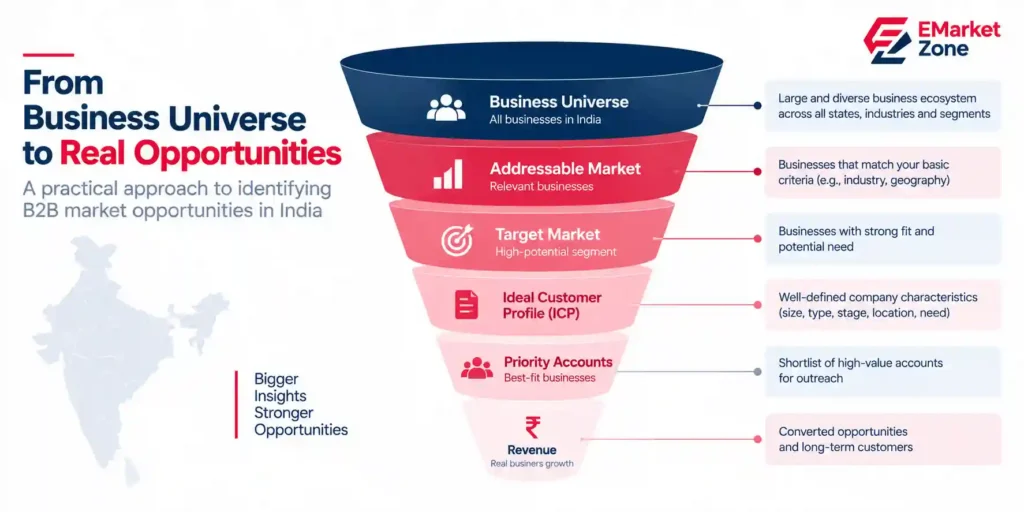
From Market to Priority Accounts
A practical B2B market-selection process can be represented as:
India Business Universe
↓
Addressable Market
↓
Target Industry + Geography
↓
ICP
↓
Priority Accounts
↓
Decision-Makers
↓
Qualified Opportunities
The market becomes smaller at every stage, but relevance increases.
That is the fundamental difference between market coverage and market prioritization.
For city-level business comparisons, see Top Business cities in India 2026.
The Key Principle
The best B2B market is not necessarily the market with the most businesses.
It is the market where scale, relevance, accessibility and business need intersect.
For a deeper examination of India’s states, cities, industries, company segments and B2B opportunity framework, read the full India B2B Market Opportunity Report 2026.
You can also use the supporting India Business Statistics 2026 research resources to explore the underlying business data.
Related Research
For the broader analysis of India’s business ecosystem, see the India Business Landscape Report 2026.
For state-level business comparisons, see Top Business States in India 2026.
For national-level statistics, explore India Business Statistics 2026.
For detailed MSME data, see State-wise MSME Statistics in India 2026
For city-level business comparisons, see Top Business City in India 2026.
Leave a comment