
TABLE OF CONTENTS
Executive Summary
01 India’s Business Landscape
Overview of India’s business ecosystem, structure and growth drivers.
02 Business Registration & Business Structures
Business registration trends, legal entities and formalization.
03 State-wise Business Landscape
Regional business distribution and investment hotspots.
04 Major Business Cities
India’s leading commercial hubs and emerging growth cities.
05 Industry-wise Business Landscape
Sector analysis and industrial ecosystem.
06 MSME Landscape
MSME statistics, digital adoption and government support.
07 Emerging Business Trends & Future Growth Drivers
AI, digital transformation and innovation.
08 Business Opportunities, Challenges & Strategic Outlook
Growth opportunities, risks and strategic recommendations.
09 Conclusion & India’s Business Outlook to 2030
Key findings and future outlook.
References
About the Publisher
Executive Summary
India Business Landscape Report 2026
India continues to strengthen its position as one of the world’s fastest-growing business ecosystems. Driven by rapid digital transformation, government reforms, expanding entrepreneurship, infrastructure development, and increasing domestic consumption, the country has become a significant destination for investment, manufacturing, services, and innovation.
From micro enterprises operating in rural districts to multinational corporations headquartered in metropolitan cities, India’s business landscape is remarkably diverse. Businesses across manufacturing, retail, healthcare, construction, logistics, education, technology, finance, hospitality, agriculture, and professional services collectively contribute to economic growth, employment generation, exports, and technological advancement.
The expansion of formal business registrations over the last decade reflects increasing regulatory compliance, digital governance, easier company incorporation processes, and wider adoption of Goods and Services Tax (GST). Government initiatives such as Digital India, Startup India, Make in India, Production Linked Incentive (PLI) schemes, and infrastructure investments continue to encourage entrepreneurship and industrial development across multiple sectors.
Regional business activity remains concentrated in economically advanced states such as Maharashtra, Gujarat, Karnataka, Tamil Nadu, Delhi NCR, Telangana, and Uttar Pradesh. These regions account for a significant share of company registrations, manufacturing output, startup activity, exports, and business investments. However, emerging states are also demonstrating increasing business formation, particularly in manufacturing, logistics, renewable energy, electronics, and food processing.
India’s Micro, Small and Medium Enterprises (MSME) sector remains the backbone of the economy, supporting employment, innovation, and regional industrialization. Alongside the growing number of registered companies, the expansion of GST registrations, digital commerce, and technology adoption is creating new opportunities for business-to-business (B2B) sales, market expansion, and investment.
This report provides a comprehensive overview of India’s business landscape through an analysis of business structures, geographic distribution, industrial composition, emerging sectors, and long-term growth trends. It is designed to help business leaders, investors, researchers, sales professionals, and policymakers better understand the evolving commercial environment and identify opportunities across industries and regions.
Report Objectives
This report aims to:
• Provide an overview of India’s business ecosystem.
• Analyze business distribution across states and major cities.
• Examine the role of different business structures, including MSMEs, Private Limited Companies, LLPs, and Public Limited Companies.
• Highlight industry-wise business concentration and growth patterns.
• Identify key manufacturing and commercial hubs.
• Explore emerging business sectors and investment opportunities.
• Present actionable insights for business expansion, sales planning, and market entry.
Who Should Read This Report?
This report is designed for:
• Business owners evaluating expansion opportunities
• B2B sales and marketing professionals
• Investors and venture capital firms
• Manufacturers and exporters
• Market researchers and consultants
• Government agencies and policymakers
• Financial institutions
• Entrepreneurs planning new ventures
Key Insights at a Glance
Note: The following figures should be updated annually using the latest authoritative public sources and, where applicable, EMarket Zone’s proprietary business datasets.
| Business Indicator | Key Insight |
|---|---|
| Business Ecosystem | India hosts one of the world’s largest and most diverse business environments, spanning manufacturing, services, trade, agriculture, and technology. |
| Economic Drivers | Manufacturing, services, MSMEs, startups, exports, and digital businesses continue to drive commercial growth. |
| Business Concentration | Maharashtra, Gujarat, Karnataka, Tamil Nadu, Delhi NCR, Telangana, and Uttar Pradesh remain among the leading business hubs. |
| Growth Sectors | Electronics, renewable energy, logistics, healthcare, SaaS, fintech, EVs, food processing, and industrial manufacturing continue to expand. |
| Digital Adoption | Increasing digitalization has accelerated business registrations, GST compliance, and online commerce. |
| Market Opportunity | India’s expanding formal business sector creates significant opportunities for B2B sales, partnerships, and investment. |
Chapter 1 (India's Business Landscape)
Introduction
India has emerged as one of the world’s most dynamic business destinations, driven by a combination of economic reforms, rapid digitalization, expanding domestic demand, and a thriving entrepreneurial ecosystem. With a population exceeding 1.4 billion and one of the fastest-growing major economies, India provides opportunities across manufacturing, services, technology, retail, healthcare, agriculture, logistics, and exports.
Over the past decade, the country’s business environment has undergone significant transformation. Digital governance, simplified business registration processes, improved financial inclusion, nationwide tax reforms through the Goods and Services Tax (GST), and government initiatives such as Make in India, Startup India, Digital India, PM Gati Shakti, and the Production Linked Incentive (PLI) schemes have encouraged businesses to formalize operations and invest in long-term growth.
Today, India’s business ecosystem ranges from individual entrepreneurs and family-owned enterprises to MSMEs, high-growth startups, listed corporations, multinational companies, exporters, and large industrial manufacturers. This diversity creates one of the largest and most resilient commercial markets globally.
Understanding the structure of this ecosystem is essential for investors, policymakers, sales teams, and businesses seeking expansion opportunities. The following sections examine the key characteristics, composition, and growth drivers shaping India’s business landscape in 2026.
1.1 India's Business Ecosystem at a Glance
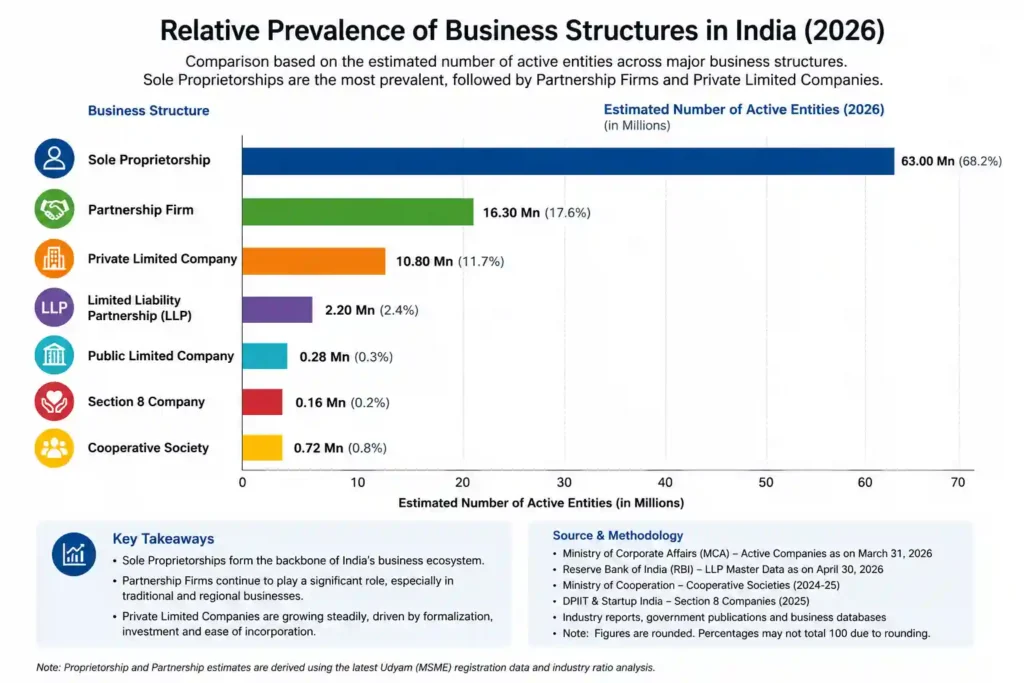
India’s commercial environment consists of businesses operating under multiple legal structures, each serving different purposes and scales of operation.
| Business Structure | Typical Business Size | Common Industries |
|---|---|---|
| Sole Proprietorship | Micro & Small | Retail, Trading, Local Services |
| Partnership Firm | Small & Medium | Professional Services, Trading |
| LLP | Small & Medium | Consulting, IT, Agencies |
| Private Limited Company | Small to Large | Manufacturing, Technology, Healthcare, Exports |
| Public Limited Company | Large Enterprises | Banking, Infrastructure, Energy |
| Section 8 Company | Non-Profit | Education, Healthcare, Social Development |
| Cooperative Society | Community-Owned | Agriculture, Dairy, Banking |
1.2 Major Business Segments in India
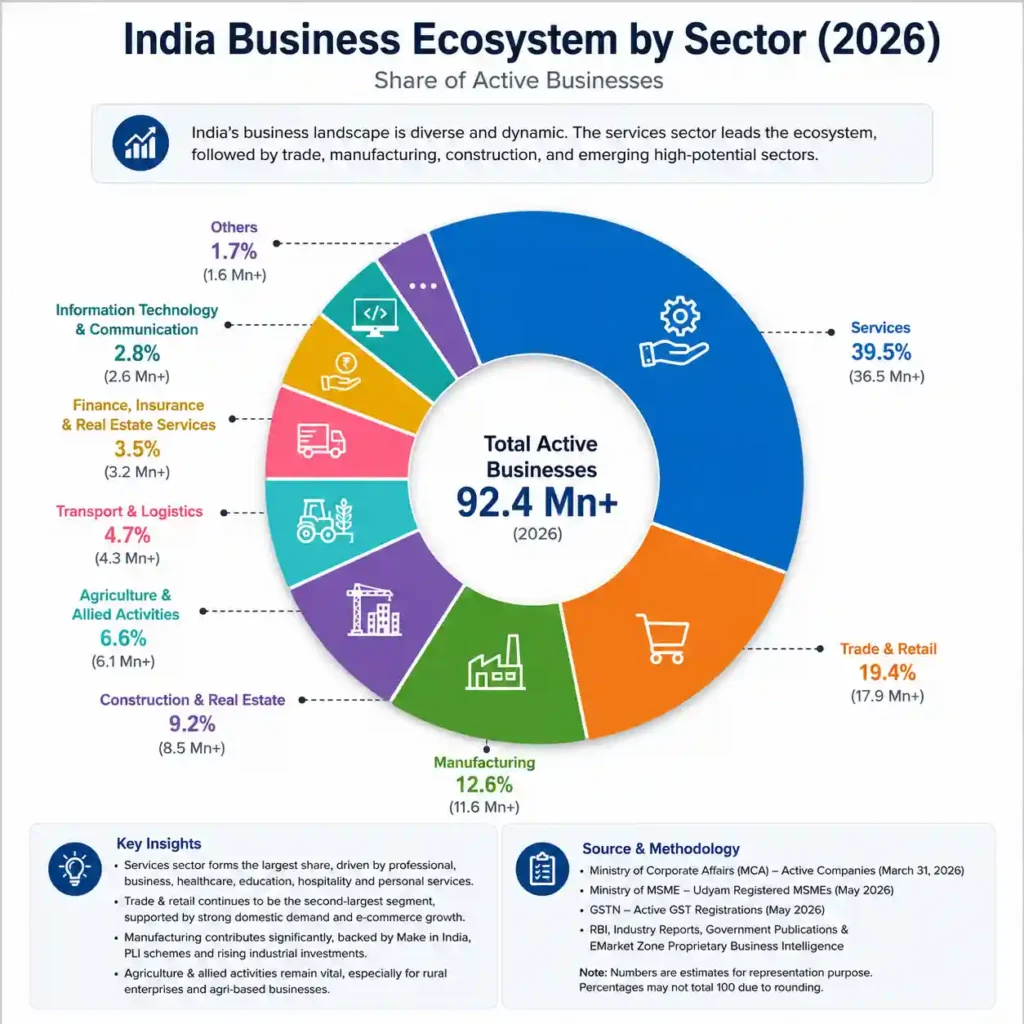
India’s economy is supported by a broad mix of industries rather than a single dominant sector. This diversification contributes to economic resilience and creates opportunities across multiple markets.
Manufacturing
India continues to expand its manufacturing base through investments in automobiles, engineering, chemicals, pharmaceuticals, electronics, textiles, food processing, and industrial machinery. Government initiatives such as Make in India and the PLI schemes have accelerated investment in high-value manufacturing sectors.
Services
The services sector remains the largest contributor to India’s economy, encompassing IT and software, financial services, healthcare, education, logistics, hospitality, consulting, and professional services. Indian technology companies continue to serve global markets while domestic demand for digital services grows steadily.
Agriculture & Allied Businesses
Agriculture remains a vital part of the economy, supporting food processing, agri-tech, fertilizers, farm equipment, and rural enterprises. Increasing investment in value-added agricultural businesses is strengthening rural supply chains.
Retail & Wholesale Trade
India’s retail landscape includes traditional local stores alongside rapidly growing organized retail and e-commerce platforms. Wholesale distributors continue to play a key role in connecting manufacturers with regional markets.
Export-Oriented Businesses
Export-focused companies contribute significantly to India’s foreign trade, particularly in engineering goods, pharmaceuticals, chemicals, textiles, gems & jewellery, IT services, and food products.
1.3 Key Business Growth Drivers
Several structural factors continue to strengthen India’s commercial environment.
Demographic Advantage
India has one of the world’s youngest workforces and a rapidly expanding middle class, driving consumer demand and entrepreneurship.
Digital Transformation
Digital payments, cloud computing, AI adoption, ERP systems, e-commerce, and SaaS solutions have significantly improved business efficiency and market access.
Government Reforms
Recent reforms have streamlined business registration, taxation, compliance, infrastructure development, and manufacturing incentives, improving the ease of doing business.
Infrastructure Development
Investments in highways, industrial corridors, ports, airports, logistics parks, and freight corridors continue to improve connectivity and reduce operational costs.
Startup Ecosystem
India’s startup ecosystem has expanded across fintech, healthtech, edtech, logistics, agritech, climate technology, and enterprise software, attracting domestic and international investment.
1.4 Regional Business Concentration
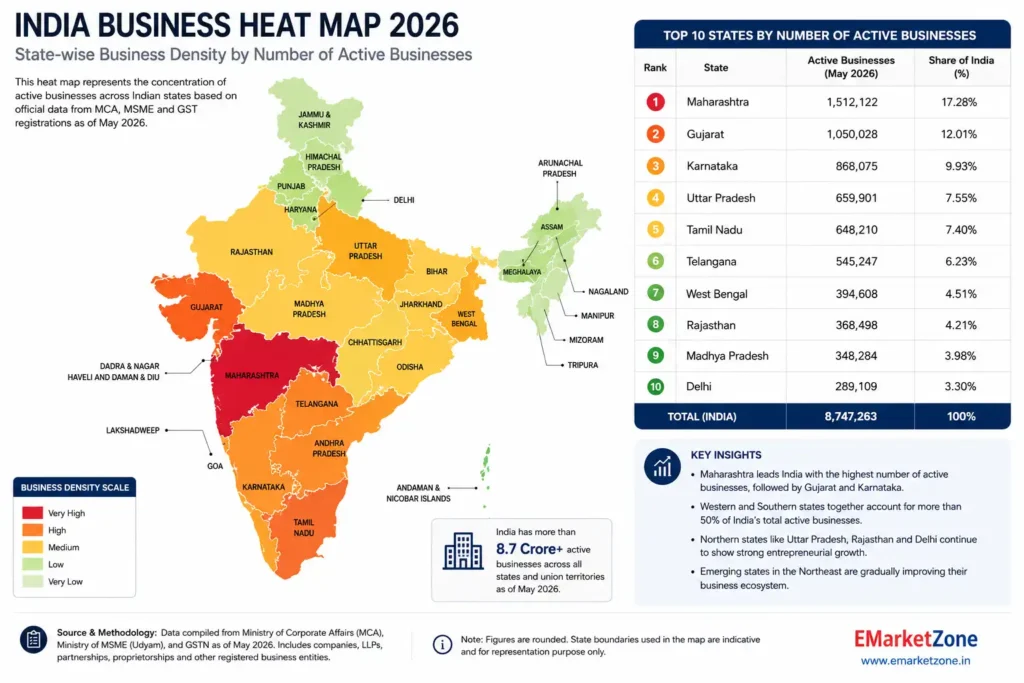
Business activity is not evenly distributed across India. Certain states have developed strong industrial ecosystems due to better infrastructure, skilled workforce availability, policy support, and investment-friendly environments.
Leading Business States
• Maharashtra
• Gujarat
• Karnataka
• Tamil Nadu
• Delhi NCR
• Telangana
• Uttar Pradesh
• Haryana
These states collectively account for a significant share of company registrations, industrial production, exports, startup activity, and corporate headquarters.
1.5 Major Business Cities
India’s commercial activity is concentrated in several metropolitan and industrial cities.
| City | Primary Strength |
|---|---|
| Mumbai | Finance, Corporate Headquarters, Trade |
| Bengaluru | IT, SaaS, Startups |
| Delhi NCR | Services, Corporate Offices |
| Hyderabad | Pharmaceuticals, Technology |
| Chennai | Manufacturing, Automotive |
| Ahmedabad | Chemicals, Textiles, Engineering |
| Pune | Automotive, Engineering, IT |
| Surat | Textiles, Diamonds |
| Kolkata | Trade, Logistics |
| Coimbatore | Engineering, Manufacturing |
These cities function as regional economic hubs and attract substantial domestic and foreign investment.
1.6 Emerging Business Opportunities
Several industries are expected to experience above-average growth over the coming years.
• Electric Vehicles (EV)
• Renewable Energy
• Semiconductor Manufacturing
• Artificial Intelligence
• Industrial Automation
• Healthcare Technology
• Food Processing
• Logistics & Warehousing
• Defence Manufacturing
• Biotechnology
These sectors are likely to attract increased investment, create employment, and generate new B2B opportunities.
Key Takeaways
• India has one of the world’s most diversified business ecosystems.
• Manufacturing, services, MSMEs, and startups are the primary pillars of economic growth.
• Business activity is concentrated in a handful of industrial and commercial states, though emerging regions are gaining momentum.
• Digital transformation, infrastructure investment, and supportive government policies continue to improve the business environment.
• Businesses that understand regional and sector-specific trends are better positioned to identify growth opportunities and optimize sales strategies.
Chapter 2 (Business Registration Landscape in India)
Introduction
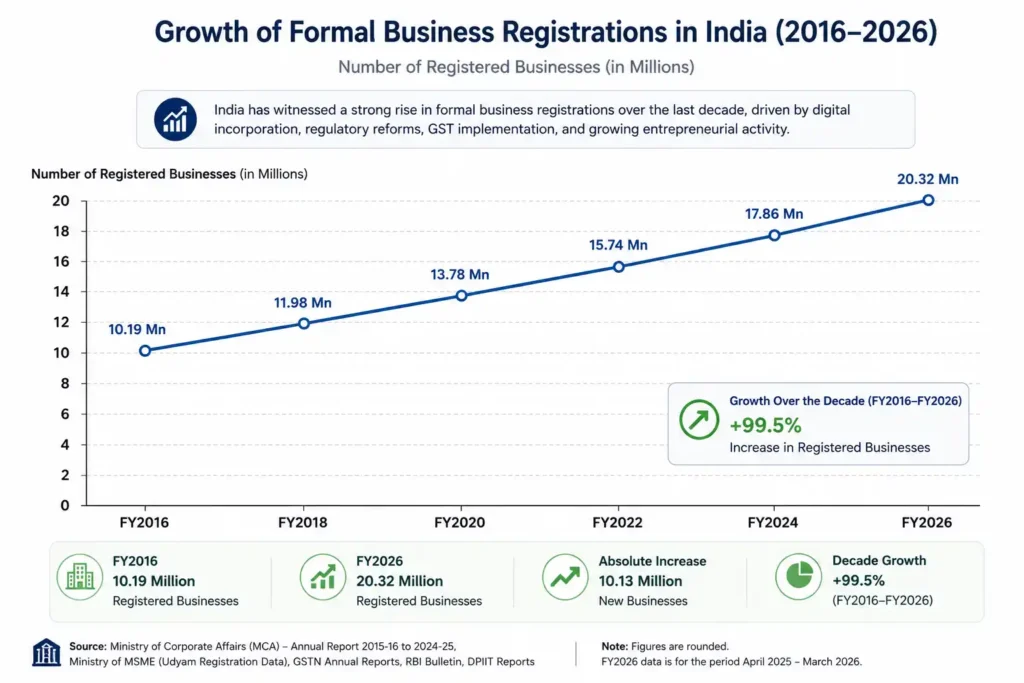
Business registration serves as one of the strongest indicators of formal economic activity. Every newly registered business reflects entrepreneurial confidence, investment intentions, employment creation, and expanding commercial opportunities. Over the past decade, India has witnessed a steady increase in business registrations, supported by digital incorporation processes, regulatory reforms, GST implementation, easier access to finance, and government initiatives encouraging formalization.
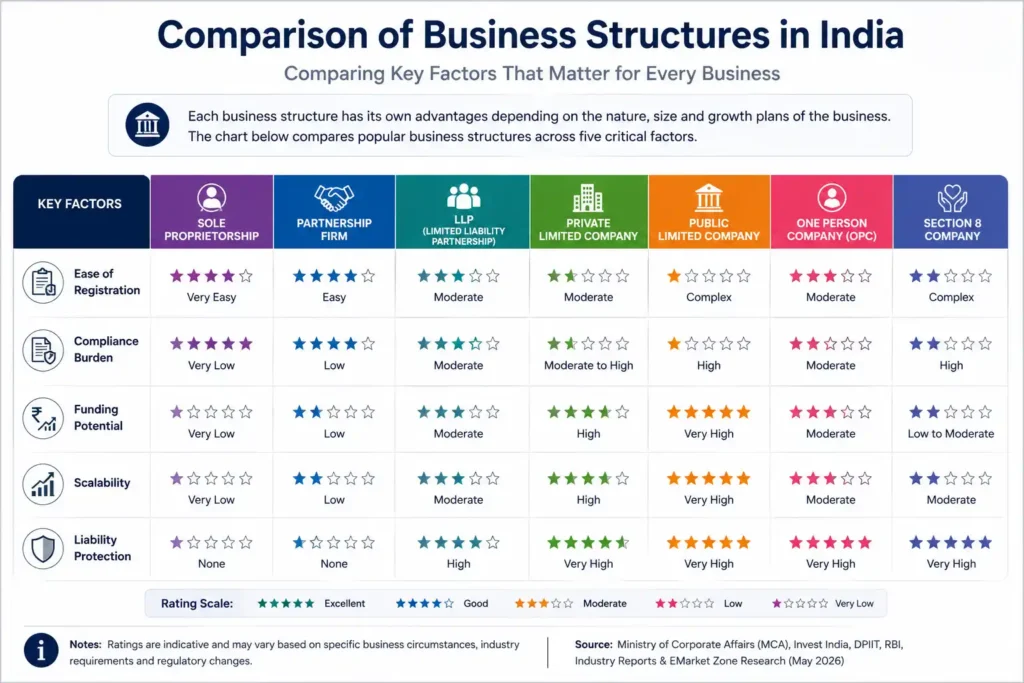
Today’s business landscape comprises millions of entities operating under different legal structures, including Sole Proprietorships, Partnership Firms, Limited Liability Partnerships (LLPs), Private Limited Companies, Public Limited Companies, One Person Companies (OPCs), and Section 8 Companies. Each structure addresses different operational, legal, and financial requirements, contributing to India’s diverse business ecosystem.
The Ministry of Corporate Affairs (MCA), Ministry of MSME, GSTN, and other government agencies have significantly simplified registration procedures through digital platforms, reducing barriers to entry for entrepreneurs and businesses across sectors.
This chapter examines how India’s business registration ecosystem has evolved, the distribution of registered entities across legal structures, and the trends shaping business formalization.
2.1 Evolution of Business Registrations
India’s formal business sector has expanded considerably over the last decade. Increased digital adoption, online incorporation, startup incentives, GST compliance, and improved ease of doing business have encouraged businesses to transition from informal operations to registered entities.
Several structural reforms have accelerated this trend:
• Online company incorporation through MCA.
• Introduction of GST and unified indirect taxation.
• Udyam Registration for MSMEs.
• Digital KYC and e-signatures.
• Startup India and Stand-Up India initiatives.
• Improved access to institutional finance.
These reforms have made business registration faster, more transparent, and more accessible, especially for first-time entrepreneurs and small enterprises.
2.2 Registered Business Structures
India’s business ecosystem includes multiple legal structures designed to accommodate different scales of operation and ownership models.
| Business Structure | Typical Size | Key Advantages |
|---|---|---|
| Sole Proprietorship | Micro | Easy setup, minimal compliance |
| Partnership Firm | Small | Shared ownership, simple operations |
| LLP | Small–Medium | Limited liability, operational flexibility |
| Private Limited Company | Medium–Large | Separate legal entity, funding access |
| Public Limited Company | Large | Capital raising through public markets |
| One Person Company (OPC) | Small | Limited liability for solo entrepreneurs |
| Section 8 Company | Non-profit | Social and charitable activities |
Each legal structure offers distinct benefits depending on factors such as ownership, taxation, liability, compliance requirements, and future growth plans.
2.3 Private Limited Companies
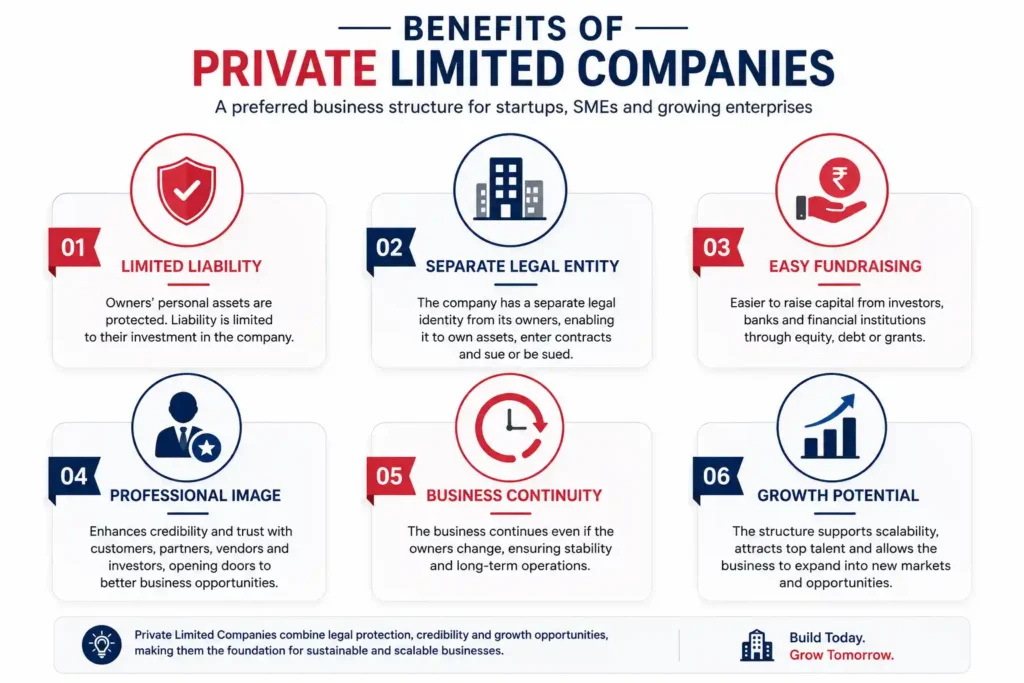
Private Limited Companies have become the preferred business structure for startups, technology firms, manufacturing businesses, exporters, and companies seeking institutional funding.
Why Businesses Choose Private Limited Companies
• Separate legal identity
• Limited liability protection
• Higher investor confidence
• Better banking relationships
• Easier equity fundraising
• Business continuity
This structure dominates India’s organized corporate sector and continues to grow due to increasing formalization and investment activity.
2.4 LLP Growth
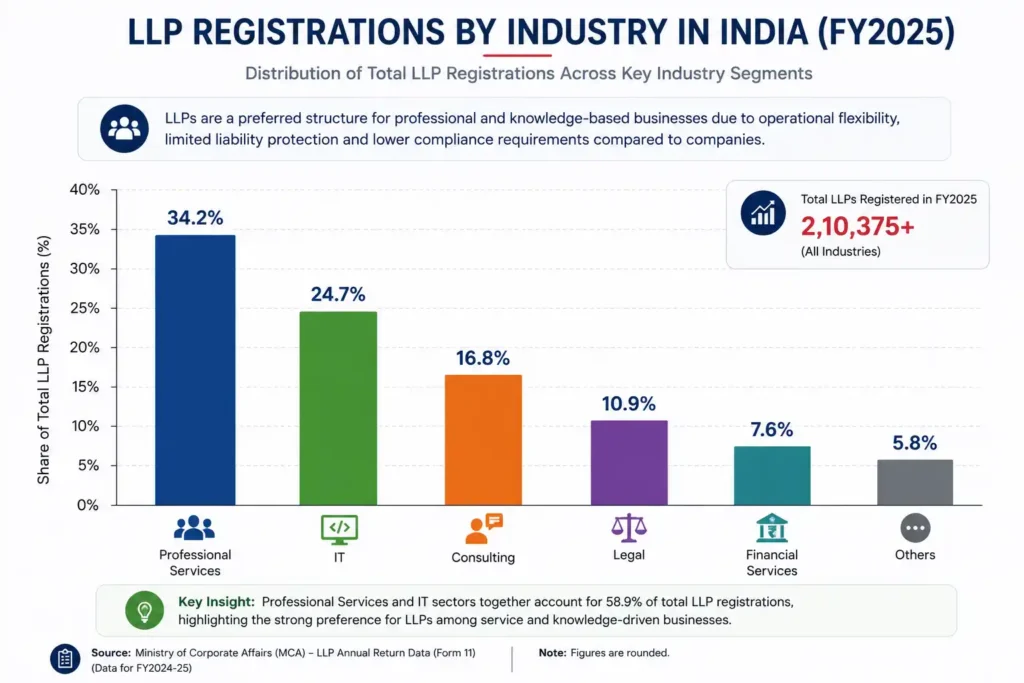
Limited Liability Partnerships (LLPs) continue gaining popularity among professional firms and service-based businesses.
Industries using LLPs include:
• Chartered Accountants
• Legal Firms
• Consultants
• IT Companies
• Architects
• Marketing Agencies
• Design Studios
LLPs combine partnership flexibility with corporate liability protection, making them suitable for knowledge-based businesses.
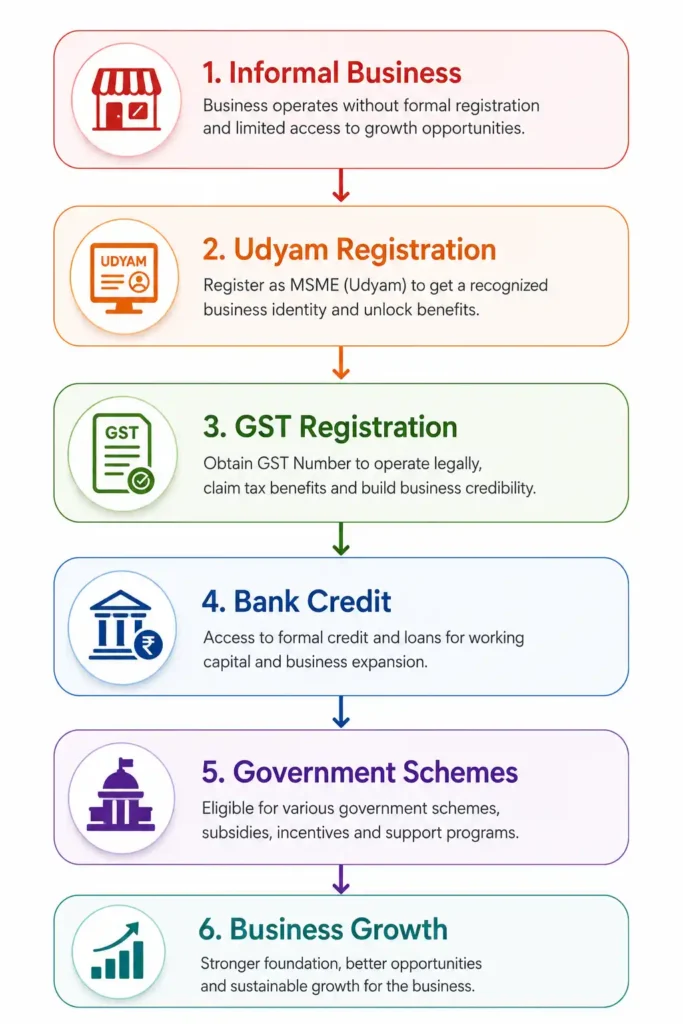
2.5 MSME Formalization
One of India’s most significant business trends has been the increasing formalization of Micro, Small, and Medium Enterprises (MSMEs).
The launch of Udyam Registration simplified the registration process, enabling businesses to access:
• Government subsidies
• Bank financing
• Tender participation
• Export incentives
• Credit guarantee schemes
• Technology support
Formalization has improved business transparency, expanded access to institutional finance, and strengthened participation in the organized economy.
2.6 Registration Trends Across Industries
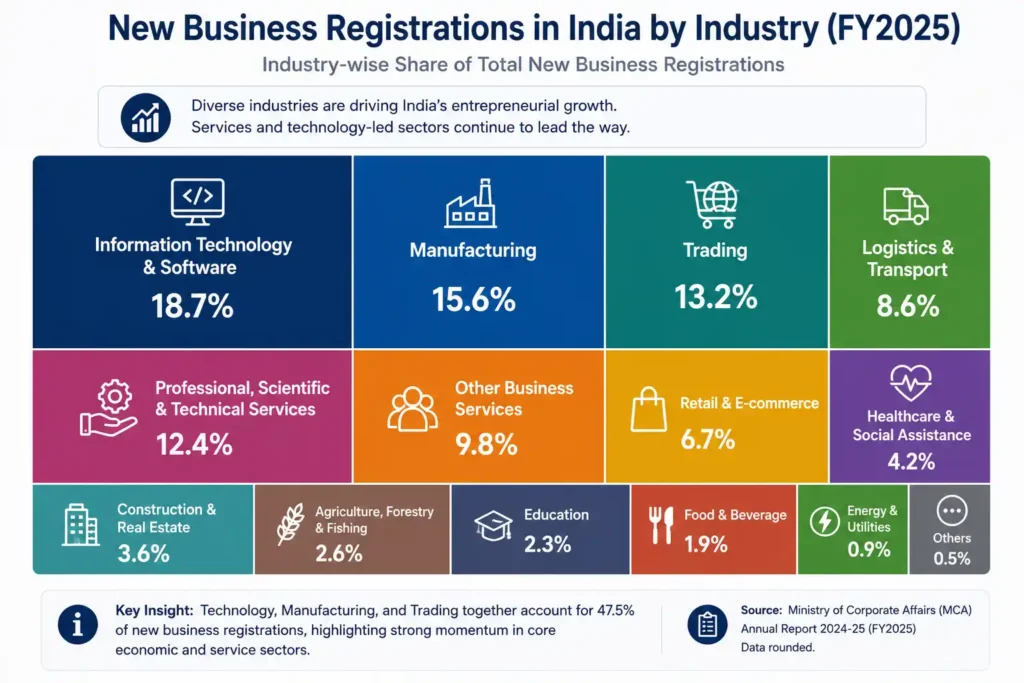
Business registrations vary considerably by industry.
The strongest growth has been observed in:
• Information Technology
• Healthcare
• Manufacturing
• Logistics
• Renewable Energy
• Food Processing
• Construction
• Professional Services
• E-commerce
• Financial Technology
These sectors continue to attract entrepreneurs due to strong domestic demand, policy support, and technological advancements.
2.7 State-wise Registration Patterns
Business registrations remain concentrated in states with strong infrastructure, industrial development, skilled workforce availability, and favorable investment policies.
Leading registration hubs include:
- Maharashtra
- Gujarat
- Karnataka
- Tamil Nadu
- Telangana
- Delhi NCR
- Uttar Pradesh
- Rajasthan
These states collectively contribute a substantial share of India’s formal business registrations.
2.8 Key Drivers Behind Business Registrations
The continued rise in business registrations is influenced by several interconnected factors.
Digital Governance
End-to-end online registration has reduced processing time and improved transparency.
Startup Ecosystem
India’s expanding startup ecosystem encourages entrepreneurs to adopt formal corporate structures early.
Financial Inclusion
Banks and investors increasingly require registered entities for lending and funding.
Government Incentives
Schemes supporting MSMEs, manufacturing, exports, and startups encourage businesses to formalize.
Digital Commerce
Growth in online marketplaces, digital payments, and SaaS platforms has lowered barriers to market entry.
Key Insights
• Business registrations in India have accelerated due to digital reforms and simplified incorporation processes.
• Private Limited Companies remain the preferred structure for scalable and investment-ready businesses.
• LLPs continue to grow among professional and knowledge-based firms.
• MSME formalization is expanding rapidly through Udyam Registration and GST adoption.
• Manufacturing, technology, logistics, and healthcare remain among the fastest-growing sectors for new registrations.
• Business activity continues to be concentrated in economically advanced states while emerging regions steadily increase their share.
Chapter Summary
India’s business registration landscape reflects the country’s transition toward a more formal, transparent, and digitally connected economy. Simplified registration processes, policy reforms, and improved access to finance have enabled businesses of all sizes to establish formal operations and participate in organized markets. As entrepreneurship, manufacturing, technology, and exports continue to expand, the formal business ecosystem is expected to grow further, creating new opportunities for investment, employment, and B2B commerce.
Chapter 3 (State-wise Business Distribution in India (2026))
Introduction
India’s business landscape is geographically diverse, with economic activity concentrated in states that have strong industrial infrastructure, skilled talent pools, robust logistics, and business-friendly policies. While every state contributes to the national economy, a relatively small group of states accounts for a significant share of formal business registrations, manufacturing output, exports, startup activity, and private investment.
In 2026, states such as Maharashtra, Gujarat, Karnataka, Tamil Nadu, Telangana, Delhi NCR, Uttar Pradesh, and Haryana continue to lead India’s business ecosystem. These regions serve as the country’s primary commercial engines, attracting entrepreneurs, domestic enterprises, multinational corporations, and foreign direct investment.
At the same time, emerging states including Rajasthan, Odisha, Madhya Pradesh, Kerala, Andhra Pradesh, Punjab, Chhattisgarh, and Assam are expanding their business base through infrastructure development, industrial corridors, logistics improvements, renewable energy projects, and sector-specific investments.
Understanding state-wise business distribution is essential for organizations planning market expansion, sales territories, investment strategies, supply chain networks, or B2B lead generation.
3.1 India's Business Concentration
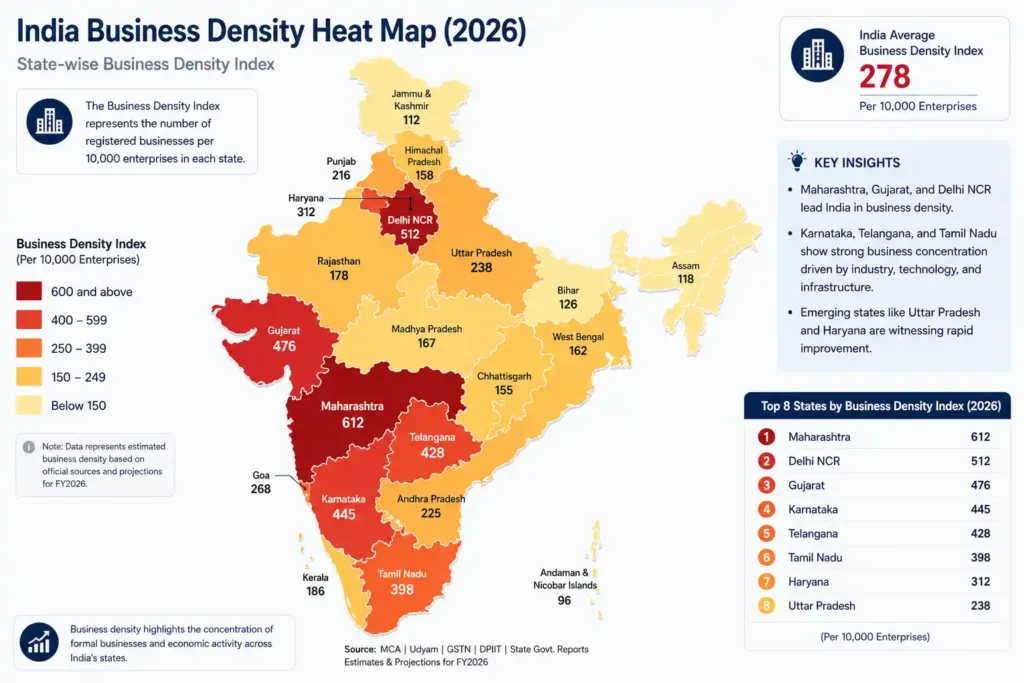
Business registrations in India are not evenly distributed. States with established industrial ecosystems, higher urbanization, better connectivity, and stronger economic output generally record higher concentrations of registered businesses.
The leading business states collectively account for a majority of India’s organized business activity, making them attractive markets for manufacturers, service providers, investors, and B2B companies.
• Key Drivers of State-wise Business Concentration
Industrial infrastructure
• Availability of skilled workforce
• Large consumer markets
• Logistics and transportation connectivity
• Export infrastructure
• Ease of doing business
• Startup ecosystem
• Access to finance
• Government industrial policies
3.2 Top Business States in India (2026)
Editorial Note: The ranking below reflects overall business ecosystem strength, considering company registrations, MSMEs, industrial output, startups, exports, logistics, and investment attractiveness. Exact counts should be updated annually from MCA, Udyam, DPIIT, GSTN, and state government sources.
| Rank | State / UT | Key Business Strengths |
|---|---|---|
| 1 | Maharashtra | Corporate HQs, Finance, Manufacturing, Services |
| 2 | Gujarat | Manufacturing, Chemicals, Engineering, Exports |
| 3 | Karnataka | IT, SaaS, Startups, Biotechnology |
| 4 | Tamil Nadu | Automotive, Electronics, Manufacturing |
| 5 | Telangana | Technology, Pharmaceuticals, GCCs |
| 6 | Delhi NCR | Corporate Offices, Consulting, Services |
| 7 | Uttar Pradesh | MSMEs, Manufacturing, Logistics |
| 8 | Haryana | Automotive, Industrial Manufacturing |
| 9 | Rajasthan | Mining, Renewable Energy, Manufacturing |
| 10 | Kerala | Healthcare, Tourism, Food Processing |
3.3 State Profiles
Maharashtra
Maharashtra remains India’s largest commercial hub in 2026. Mumbai serves as the country’s financial capital, while Pune, Nashik, Nagpur, Aurangabad, and Kolhapur support manufacturing, automotive production, engineering, pharmaceuticals, logistics, and information technology.
Major Industries
• BFSI
• Manufacturing
• Pharmaceuticals
• IT
• Chemicals
• Automotive
• Logistics
Key Business Cities
• Mumbai
• Pune
• Nashik
• Nagpur
• Aurangabad
Gujarat
Gujarat continues to lead India’s industrial manufacturing sector. Strong port infrastructure, export-oriented industries, petrochemicals, engineering, and business-friendly policies make the state one of the country’s most attractive investment destinations.
Major Industries
• Chemicals
• Petrochemicals
• Engineering
• Textiles
• Renewable Energy
• Pharmaceuticals
Major Cities
• Ahmedabad
• Surat
• Vadodara
• Rajkot
• Jamnagar
Karnataka
Karnataka remains India’s technology powerhouse, driven by Bengaluru’s globally recognized startup and IT ecosystem. The state also has a strong presence in aerospace, biotechnology, electronics, and advanced manufacturing.
Major Industries
• IT
• SaaS
• AI
• Biotechnology
• Electronics
• Aerospace
Major Cities
• Bengaluru
• Mysuru
• Mangaluru
• Hubballi-Dharwad
Tamil Nadu
Tamil Nadu is one of India’s most diversified industrial economies, with leadership in automotive manufacturing, electronics, textiles, heavy engineering, renewable energy, and exports.
Major Cities
• Chennai
• Coimbatore
• Tiruppur
• Salem
• Hosur
Telangana
Telangana continues to attract investments in pharmaceuticals, technology services, global capability centers (GCCs), artificial intelligence, and life sciences. Hyderabad remains one of India’s fastest-growing commercial cities.
Major Cities
• Hyderabad
• Warangal
• Karimnagar
3.4 Emerging Business States
Beyond the established economic leaders, several states are strengthening their business ecosystems through industrial development, policy reforms, and infrastructure investment.
| State | Growth Drivers |
|---|---|
| Rajasthan | Solar energy, manufacturing, logistics |
| Odisha | Steel, mining, ports |
| Madhya Pradesh | Food processing, pharmaceuticals |
| Andhra Pradesh | Ports, electronics, manufacturing |
| Punjab | Agriculture, engineering, exports |
| Chhattisgarh | Steel, cement, mining |
| Assam | Tea, logistics, petrochemicals |
These states present increasing opportunities for businesses seeking lower operating costs and expanding regional markets.
3.5 Regional Distribution
Western India
The western region remains India’s strongest industrial belt, led by Maharashtra and Gujarat. It accounts for a significant share of manufacturing, exports, finance, chemicals, engineering, and corporate headquarters.
Southern India
Southern India dominates technology, electronics, automotive manufacturing, pharmaceuticals, and global capability centers, driven by Karnataka, Tamil Nadu, Telangana, Kerala, and Andhra Pradesh.
Northern India
Delhi NCR, Haryana, Uttar Pradesh, Punjab, and Rajasthan continue to expand in manufacturing, logistics, infrastructure, e-commerce, and services.
Eastern & North-Eastern India
States including West Bengal, Odisha, Bihar, Jharkhand, Assam, and others are improving connectivity, industrial capacity, and investment attractiveness through government-led infrastructure initiatives.
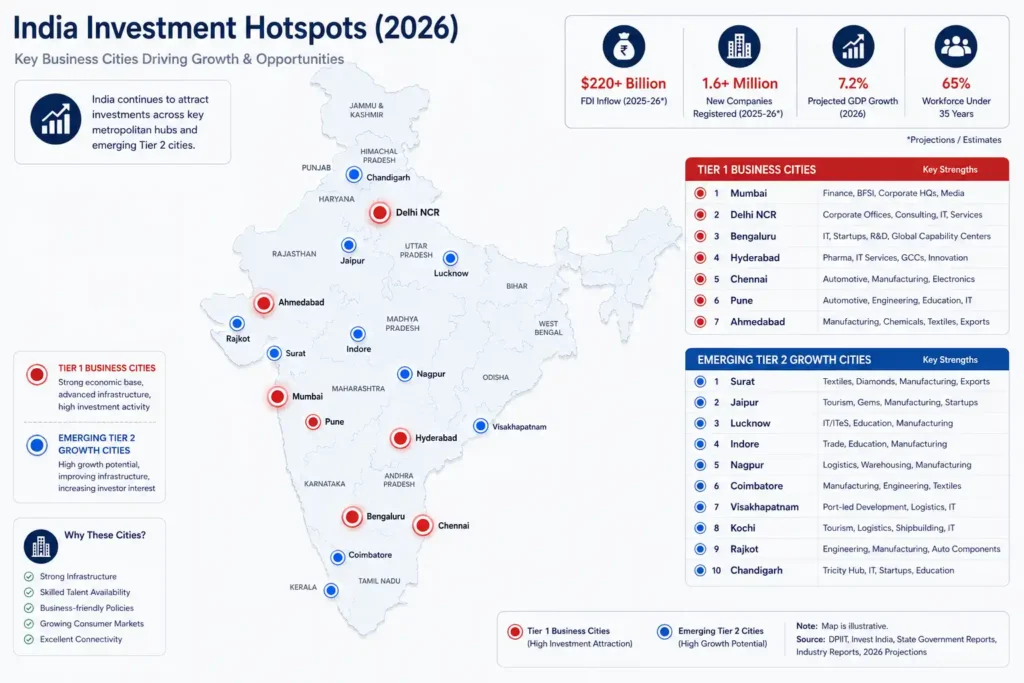
3.6 Investment Hotspots (2026)
The following cities are expected to attract significant business investment during 2026:
• Mumbai
• Bengaluru
• Hyderabad
• Chennai
• Pune
• Ahmedabad
• Gurugram
• Noida
• Surat
• Coimbatore
These cities benefit from strong infrastructure, talent availability, industrial clusters, and established business ecosystems.
3.7 Business Expansion Opportunities
Businesses planning expansion in 2026 should evaluate states based on:
• Market size
• Industry clusters
• Workforce availability
• Infrastructure quality
• Logistics connectivity
• State incentives
• Export potential
• Digital adoption
Selecting states aligned with industry-specific strengths can improve operational efficiency and market penetration.
Key Insights
• Maharashtra remains India’s leading commercial state.
• Gujarat continues to dominate industrial manufacturing and exports.
• Karnataka leads technology, SaaS, AI, and startup innovation.
• Tamil Nadu maintains its position as a manufacturing and automotive powerhouse.
• Telangana is emerging as a global center for pharmaceuticals and GCCs.
• Uttar Pradesh and Haryana are rapidly expanding industrial and logistics ecosystems.
• Rajasthan, Odisha, Madhya Pradesh, and Andhra Pradesh are becoming attractive investment destinations due to infrastructure growth and sector-focused development.
Chapter 4 (Top Business Cities in India (2026))
Introduction
While states shape India’s economic landscape, it is the country’s major cities that function as the primary engines of business growth, innovation, investment, and employment. India’s leading metropolitan areas host corporate headquarters, industrial clusters, startup ecosystems, export hubs, financial institutions, research centers, and advanced manufacturing facilities, making them critical to the nation’s commercial development.
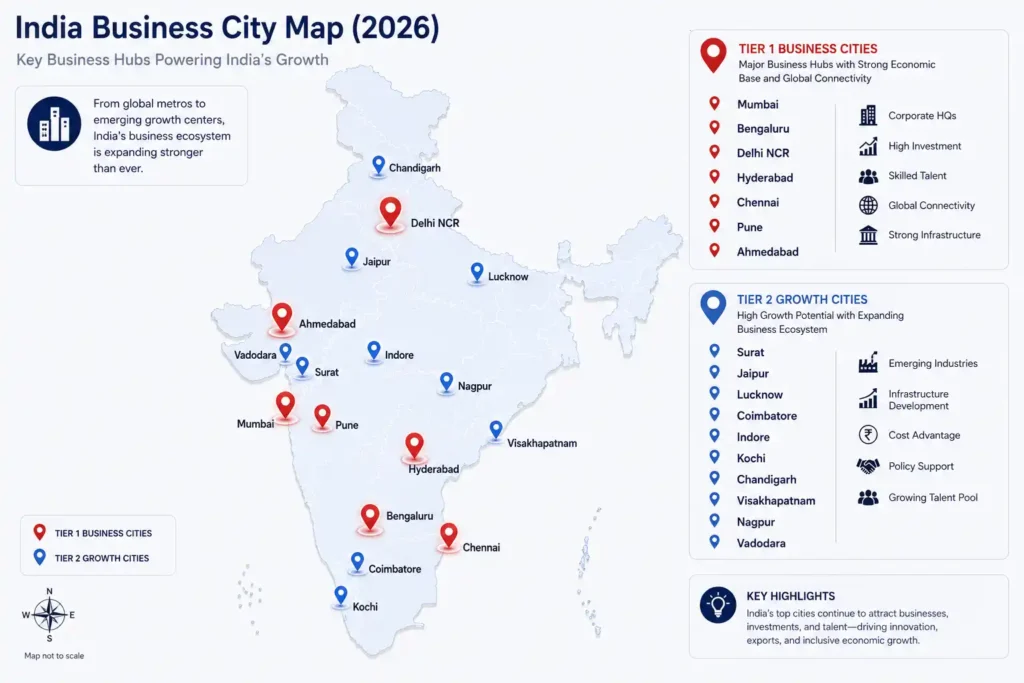
In 2026, cities such as Mumbai, Bengaluru, Delhi NCR, Hyderabad, Chennai, Pune, Ahmedabad, Surat, Gurugram, and Noida continue to attract domestic and international investment due to their strong infrastructure, skilled workforce, digital connectivity, and supportive business ecosystems.
Alongside these established business hubs, a growing number of Tier 2 cities—including Coimbatore, Indore, Lucknow, Jaipur, Nagpur, Kochi, Visakhapatnam, Chandigarh, Vadodara, and Bhubaneswar—are emerging as attractive destinations for manufacturing, technology, logistics, healthcare, and professional services.
For businesses planning expansion, sales territory optimization, distribution networks, or market entry, understanding city-level business concentration is often more valuable than state-level analysis.
Related Analysis
Which states currently offer the strongest business ecosystems and expansion opportunities? Read our detailed comparison of India’s leading business states, including industry strengths, infrastructure, investment potential, and emerging growth markets.
Read: Top Business States in India (2026)
4.1 India's Leading Business Cities
India’s commercial activity is concentrated within a relatively small number of metropolitan areas that account for a significant share of registered companies, startups, manufacturing facilities, exports, and service-sector employment.
These cities benefit from:
• Excellent transport infrastructure
• International airports and seaports
• Skilled talent availability
• Large customer markets
• Corporate headquarters
• Strong supplier ecosystems
• Business-friendly environment
• Technology adoption
4.2 Top 10 Business Cities (2026)
| Rank | City | Primary Business Strength |
|---|---|---|
| 1 | Mumbai | Finance, Corporate HQs, Media, Trade |
| 2 | Bengaluru | IT, AI, SaaS, Startups |
| 3 | Delhi NCR | Corporate Services, Consulting, Government |
| 4 | Hyderabad | Pharma, GCCs, Technology |
| 5 | Chennai | Automotive, Electronics, Manufacturing |
| 6 | Pune | Engineering, Automotive, IT |
| 7 | Ahmedabad | Manufacturing, Chemicals, Textiles |
| 8 | Surat | Diamonds, Textiles, Manufacturing |
| 9 | Gurugram | Corporate Offices, Technology |
| 10 | Noida | IT, Electronics, Manufacturing |
4.3 Mumbai – India's Financial Capital
Mumbai continues to lead India’s commercial ecosystem in 2026. Home to the Bombay Stock Exchange (BSE), National Stock Exchange (NSE), Reserve Bank of India, leading banks, multinational corporations, media houses, and financial institutions, Mumbai remains the country’s primary financial center.
Major Industries
• Banking & Financial Services
• Capital Markets
• Insurance
• Media & Entertainment
• Pharmaceuticals
• Logistics
• Shipping
• Consulting
Why Mumbai Leads
• Largest corporate headquarters concentration
• International financial connectivity
• Port infrastructure
• Access to capital markets
• Mature business ecosystem
4.4 Bengaluru – India's Technology Capital
Bengaluru remains India’s innovation hub, hosting thousands of technology companies, startups, R&D centers, and Global Capability Centers (GCCs).
The city leads in:
• Artificial Intelligence
• SaaS
• Cloud Computing
• Semiconductor Design
• Biotechnology
• Enterprise Software
Major Business Advantages
• Highly skilled workforce
• Strong startup ecosystem
• Global technology companies
• Venture capital availability
• Research institutions
4.5 Delhi NCR – Corporate & Services Hub
Delhi NCR—including Gurugram and Noida—has become India’s largest concentration of corporate offices, consulting firms, government institutions, multinational companies, and service organizations.
Key sectors include:
• Corporate Services
• Consulting
• E-commerce
• IT
• Telecom
• Real Estate
• Professional Services
4.6 Hyderabad – India's Innovation & Life Sciences Hub
Hyderabad has emerged as one of India’s fastest-growing business cities.
The city excels in:
• Pharmaceuticals
• Biotechnology
• GCCs
• Information Technology
• Artificial Intelligence
• Data Centers
Hyderabad continues attracting multinational investments due to its infrastructure, skilled workforce, and relatively competitive operating costs.
4.7 Chennai – Manufacturing Powerhouse
Chennai remains India’s largest automotive manufacturing cluster and an important center for electronics, heavy engineering, logistics, and exports.
Key industries include:
• Automobile Manufacturing
• Auto Components
• Electronics
• Heavy Engineering
• Ports
• Renewable Energy
4.8 Emerging Tier 2 Business Cities
Tier 2 cities are becoming increasingly important due to lower operating costs, improved infrastructure, expanding consumer markets, and government investment.
| City | Growth Drivers |
|---|---|
| Surat | Textiles, Diamonds, Manufacturing |
| Coimbatore | Engineering, Pumps, Textiles |
| Jaipur | Tourism, Gems, Manufacturing |
| Lucknow | IT, Manufacturing, Healthcare |
| Indore | Startups, Food Processing, Logistics |
| Nagpur | Warehousing, Logistics |
| Kochi | Ports, Tourism, IT |
| Chandigarh | Services, IT |
| Vadodara | Chemicals, Engineering |
| Visakhapatnam | Ports, Manufacturing |
4.9 City-wise Investment Attractiveness (2026)
Business attractiveness depends on multiple factors beyond population size.
• Evaluation Criteria
• Infrastructure
• Skilled Workforce
• Cost of Operations
• Connectivity
• Startup Ecosystem
• Industrial Base
• Government Support
• Investment Activity
| City | Infrastructure | Talent | Manufacturing | Technology | Overall |
|---|---|---|---|---|---|
| Mumbai | ★★★★★ | ★★★★★ | ★★★★☆ | ★★★★☆ | ★★★★★ |
| Bengaluru | ★★★★★ | ★★★★★ | ★★★☆☆ | ★★★★★ | ★★★★★ |
| Hyderabad | ★★★★★ | ★★★★★ | ★★★★☆ | ★★★★★ | ★★★★★ |
| Chennai | ★★★★★ | ★★★★☆ | ★★★★★ | ★★★★☆ | ★★★★★ |
| Pune | ★★★★☆ | ★★★★★ | ★★★★★ | ★★★★☆ | ★★★★★ |
4.10 Future Growth Cities (2026–2030)
Several cities are expected to experience accelerated business expansion over the coming years due to industrial corridors, smart city projects, logistics infrastructure, and digital transformation.
High-potential growth cities include:
• Noida
• Gurugram
• Indore
• Surat
• Coimbatore
• Lucknow
• Visakhapatnam
• Kochi
• Nagpur
• Bhubaneswar
These cities are likely to attract increasing investments in manufacturing, technology, logistics, healthcare, education, and renewable energy.
Key Insights
• Mumbai remains India’s financial and corporate headquarters capital.
• Bengaluru continues to lead the country’s technology, AI, SaaS, and startup ecosystem.
• Delhi NCR dominates corporate services, consulting, and administrative business activity.
• Hyderabad strengthens its position as a global hub for pharmaceuticals, technology, and Global Capability Centers.
• Chennai remains one of India’s strongest manufacturing and automotive cities.
• Pune continues to grow as an engineering, education, automotive, and IT center.
• Tier 2 cities are becoming increasingly important for businesses seeking cost-effective expansion and access to emerging regional markets.
Chapter 5 (Industry-wise Business Distribution in India (2026))
Introduction
India’s business ecosystem is built on a diverse mix of industries that collectively drive economic growth, employment, exports, innovation, and domestic consumption. Unlike many economies that rely heavily on a limited number of sectors, India’s commercial landscape spans manufacturing, information technology, healthcare, construction, retail, financial services, logistics, agriculture, education, renewable energy, tourism, and professional services.
In 2026, digital transformation, infrastructure development, government initiatives, global supply chain diversification, and rising consumer demand continue to reshape industry dynamics. While traditional sectors such as manufacturing and retail remain economic pillars, high-growth industries including artificial intelligence, SaaS, biotechnology, electric vehicles, renewable energy, fintech, and logistics are creating new opportunities for businesses and investors.
Understanding industry-wise business distribution enables organizations to identify target markets, prioritize sales efforts, optimize investment strategies, and evaluate sector-specific growth opportunities.
5.1 India's Industrial Landscape
India’s economy is supported by thousands of businesses operating across diverse sectors. Each industry contributes differently to employment, exports, business registrations, investment, and GDP.
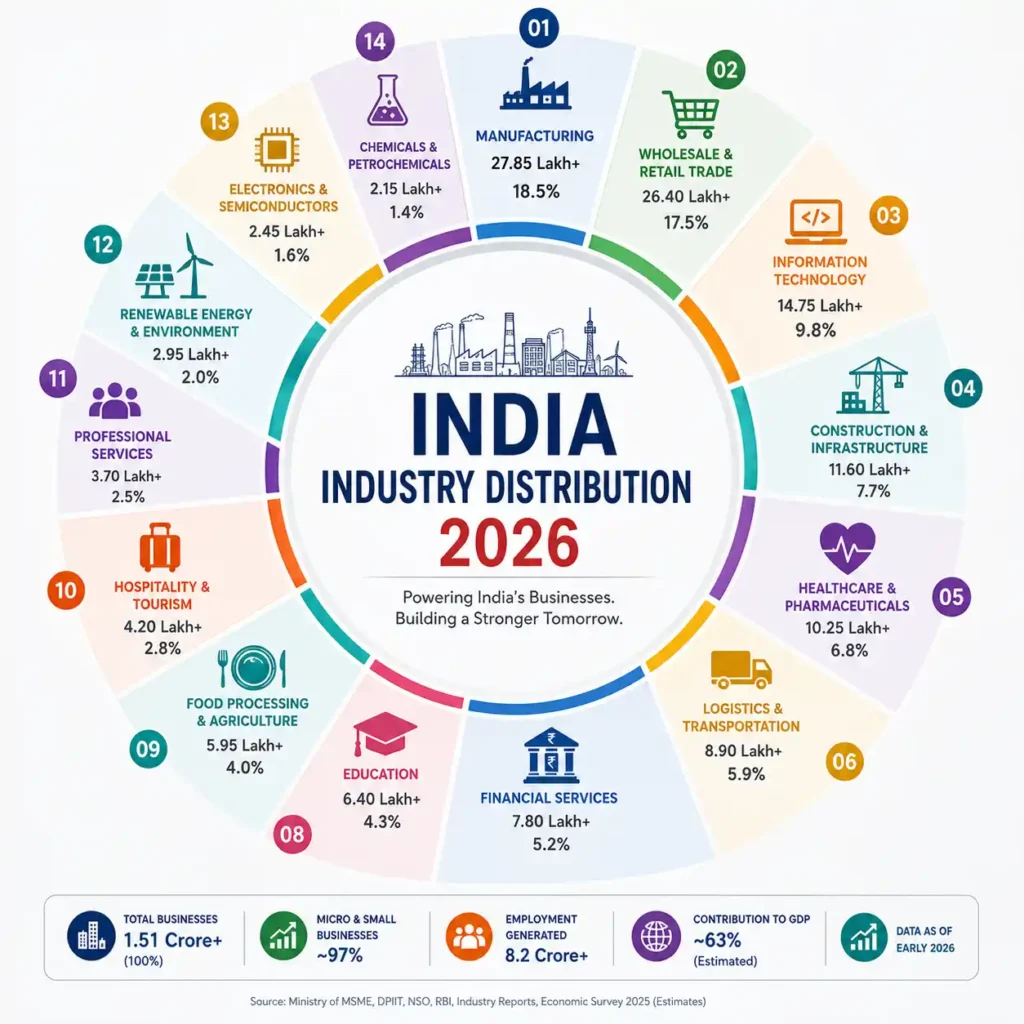
Broadly, India’s business ecosystem can be grouped into the following categories:
• Manufacturing
• Information Technology & Software
• Wholesale & Retail Trade
• Construction & Infrastructure
• Healthcare & Pharmaceuticals
• Financial Services
• Logistics & Transportation
• Agriculture & Food Processing
• Education
• Hospitality & Tourism
• Professional Services
• Renewable Energy
• Electronics & Semiconductor
• Chemicals & Petrochemicals
• Textiles & Apparel
These industries form the backbone of India’s formal business economy.
5.2 Top Industries by Business Activity
The following industries account for a significant proportion of registered businesses and commercial activity.
| Rank | Industry | Primary Growth Drivers |
|---|---|---|
| 1 | Manufacturing | Industrialization, Exports, Make in India |
| 2 | Wholesale & Retail Trade | Consumer Demand, E-commerce |
| 3 | Information Technology | Digital Transformation |
| 4 | Construction | Infrastructure Projects |
| 5 | Healthcare & Pharmaceuticals | Population Growth, Healthcare Demand |
| 6 | Logistics & Transportation | Supply Chains, E-commerce |
| 7 | Financial Services | Digital Banking, Fintech |
| 8 | Education | EdTech, Private Institutions |
| 9 | Food Processing | Domestic Consumption, Exports |
| 10 | Renewable Energy | Energy Transition |
5.3 Manufacturing Industry
Manufacturing remains one of India’s most important economic sectors, supported by initiatives such as Make in India, the Production Linked Incentive (PLI) schemes, industrial corridors, and expanding exports.
Major Manufacturing Segments
• Automotive
• Engineering
• Electronics
• Pharmaceuticals
• Chemicals
• Food Processing
• Textiles
• Machinery
• Electrical Equipment
• Renewable Energy Components
Major Manufacturing States
• Maharashtra
• Gujarat
• Tamil Nadu
• Karnataka
• Uttar Pradesh
• Telangana
Manufacturing Opportunities
• Export-oriented production
• Industrial automation
• Electronics manufacturing
• EV supply chains
• Semiconductor ecosystem
5.4 Information Technology & Software
India continues to be one of the world’s leading technology destinations.
Technology businesses are concentrated in:
• Bengaluru
• Hyderabad
• Pune
• Chennai
• Gurugram
• Noida
Major Technology Segments
• SaaS
• Artificial Intelligence
• Cloud Computing
• Cybersecurity
• Enterprise Software
• FinTech
• Data Analytics
• Global Capability Centers (GCCs)
Technology exports continue to contribute significantly to India’s services economy.
5.5 Healthcare & Pharmaceuticals
India remains one of the world’s largest pharmaceutical manufacturing hubs while healthcare services continue expanding due to rising income levels and increasing healthcare awareness.
Major industries include:
• Pharmaceuticals
• Medical Devices
• Biotechnology
• Hospitals
• Diagnostics
• Healthcare Technology
Leading states include:
• Telangana
• Maharashtra
• Gujarat
• Karnataka
• Himachal Pradesh
5.6 Logistics & Supply Chain
The logistics sector has experienced rapid growth due to:
• E-commerce expansion
• Highway development
• Dedicated Freight Corridors
• Multi-modal logistics parks
• Port modernization
Major logistics hubs:
• Mumbai
• Delhi NCR
• Chennai
• Hyderabad
• Nagpur
• Ahmedabad
5.7 Emerging High-Growth Industries
Several industries are expected to outperform the broader market over the next decade.
| Industry | Growth Outlook |
|---|---|
| Artificial Intelligence | Very High |
| Electric Vehicles | Very High |
| Renewable Energy | Very High |
| Semiconductor Manufacturing | High |
| Battery Manufacturing | High |
| Defence Manufacturing | High |
| Biotechnology | High |
| Aerospace | High |
| Robotics | High |
| Data Centers | High |
5.8 Industry Contribution by Region
Different regions specialize in different industries.
| Region | Leading Industries |
|---|---|
| West | Manufacturing, Chemicals, Finance |
| South | IT, Electronics, Automotive |
| North | Logistics, Services, Manufacturing |
| East | Steel, Mining, Ports |
| North-East | Agriculture, Tourism, Food Processing |
This regional specialization supports diversified economic growth and enables businesses to develop targeted market-entry strategies.
5.9 Business Opportunities Across Industries
Businesses entering the Indian market should prioritize sectors with strong structural demand, supportive government policies, and long-term scalability.
High-Potential B2B Opportunities
• Industrial Manufacturing
• Business Software
• Healthcare Solutions
• Logistics Services
• Renewable Energy Equipment
• Financial Technology
• Industrial Automation
• Supply Chain Services
• Digital Marketing
• Business Intelligence & Data Services
Key Insights
• Manufacturing continues to anchor India’s industrial economy, supported by government incentives and export growth.
• Information technology remains India’s most globally competitive services sector, with Bengaluru, Hyderabad, and Pune leading innovation.
• Healthcare and pharmaceuticals benefit from rising domestic demand and India’s strength as a global medicine producer.
• Logistics is expanding rapidly due to infrastructure investment and e-commerce growth.
• Renewable energy, electric vehicles, semiconductors, AI, and data centers represent the strongest long-term growth opportunities.
• Regional specialization enables businesses to align expansion strategies with state-level industry strengths.
Chapter Summary
India’s industry landscape in 2026 reflects a balanced mix of mature sectors and emerging technologies. Manufacturing, IT, healthcare, logistics, and financial services continue to dominate business activity, while next-generation industries such as AI, renewable energy, EVs, semiconductors, and biotechnology are reshaping the country’s future economic trajectory. Organizations that understand these sectoral dynamics are better positioned to identify high-value markets, optimize resource allocation, and capitalize on India’s evolving business ecosystem.
Looking for verified business contacts or industry-specific business data? Explore EMarket Zone’s database solutions.
Chapter 6 (MSME Landscape in India (2026))
Introduction
Micro, Small, and Medium Enterprises (MSMEs) form the backbone of India’s economy, driving entrepreneurship, employment, manufacturing, exports, and regional development. From small workshops and family-owned businesses to modern manufacturing units and technology-driven enterprises, MSMEs contribute significantly to India’s industrial output and economic resilience.
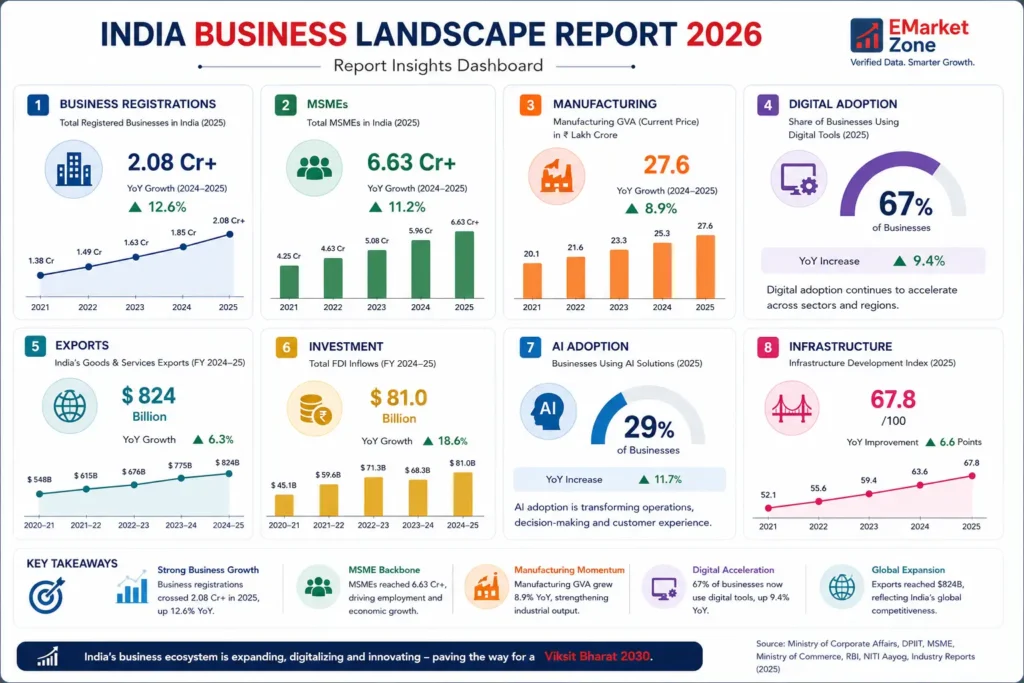
As of 2026, India has 6.5 crore+ registered MSMEs through the Udyam Registration Portal, representing one of the world’s largest small business ecosystems. These enterprises operate across manufacturing, services, retail, agriculture, logistics, healthcare, education, construction, and technology, creating employment for millions while supporting large industries through supply chains and vendor networks.
Government initiatives such as Udyam Registration, Credit Guarantee Fund Trust for Micro and Small Enterprises (CGTMSE), Production Linked Incentive (PLI) schemes, PM Vishwakarma, Digital India, and Startup India continue to accelerate MSME formalization, digital adoption, and access to finance.
For businesses, investors, lenders, and B2B organizations, understanding India’s MSME ecosystem is essential for identifying high-value markets, procurement opportunities, and long-term commercial partnerships.
6.1 India's MSME Ecosystem (2026)
India’s MSME sector spans nearly every industry and region, making it one of the country’s most diversified economic pillars.
MSMEs operate across:
• Manufacturing
• Wholesale & Retail Trade
• Construction
• Information Technology
• Food Processing
• Healthcare
• Professional Services
• Logistics
• Education
• Hospitality
• Agriculture
• Renewable Energy
The widespread presence of MSMEs enables balanced economic development by generating local employment, supporting regional industries, and strengthening domestic supply chains.
6.2 MSME Classification (2026)
India classifies MSMEs based on investment in plant & machinery/equipment and annual turnover, ensuring a uniform framework for policy implementation and financial support.
| Category | Investment Limit | Annual Turnover |
|---|---|---|
| Micro Enterprise | Up to ₹2.5 Crore | Up to ₹10 Crore |
| Small Enterprise | Up to ₹25 Crore | Up to ₹100 Crore |
| Medium Enterprise | Up to ₹125 Crore | Up to ₹500 Crore |
These revised thresholds allow growing businesses to retain MSME benefits while scaling operations.
6.3 State-wise MSME Distribution
MSME activity is concentrated in economically advanced states with strong industrial infrastructure, manufacturing clusters, and entrepreneurial ecosystems.
Leading MSME States
• Maharashtra
• Tamil Nadu
• Gujarat
• Uttar Pradesh
• Karnataka
• Rajasthan
• Telangana
• Delhi NCR
• Kerala
• West Bengal
These states account for a significant share of India’s registered MSMEs across manufacturing and service sectors.
6.4 Industry-wise MSME Distribution
MSMEs support both traditional industries and emerging sectors.
Major MSME Industries
| Industry | Primary Activities |
|---|---|
| Manufacturing | Engineering, Machinery, Components |
| Food Processing | Packaged Foods, Agro Products |
| Textiles | Garments, Fabrics, Apparel |
| Chemicals | Industrial Chemicals |
| Pharmaceuticals | Medicines, Medical Supplies |
| IT Services | Software, SaaS, Consulting |
| Construction | Building Materials, Contractors |
| Logistics | Warehousing, Transportation |
| Retail | Distribution, Wholesale |
| Professional Services | CA, Legal, Marketing |
6.5 MSMEs and Employment
MSMEs remain among India’s largest employment generators after agriculture.
They create jobs across:
• Manufacturing
• Services
• Retail
• Construction
• Logistics
• Hospitality
• Healthcare
• Education
The sector is especially important in semi-urban and rural India, where MSMEs provide local employment and promote inclusive economic development.
6.6 MSMEs and Exports
Indian MSMEs contribute significantly to merchandise exports by supplying products and components across global value chains.
Major export-oriented MSME sectors include:
• Engineering Goods
• Textiles
• Pharmaceuticals
• Chemicals
• Food Products
• Leather
• Auto Components
• Gems & Jewellery
• Handicrafts
Government export promotion schemes continue to improve international competitiveness.
6.7 Digital Transformation of MSMEs
Digital adoption has become one of the strongest growth drivers for Indian MSMEs.
Key Technologies
• Digital Payments
• Cloud Software
• ERP
• CRM
• E-commerce
• AI Tools
• Business Analytics
• Digital Marketing
• Online Procurement
Businesses adopting digital technologies generally improve operational efficiency, customer acquisition, and scalability.
6.8 Government Support Ecosystem
The Government of India continues to strengthen MSMEs through financial assistance, skill development, market access, and technology adoption.
Major initiatives include:
• Udyam Registration
• CGTMSE
• PM Vishwakarma
• ZED Certification
• Startup India
• Stand-Up India
• PLI Support
• Digital MSME
• GeM Portal
• Cluster Development Programme
These initiatives reduce barriers to formalization and improve long-term competitiveness.
6.9 Future Outlook (2026–2030)
India’s MSME sector is expected to expand steadily over the coming years, supported by:
• Manufacturing growth
• Digital transformation
• Export expansion
• AI adoption
• Industrial automation
• Supply chain diversification
• Infrastructure investment
• Formalization through Udyam
MSMEs are expected to play an increasingly important role in India’s ambition of becoming a $5 trillion+ economy and a global manufacturing hub.
Key Insights
• India has one of the world’s largest MSME ecosystems, with 6.5 crore+ registered enterprises.
• Manufacturing and services remain the dominant MSME sectors.
• Maharashtra, Tamil Nadu, Gujarat, Karnataka, and Uttar Pradesh continue to lead in MSME concentration.
• Digital transformation is reshaping how MSMEs operate, sell, and scale.
• Government initiatives are improving access to finance, technology, and domestic and international markets.
• MSMEs will remain central to India’s employment generation, exports, industrial development, and regional economic growth through 2030.
Chapter Summary
India’s MSME sector represents the foundation of the country’s entrepreneurial and industrial ecosystem. With millions of enterprises spread across diverse industries and regions, MSMEs contribute substantially to employment, manufacturing, exports, innovation, and inclusive economic growth. As digital adoption, government support, and global market opportunities continue to expand, MSMEs are well positioned to become even more competitive, resilient, and globally connected over the remainder of the decade.
Chapter 7 (Emerging Business Trends & Future Growth Drivers (2026))
Introduction
India’s business environment is evolving rapidly, driven by technological innovation, changing consumer behavior, policy reforms, global supply chain shifts, and increasing digital adoption. Businesses that embrace these structural changes are better positioned to improve efficiency, expand into new markets, and remain competitive in an increasingly connected economy.
In 2026, growth is no longer defined solely by company size or industry. Instead, competitiveness depends on how effectively businesses leverage digital technologies, automation, sustainability, data-driven decision-making, and global market access.
This chapter examines the major trends shaping India’s business ecosystem and the long-term drivers expected to influence growth through the remainder of the decade.
7.1 Digital Transformation
Digital transformation continues to redefine how Indian businesses operate, communicate, and serve customers. Organizations across industries are adopting cloud-based systems, enterprise software, digital payments, automation, and online sales channels to improve productivity and customer experience.
• Key Adoption Areas
• Cloud Computing
• ERP Solutions
• CRM Platforms
• Digital Payments
• E-commerce
• Business Analytics
• AI-powered Automation
• Cybersecurity
Digital adoption has become a competitive necessity for businesses of every size, from micro-enterprises to large corporations.
7.2 Artificial Intelligence & Automation
Artificial Intelligence (AI) is moving beyond experimentation into mainstream business operations. Companies are increasingly using AI to automate repetitive tasks, improve customer service, enhance decision-making, and optimize operations.
• Common Business Applications
• Predictive Analytics
• Customer Support Chatbots
• Sales Forecasting
• Inventory Optimization
• Document Processing
• Marketing Automation
• Personalized Recommendations
• Fraud Detection
AI adoption is expected to accelerate across manufacturing, finance, healthcare, logistics, retail, and professional services.
7.3 Sustainability & Green Business
Environmental sustainability is becoming a core business priority. Companies are increasingly investing in energy efficiency, renewable energy, waste reduction, and ESG reporting to meet regulatory expectations and customer demand.
• Major Focus Areas
• Renewable Energy
• Carbon Reduction
• Sustainable Manufacturing
• Green Supply Chains
• Circular Economy
• ESG Compliance
Businesses integrating sustainability into their operations are likely to strengthen resilience and long-term competitiveness.
7.4 Manufacturing Modernization
India’s manufacturing sector is shifting toward smart factories and advanced production systems.
• Emerging Technologies
• Industry 4.0
• Industrial IoT
• Robotics
• Smart Sensors
• Predictive Maintenance
• Digital Twins
• Advanced Quality Control
Manufacturers adopting these technologies are improving efficiency, reducing costs, and enhancing product quality.
7.5 Global Supply Chain Diversification
India is becoming an increasingly attractive destination for global manufacturing and sourcing as companies diversify supply chains.
• Growth Drivers
• Competitive Workforce
• Government Incentives
• Industrial Corridors
• Logistics Improvements
• Export Promotion
• Trade Agreements
Industries such as electronics, pharmaceuticals, engineering, automotive components, and chemicals are expected to benefit significantly.
7.6 Data-Driven Decision Making
Organizations are increasingly relying on business intelligence and market data to support strategic planning.
Growing adoption includes:
• Market Research
• Customer Analytics
• Sales Intelligence
• Business Databases
• Demand Forecasting
• Competitive Intelligence
• Geographic Analysis
Reliable business data has become a strategic asset for sales, marketing, expansion, and investment decisions.
7.7 Workforce & Skills Evolution
The workforce is changing rapidly as businesses require stronger digital, analytical, and technical capabilities.
• High-Demand Skills
• Artificial Intelligence
• Data Analytics
• Cybersecurity
• Cloud Computing
• Digital Marketing
• Automation
• Project Management
• Financial Analysis
Continuous learning and upskilling are becoming essential for organizational competitiveness.
Key Insights
• Digital transformation is becoming essential across industries.
• AI and automation are reshaping business operations and productivity.
• Sustainability is evolving from a compliance requirement into a competitive advantage.
• Smart manufacturing and Industry 4.0 are modernizing India’s industrial base.
• Global supply chain diversification presents significant opportunities for Indian businesses.
• Data-driven decision-making is increasingly influencing business strategy.
• Workforce upskilling remains critical for long-term competitiveness.
Chapter 8 (Business Opportunities, Challenges & Strategic Outlook (2026))
Introduction
India is entering a new phase of economic expansion driven by digital transformation, manufacturing growth, infrastructure investment, entrepreneurship, and global supply chain diversification. While these developments create significant commercial opportunities, businesses must also navigate an evolving landscape of regulatory requirements, technology disruption, changing customer expectations, and increasing global competition.
Organizations that combine market intelligence with strategic planning will be better positioned to capture new opportunities, optimize operations, and build sustainable long-term growth.
This chapter evaluates India’s business environment through the lens of opportunity, risk, and future readiness, providing practical insights for business leaders, investors, sales teams, and decision-makers.
8.1 India's Biggest Growth Opportunities
Several sectors are expected to experience sustained expansion over the coming years, supported by government initiatives, rising consumer demand, technological innovation, and infrastructure development.
High-Growth Industries
| Industry | Growth Potential | Primary Drivers |
|---|---|---|
| Artificial Intelligence | ★★★★★ | Automation, Analytics |
| Manufacturing | ★★★★★ | Make in India, PLI |
| Renewable Energy | ★★★★★ | Green Transition |
| Electric Vehicles | ★★★★★ | EV Adoption |
| Logistics | ★★★★☆ | E-commerce, Infrastructure |
| Healthcare | ★★★★☆ | Population & Digital Health |
| SaaS & IT | ★★★★★ | Global Demand |
| FinTech | ★★★★☆ | Digital Payments |
| Semiconductor | ★★★★★ | Electronics Manufacturing |
| Data Centers | ★★★★☆ | AI & Cloud |
8.2 India's Best Investment Regions
Different regions provide unique advantages depending on business objectives.
| Region | Business Strength |
|---|---|
| West India | Manufacturing, Finance |
| South India | Technology, Electronics |
| North India | Logistics, Services |
| East India | Mining, Steel |
| North-East | Tourism, Agriculture |
8.3 Best Cities for Business Expansion
Cities offering the strongest combination of infrastructure, workforce, market size, and investment climate include:
• Mumbai
• Bengaluru
• Hyderabad
• Pune
• Chennai
• Ahmedabad
• Gurugram
• Noida
• Surat
• Coimbatore
8.4 Major Challenges Facing Businesses
Rapid economic growth also brings operational challenges.
• Key Business Challenges
• Regulatory compliance
• Rising competition
• Talent shortages
• Cybersecurity risks
• Supply chain disruptions
• Inflationary pressures
• Technology adoption costs
• Global uncertainty
• ESG compliance
• Skilled workforce availability
Businesses that proactively invest in resilience, technology, and workforce development will be better prepared to navigate these challenges.
8.5 Digital Readiness Assessment
Digital maturity has become a major differentiator.
• Business Maturity Levels
• Traditional
• Digitally Enabled
• Automated
• Data-Driven
• AI-Powered
Organizations advancing through these stages generally improve efficiency, scalability, and customer experience.
8.6 Business Expansion Framework
Successful expansion requires evaluating multiple strategic factors.
• Decision Framework
• Market Potential
• Competition
• Customer Demand
• Infrastructure
• Workforce
• Logistics
• Compliance
• Cost Structure
• Technology Readiness
8.7 Sales Intelligence & Business Data
Reliable business intelligence enables organizations to improve targeting, reduce acquisition costs, and increase sales efficiency.
• Data Applications
• Lead Generation
• Territory Planning
• Market Expansion
• Customer Segmentation
• Competitor Analysis
• Sales Forecasting
• Distributor Identification
• Vendor Discovery
• Market Research
For B2B organizations, high-quality business databases have become a strategic asset for improving sales productivity and decision-making.
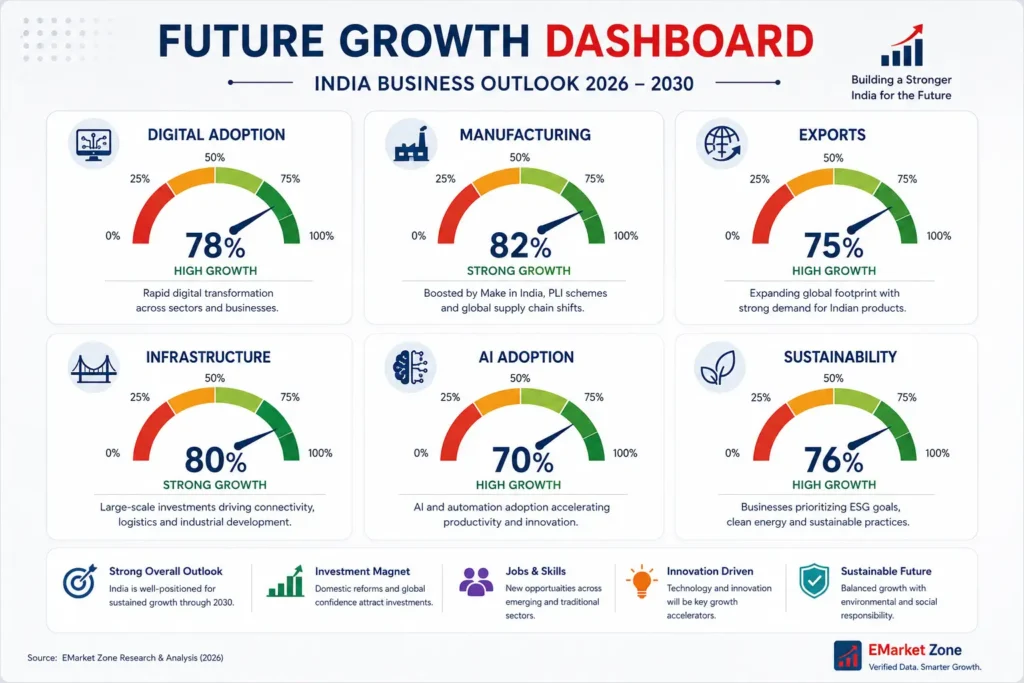
8.8 Future Business Outlook (2026–2030)
Reliable business intelligence enables organizations to improve targeting, reduce acquisition costs, and increase sales efficiency.
• Data Applications
• Lead Generation
• Territory Planning
• Market Expansion
• Customer Segmentation
• Competitor Analysis
• Sales Forecasting
• Distributor Identification
• Vendor Discovery
• Market Research
For B2B organizations, high-quality business databases have become a strategic asset for improving sales productivity and decision-making.
Key Takeaways
• AI, manufacturing, renewable energy, semiconductors, logistics, and SaaS present the strongest growth opportunities.
• Western and Southern India remain the country’s most attractive investment regions, while Tier 2 cities continue to gain momentum.
• Digital transformation and data-driven decision-making are becoming essential for long-term competitiveness.
• Organizations should balance expansion opportunities with operational resilience, technology adoption, and workforce development.
• Businesses that align with India’s structural growth trends are better positioned to capitalize on the country’s evolving economic landscape.
Chapter 9 (Conclusion & India's Business Outlook to 2030)
Introduction
India stands at one of the most significant turning points in its economic history. Over the past decade, the country has strengthened its position as one of the world’s fastest-growing major economies through structural reforms, digital transformation, manufacturing expansion, infrastructure development, and an increasingly formalized business ecosystem.
The findings presented throughout this report demonstrate that India’s business landscape is becoming larger, more organized, more technology-driven, and increasingly attractive for entrepreneurs, investors, multinational corporations, and domestic enterprises alike.
From rapid MSME formalization and rising private sector investment to the emergence of advanced manufacturing, artificial intelligence, renewable energy, and global supply chain diversification, India is building a diversified economic foundation capable of supporting long-term sustainable growth.
The coming years will not simply witness more businesses—they will see fundamentally different businesses powered by data, technology, automation, and innovation.
9.1 India's Business Journey
India’s business ecosystem has evolved through several transformational phases.
| Period | Business Transformation |
|---|---|
| Before 2010 | Traditional & Informal Economy |
| 2010–2016 | Digital Foundations & Entrepreneurship |
| 2016–2020 | GST, Startup Ecosystem & Formalization |
| 2020–2024 | Digital Acceleration & Resilience |
| 2025–2026 | AI Adoption, Manufacturing Growth & Global Expansion |
| 2027–2030 | Innovation-Led & Globally Competitive Economy |
Each phase has strengthened India’s ability to compete in global markets while creating new opportunities for businesses of every size.
9.2 Key Findings from This Report
The analysis across previous chapters highlights several consistent themes.
Business Ecosystem
• Formal business registrations continue to expand.
• MSMEs remain the foundation of economic activity.
• Private Limited Companies are increasing steadily.
• Digital compliance is improving transparency.
Geography
• Maharashtra, Gujarat, Karnataka, Tamil Nadu, Telangana, and Delhi NCR remain major business hubs.
• Tier 2 cities are becoming increasingly attractive investment destinations.
Industries
• Manufacturing remains India’s industrial backbone.
• Technology, healthcare, logistics, and financial services continue expanding.
• AI, semiconductors, renewable energy, and EVs represent the next growth wave.
Digital Economy
• Businesses increasingly rely on automation, analytics, and AI.
• Business intelligence and market data have become strategic assets.
• Digital-first organizations are outperforming traditional competitors.
9.3 Strategic Recommendations
Organizations seeking long-term growth should focus on the following strategic priorities.
For Business Owners
• Invest in digital transformation.
• Build data-driven decision-making capabilities.
• Expand into high-growth regions.
• Strengthen customer intelligence.
• Adopt AI and automation where practical.
For Investors
• Prioritize manufacturing, AI, renewable energy, logistics, and healthcare.
• Evaluate emerging Tier 2 cities.
• Monitor infrastructure-led growth corridors.
For Sales & Marketing Teams
• Improve customer segmentation.
• Use verified business intelligence.
• Focus on account-based marketing.
• Develop industry-specific outreach strategies.
For MSMEs
• Complete formal registration.
• Adopt digital tools.
• Expand into export markets.
• Improve operational efficiency through automation.
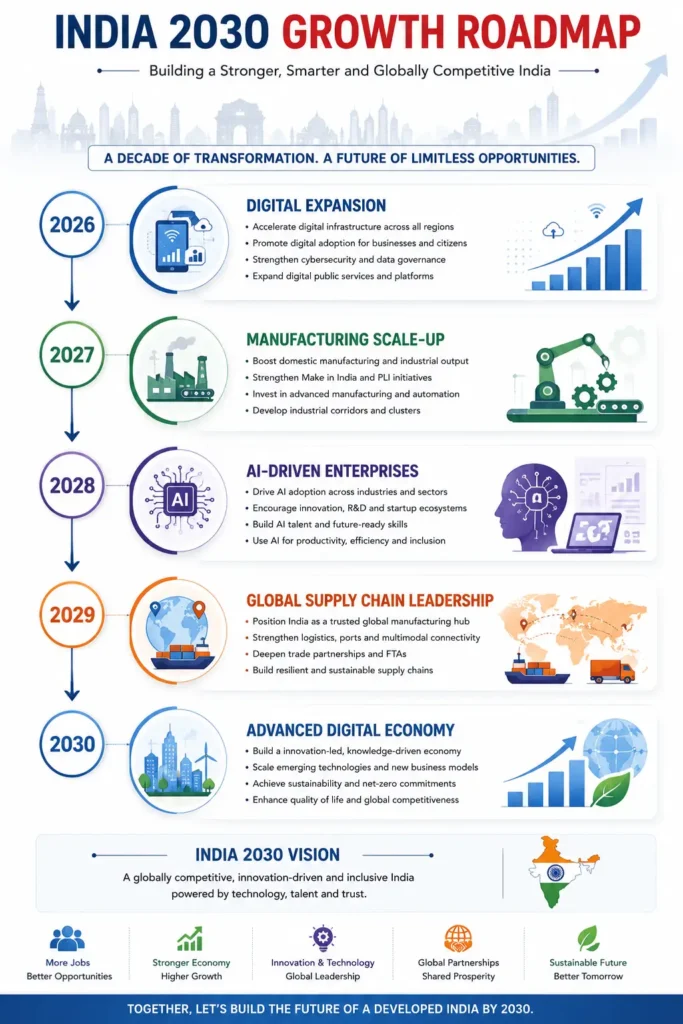
9.4 India's Outlook to 2030
By 2030, India is expected to become one of the world’s most influential business and investment destinations.
Several long-term structural drivers support this outlook:
• Continued infrastructure investment
• Manufacturing expansion
• Digital economy growth
• AI adoption across industries
• Renewable energy transition
• Growing domestic consumption
• Global supply chain diversification
• Expanding startup ecosystem
• Rising exports
• Increasing business formalization
These trends are expected to strengthen India’s competitiveness across manufacturing, technology, services, logistics, healthcare, and advanced industries.
9.5 The Role of Business Intelligence
As India’s economy becomes more competitive, access to accurate and timely business information will increasingly differentiate successful organizations from their peers.
Business intelligence enables organizations to:
• Identify new markets
• Discover qualified prospects
• Understand industry trends
• Evaluate competitors
• Plan regional expansion
• Improve sales efficiency
• Support investment decisions
• Reduce market uncertainty
In an increasingly data-driven economy, business intelligence is no longer a support function—it is a strategic capability.
9.6 Final Perspective
India’s business ecosystem in 2026 reflects a nation moving confidently toward a more formal, technology-enabled, and globally integrated economy. Across industries and regions, businesses are embracing digital transformation, investing in innovation, and expanding into new domestic and international markets.
The convergence of government reforms, entrepreneurial momentum, infrastructure development, and technological advancement has created a favorable environment for sustained business growth. While challenges such as regulatory complexity, talent shortages, and competitive pressures remain, organizations that prioritize adaptability, strategic planning, and data-driven decision-making will be well positioned to succeed.
The evidence presented throughout this report suggests that India’s next phase of growth will be shaped not only by the number of businesses established but by their ability to leverage technology, build resilient operations, and respond to changing market dynamics. Businesses that invest in intelligence, innovation, and execution today are likely to become the market leaders of tomorrow.
Final Key Takeaways
India’s Business Landscape at a Glance
• One of the world’s fastest-growing formal business ecosystems.
• MSMEs continue to drive entrepreneurship, employment, and regional development.
• Manufacturing, technology, healthcare, logistics, and financial services remain core economic pillars.
• AI, renewable energy, semiconductors, and advanced manufacturing represent the strongest long-term opportunities.
• Tier 2 cities are emerging as important investment and expansion destinations.
• Business intelligence, digital transformation, and automation are becoming critical competitive advantages.
About This Report
India Business Landscape Report 2026 has been prepared by EMarket Zone to provide a comprehensive overview of India’s evolving business ecosystem. The report combines publicly available government statistics, economic indicators, industry insights, and market analysis to present an integrated view of business trends, regional distribution, industrial development, MSME growth, and future opportunities.
Designed for business leaders, investors, consultants, policymakers, sales professionals, and researchers, this report serves as a practical reference for understanding India’s commercial landscape and supporting informed strategic decision-making.
Looking for verified business contacts or industry-specific business data? Explore EMarket Zone’s database solutions.
End of Report
EMarket Zone
Verified Data. Smarter Growth.
Copyright © 2026 EMarket Zone. All rights reserved.
References
This report is based on publicly available information and industry research, including:
• Ministry of Corporate Affairs (MCA)
• Ministry of MSME
• Department for Promotion of Industry and Internal Trade (DPIIT)
• Reserve Bank of India (RBI)
• Ministry of Commerce & Industry
• National Statistical Office (NSO)
• Economic Survey of India
• Government of India Open Data Platform
• EMarket Zone Research & Analysis (2026)