
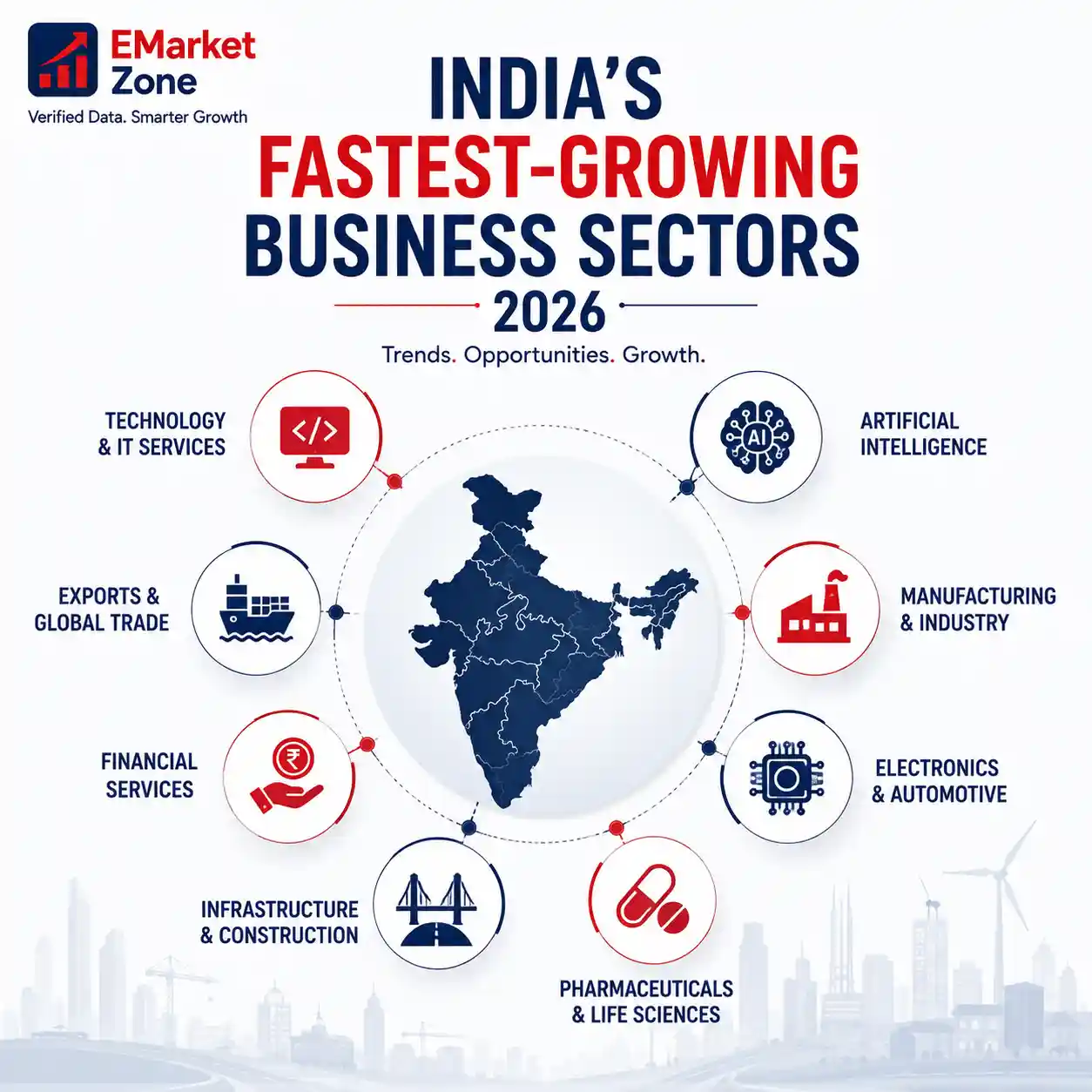
India’s growth story is no longer concentrated in a handful of traditional industries.
Technology and digital services remain major growth engines, but manufacturing, artificial intelligence, electronics, pharmaceuticals, infrastructure, logistics and exports are creating additional opportunities across the economy.
The Economic Survey 2025–26 identifies services, industry, investment and infrastructure, and AI as important components of India’s next phase of economic development.
For businesses, the important question is not simply which sectors are growing fastest. It is where growth is creating new customers, suppliers, investment and B2B opportunities.
This article examines the major sectors shaping India’s business landscape in 2026 and the opportunities they are creating for businesses.
➡️ India Business Landscape Report 2026
For a comprehensive overview of India’s business ecosystem, explore our India Business Landscape Report 2026.
Technology, AI & Digital Services
Technology remains one of India’s strongest business sectors, but its opportunity is expanding beyond traditional IT services.
India’s services economy increasingly includes software, cloud computing, consulting, digital platforms, cybersecurity, AI and Global Capability Centres.
The Economic Survey 2025–26 highlights the continued importance of digitally delivered services and notes that professional and management consulting has become an increasingly important contributor to India’s services exports.
AI is also changing the opportunity. Businesses are increasingly moving from experimenting with AI to applying it to sales, customer service, software development, analytics, manufacturing and operational workflows.
Key opportunities
• SaaS and software
• AI solutions
• Cloud services
• Cybersecurity
• Business intelligence
• IT services
• Consulting
• Automation
Business outlook: Very strong.
Check EMarket Zone Company Database India
Manufacturing Is Moving Toward Higher-Value Production
Manufacturing is becoming increasingly important to India’s growth strategy.
The government’s Production Linked Incentive programme covers 14 strategic sectors and is designed to increase domestic production, attract investment, strengthen supply chains and expand exports.
As of 31 March 2026, PLI schemes had attracted more than ₹2.40 lakh crore in actual investment, generated more than 14.15 lakh direct and indirect employment opportunities, and contributed to exports exceeding ₹15.2 lakh crore.
The opportunity therefore extends beyond factories themselves.
Manufacturing growth creates demand for:
• Machinery
• Industrial equipment
• Engineering services
• Components
• Packaging
• Chemicals
• Automation
• Logistics
• Industrial software
This makes manufacturing one of the most important B2B opportunity areas in India.
For detailed MSME data, see State-wise MSME Statistics in India 2026
Electronics, Automotive & Pharmaceuticals
Several manufacturing sectors are receiving particularly strong investment and policy support.
Electronics has become a major manufacturing priority, while automotive and pharmaceutical production are developing deeper domestic supply chains.
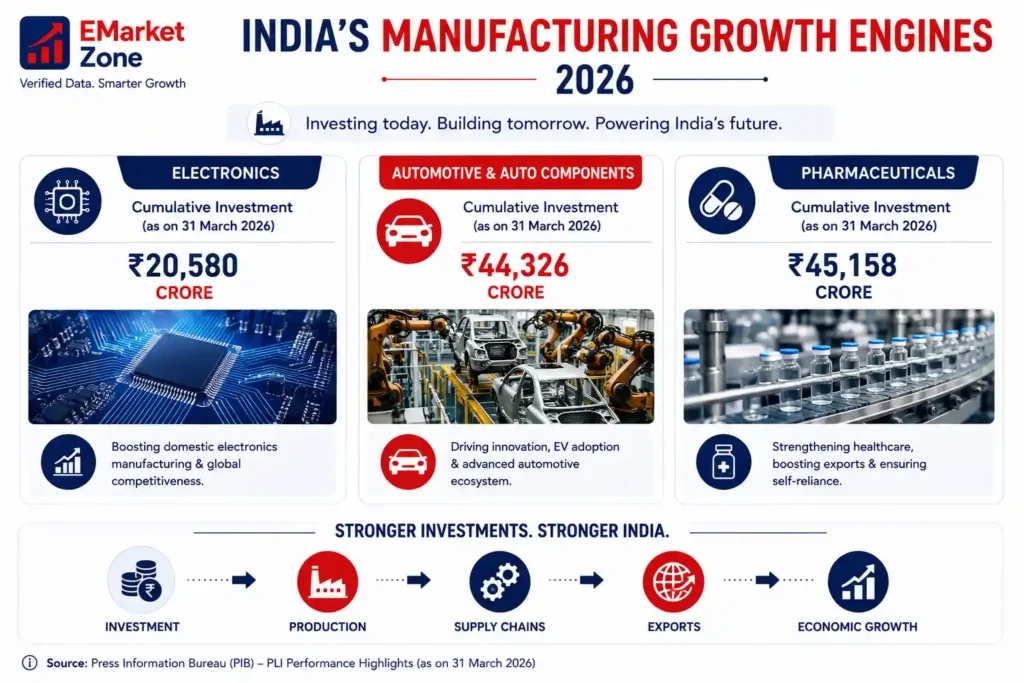
Under the PLI programme, the government reported more than ₹20,580 crore of cumulative investment in large-scale electronics manufacturing, ₹44,326 crore in automobiles and auto components, and ₹45,158 crore in pharmaceuticals as of March 2026.
The automotive sector is also expanding into electric vehicles, advanced automotive products and battery technologies. The PLI-Auto scheme had attracted ₹44,326 crore of investment by 31 March 2026.
In pharmaceuticals, PLI-supported projects are encouraging investment in higher-value products and domestic manufacturing capabilities.
Key opportunity areas
| Sector | B2B Opportunities |
|---|---|
| Electronics | Components, equipment, automation |
| Automotive | Components, engineering, EV supply chain |
| Pharmaceuticals | APIs, equipment, packaging, services |
Checkout EMarket Zone Manufacturer Database India
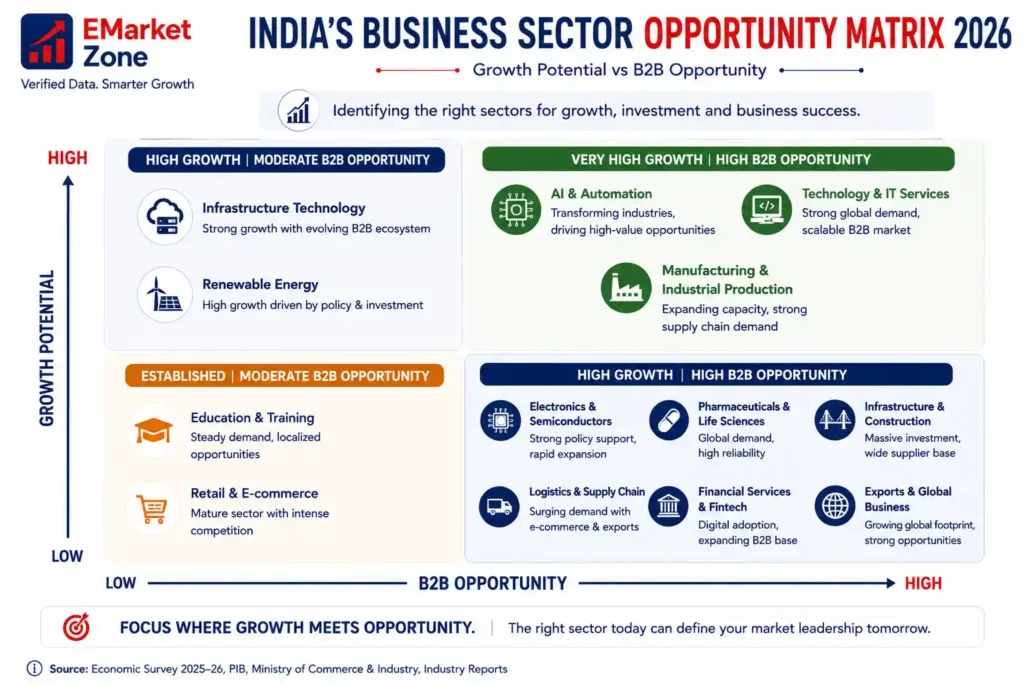
Infrastructure, Logistics & Financial Services
India’s business expansion requires both physical and financial infrastructure.
Investment in roads, railways, ports, airports, industrial corridors, logistics networks, warehouses and digital infrastructure creates demand across thousands of supporting businesses.
The Economic Survey 2025–26 identifies investment and infrastructure as key elements of India’s competitiveness, connectivity and capacity-building agenda.
Financial services are evolving alongside this expansion. Banks, fintech companies, insurers, payment platforms and financial technology providers increasingly support businesses moving into the formal and digital economy.
• Opportunity areas
• Construction
• Building materials
• Engineering
• Logistics
• Warehousing
• Industrial equipment
• Financial technology
• Business finance
For national-level statistics, explore India Business Statistics 2026.
Exports Are Creating New Business Opportunities
India’s export economy is expanding across both goods and services.
The Ministry of Commerce estimates India’s combined merchandise and services exports at US$860.09 billion in FY2025–26, compared with US$825.26 billion in FY2024–25, representing estimated growth of 4.22%.
The opportunity is not limited to large exporters.
Export growth creates demand for:
• Manufacturers
• Component suppliers
• Packaging companies
• Logistics providers
• Financial services
• Compliance services
• Technology providers
• Professional services
India’s export opportunity is therefore also a B2B ecosystem opportunity.
For state-level business comparisons, see Top Business States in India 2026.
The Real Opportunity Is More Specific Than an Industry
Knowing that a sector is growing is only the first step.
Businesses need to identify where that sector is concentrated and which companies are most relevant.
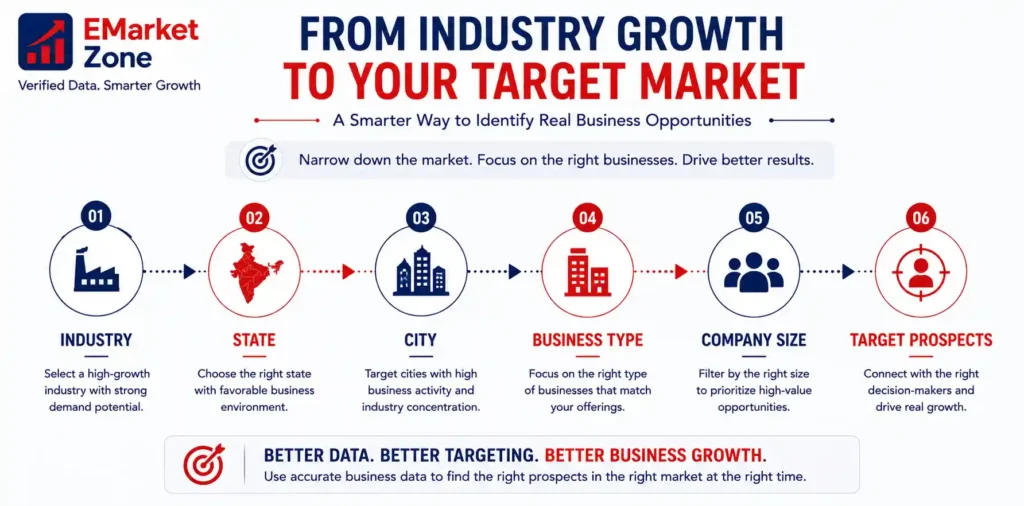
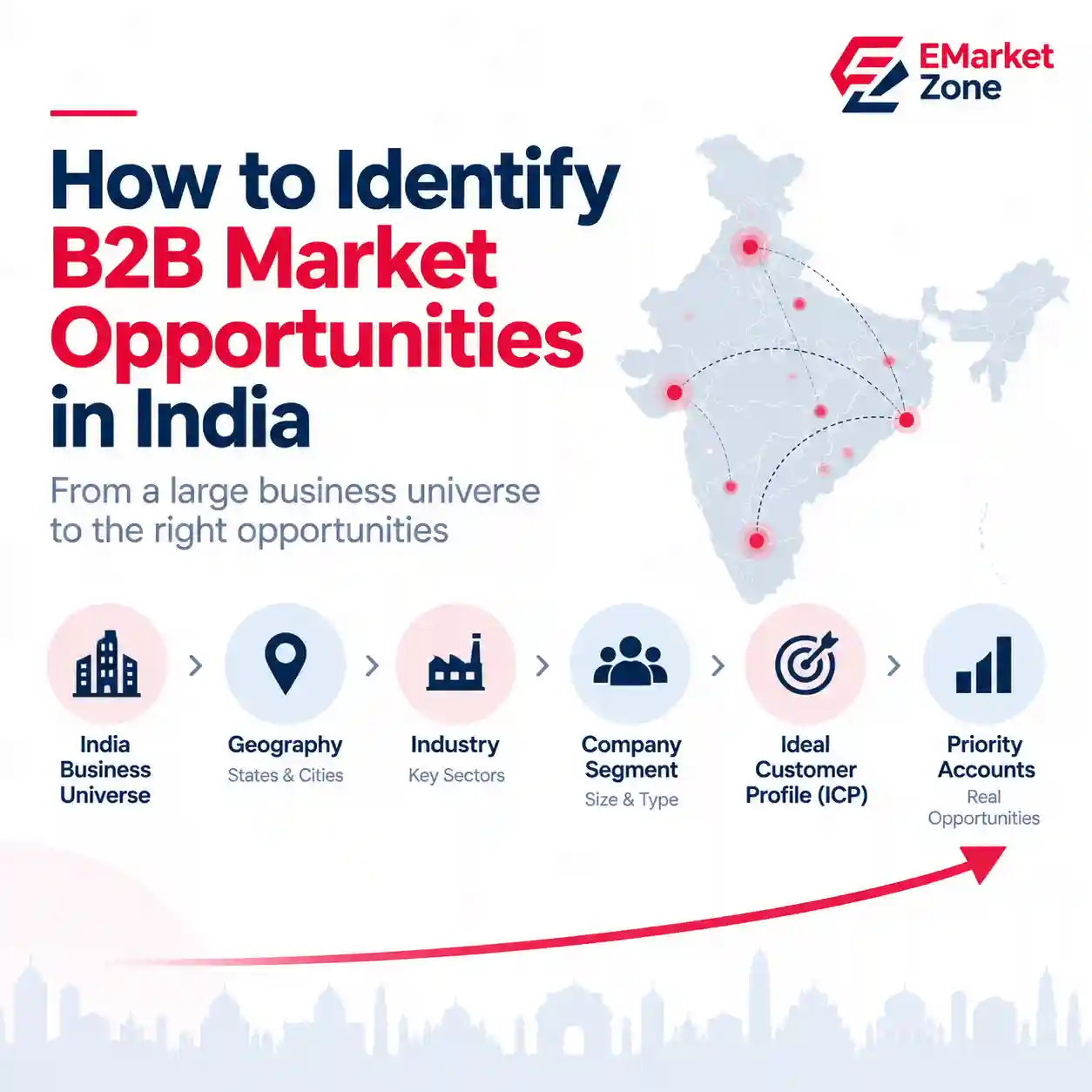
A practical market-selection framework is:
Industry → State → City → Company Type → Business Size → Target Prospect
For example, a machinery supplier may target:
Manufacturing → Gujarat → Ahmedabad → Engineering Companies → Medium Businesses
A software company may instead target:
Technology → Karnataka → Bengaluru → Growing Companies → B2B Buyers
This is where structured business data becomes commercially useful.
The objective is not to build the biggest possible prospect list. It is to identify the right companies inside the right market.
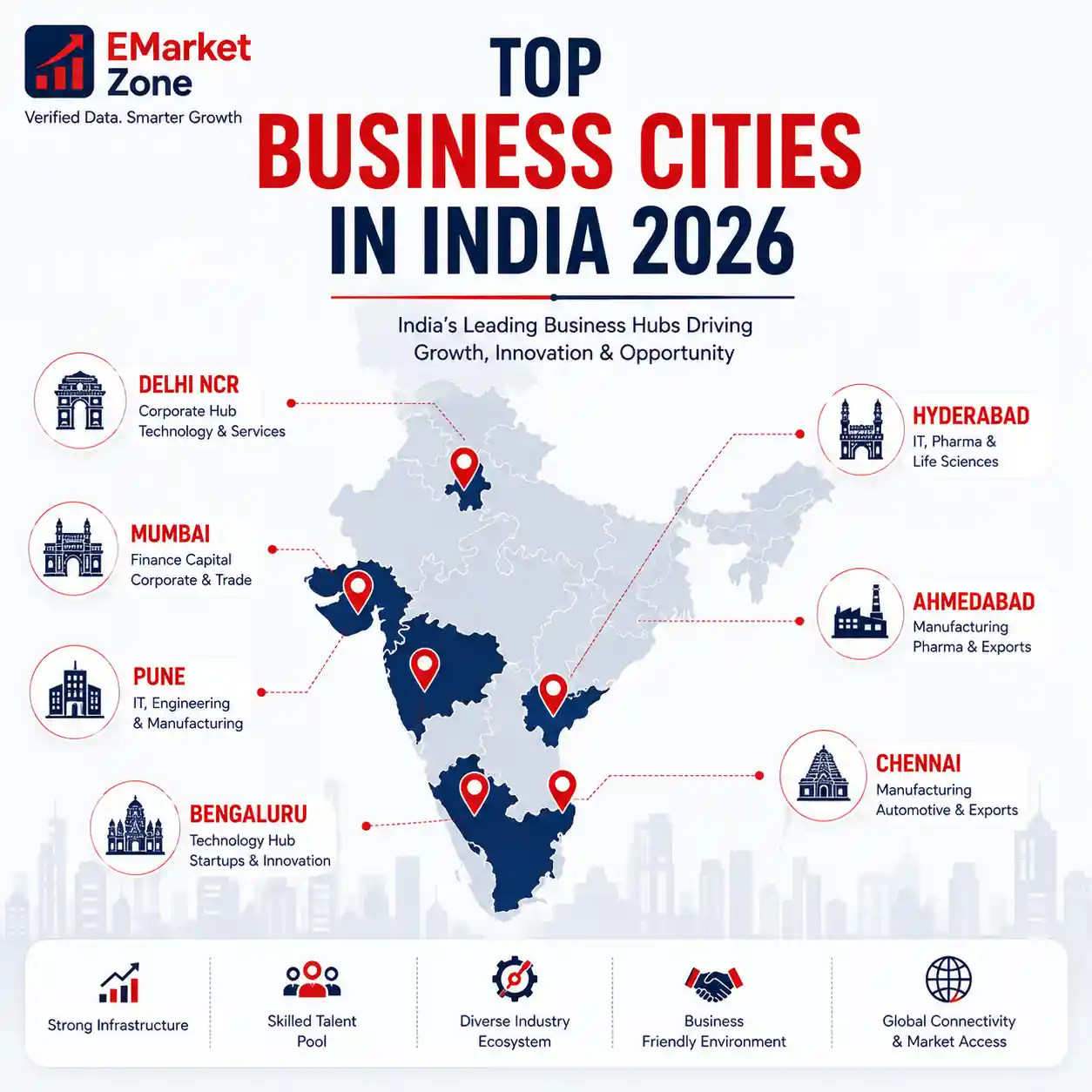
For city-level business comparisons, see Top Business cities in India 2026.
What Businesses Should Watch in 2026
Five themes stand out across India’s business landscape:
1. AI is moving toward practical adoption
The opportunity is shifting from AI experimentation toward measurable business applications.
2. Manufacturing is becoming more sophisticated
Investment is increasingly moving toward electronics, automotive, pharmaceuticals and other higher-value industries.
3. Services remain globally competitive
India’s services economy continues to expand across technology, consulting and digitally delivered activities.
4. Infrastructure creates secondary markets
Large infrastructure investment generates demand for suppliers, manufacturers, contractors and service providers.
5. Data-driven market selection is becoming more important
As India’s business ecosystem expands, companies need better segmentation to decide where to sell and whom to target.
India’s Growth Opportunity Is Becoming More Connected
India’s 2026 business opportunity is not concentrated in one industry.
Technology supports almost every sector. AI is changing how businesses operate. Manufacturing is strengthening domestic supply chains. Infrastructure is creating new markets. Pharmaceuticals and electronics are moving toward higher-value production. Exports are connecting Indian businesses with global demand.
The most important opportunity is therefore not simply identifying a fast-growing industry.
It is identifying the right combination of industry, geography, company type and customer profile.
For businesses, that means moving from:
“Which sector is growing?”
to:
“Which companies in which markets are positioned to create our next opportunity?”
That is where business data becomes more than a database. It becomes a tool for market selection and growth.
Related Research
For the broader analysis of India’s business ecosystem, see the India Business Landscape Report 2026.
For state-level business comparisons, see Top Business States in India 2026.
For national-level statistics, explore India Business Statistics 2026.
For detailed MSME data, see State-wise MSME Statistics in India 2026
For city-level business comparisons, see Top Business City in India 2026.
Explore Business Data
Reliable market expansion starts with reliable data.
EMarket Zone provides verified business databases covering:
• MSME Businesses
• Private Limited Companies
• Manufacturers
• GST Registered Businesses
• Exporters
• Industry-wise Databases
• State-wise Business Databases
• City-wise Business Databases
Whether you’re planning sales outreach, market expansion, competitive analysis, or investment research, our business intelligence solutions help you connect with the right businesses across India.
References
This article uses government and institutional data, including:
- Government of India — Economic Survey 2025–26
- Ministry of Commerce & Industry — Export statistics
- Press Information Bureau — Production Linked Incentive data
- Ministry of Heavy Industries — Automotive and battery manufacturing data
- Department of Pharmaceuticals — Pharmaceutical manufacturing data
The statistics represent different reporting periods, which are stated alongside the relevant figures.
Economic Survey 2025–26
Ministry of Commerce & Industry — FY2025–26 Exports
Government of India — PLI Performance
• EMarket Zone Research & Analysis (2026)
Leave a comment