
A large B2B market does not automatically make customer acquisition easier.
India has millions of registered enterprises across manufacturing, services and trading. The Ministry of MSME’s dashboard currently reports more than 9.57 crore Udyam and Udyam Assist Platform registrations, with trading, services and manufacturing forming major activity categories.
The real challenge is deciding which businesses are actually worth targeting.
That is where an Ideal Customer Profile (ICP) becomes useful.
What Is an Ideal Customer Profile?
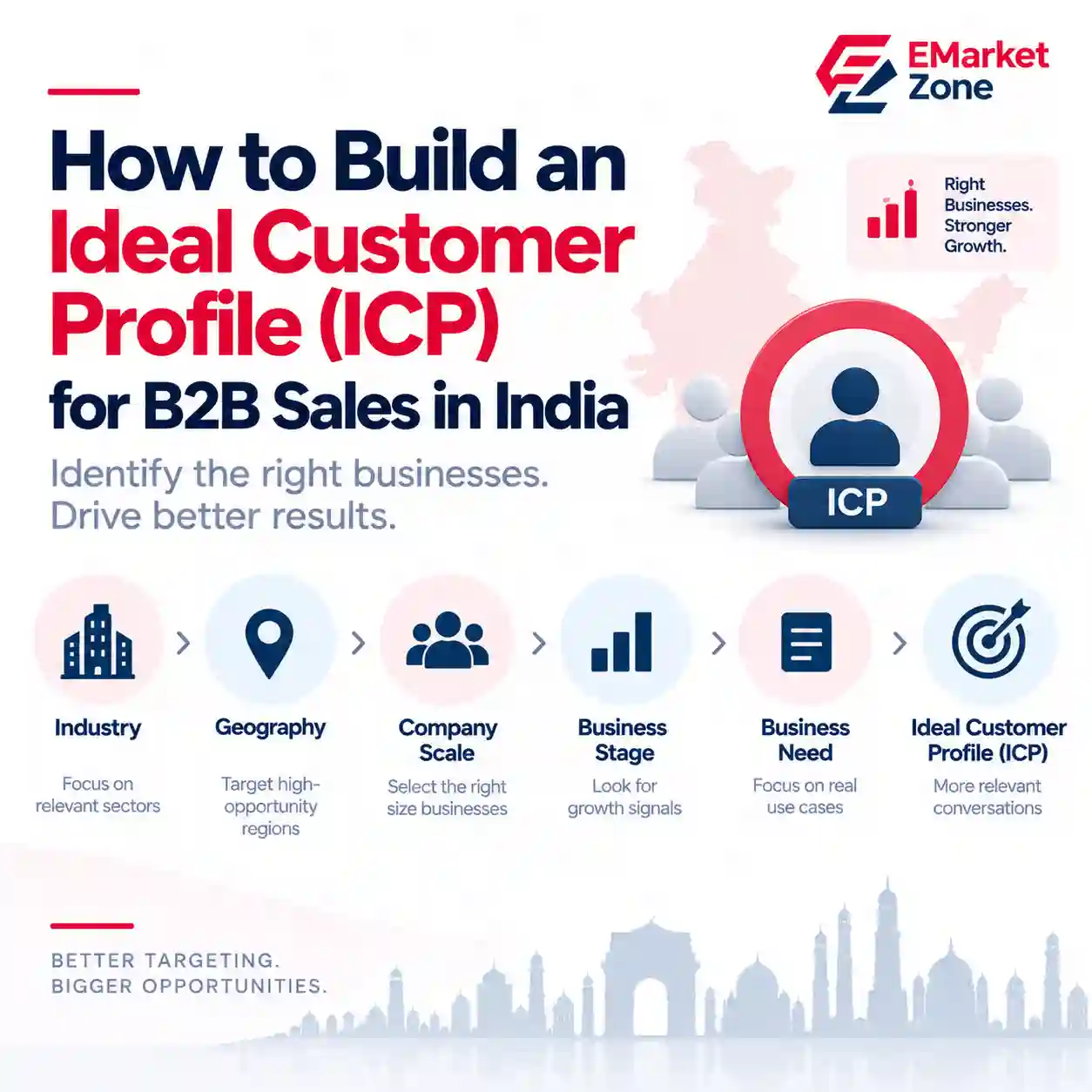
An Ideal Customer Profile describes the characteristics of a company that is most relevant to a particular B2B product or service.
An ICP can include:
• Industry
• Geography
• Company size
• Business type
• Revenue or operating scale
• Business stage
• Technology adoption
• Business need
• Growth signals
An ICP is different from a buyer persona.
ICP = the right company.
Buyer persona = the right person within that company.
For example, a software company might define its ICP as:
Mid-sized Indian manufacturers with multiple facilities, growing operations and a need to improve production management.
The next step would be identifying the relevant decision-makers inside those companies.
How Do You Build an ICP for the Indian B2B Market?
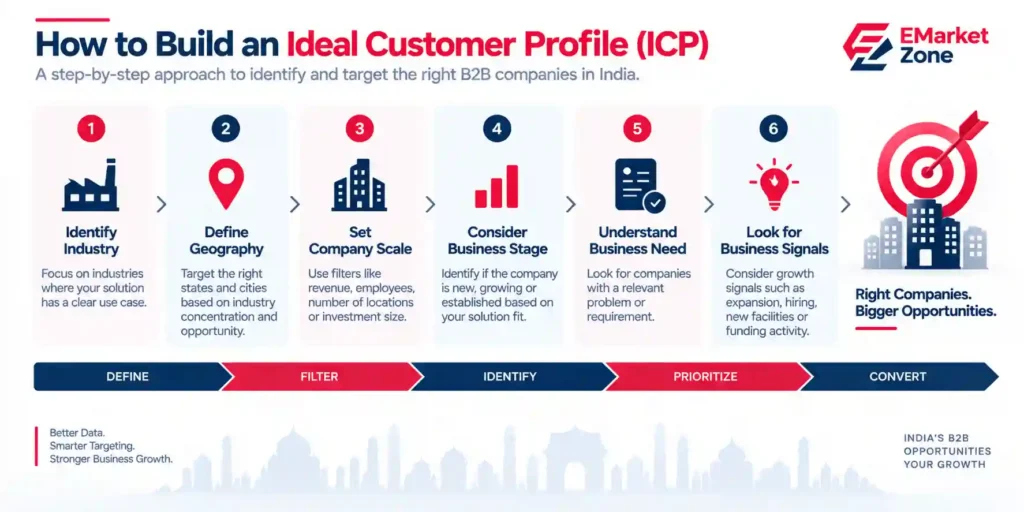
1. Start With the Problem You Solve
Do not begin with a database of companies.
Begin with the problem your product solves.
Ask:
Which businesses experience this problem strongly enough to pay for a solution?
For example:
A CRM platform may focus on companies with active sales teams.
An industrial equipment supplier may focus on manufacturers with relevant production requirements.
A logistics provider may focus on businesses with significant movement of goods.
The problem should determine the market—not the other way around.
2. Define the Right Industry
Industry is one of the strongest ICP filters.
A broad category such as “Indian businesses” is usually too large to be commercially useful.
Instead, identify the industries where your solution has a clear use case.
For example:
Healthcare → Hospitals → Multi-location hospitals
or
Manufacturing → Automotive → Auto-component manufacturers
or
Technology → SaaS → Growing B2B SaaS companies
The objective is not to create the narrowest possible segment. It is to identify a segment where the product has a strong and understandable use case.
3. Add Geography
Where a company operates can significantly affect its commercial relevance.
The MSME Ministry’s current state-level dashboard shows substantial differences in registered enterprise concentration across states. For example, Maharashtra, Uttar Pradesh, Karnataka, Tamil Nadu and other large states account for significant registered business populations.
But geographic size should not automatically determine priority.
Instead ask:
Where are my target industries concentrated?
A company selling industrial machinery may need specific manufacturing clusters.
A professional-services firm may prioritize major corporate cities.
A logistics company may focus on locations with strong manufacturing, warehousing and distribution activity.
This is why industry + geography is generally more useful than geography alone.
For the broader geographic analysis, see the India B2B Market Opportunity Report 2026.
4. Define Company Scale
Company scale helps determine whether the economics of the opportunity make sense.
Possible filters include:
• Employees
• Revenue
• Investment
• Number of locations
• Production capacity
• Customer base
• Business volume
For MSMEs specifically, India’s classification framework was revised from April 2025. The current definitions use both investment and turnover thresholds to distinguish micro, small and medium enterprises.
But company size should not be treated as the final answer.
A smaller company with an urgent problem may be more relevant than a much larger company with no immediate requirement.
5. Look for Business Signals
This is where an ICP becomes more useful than a static company list.
Look for signals such as:
- Expansion
- New facility openings
- Hiring
- New product launches
- Geographic expansion
- Export activity
- Technology adoption
- Fundraising
- Major capacity additions
These signals can indicate that a company is changing and may therefore have new requirements.
The concept is simple:
Firmographics tell you what a company is.
Business signals can indicate what is happening to the company.
That difference matters when deciding who to approach first.
6. Separate ICP From Priority Accounts
Not every company that matches the ICP should receive the same level of attention.
A useful structure is:
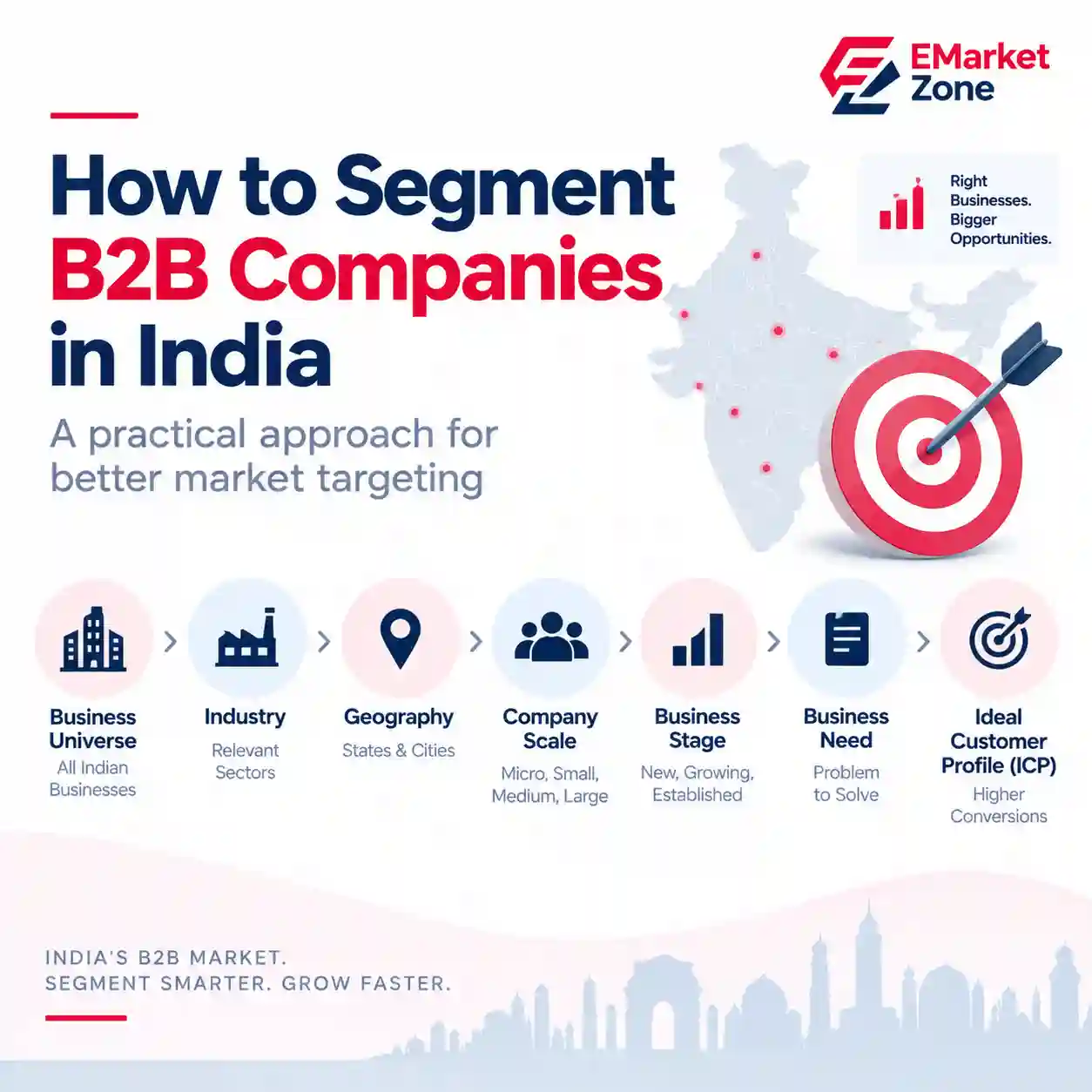
Business Universe
↓
ICP Segment
↓
ICP-Matched Companies
↓
Priority Accounts
↓
Decision-Makers
↓
Sales Opportunities
For example, if 50,000 companies match your basic ICP, you might identify a smaller group showing stronger fit or active business signals.
Those companies become the priority account universe.
What Makes a Strong B2B ICP?
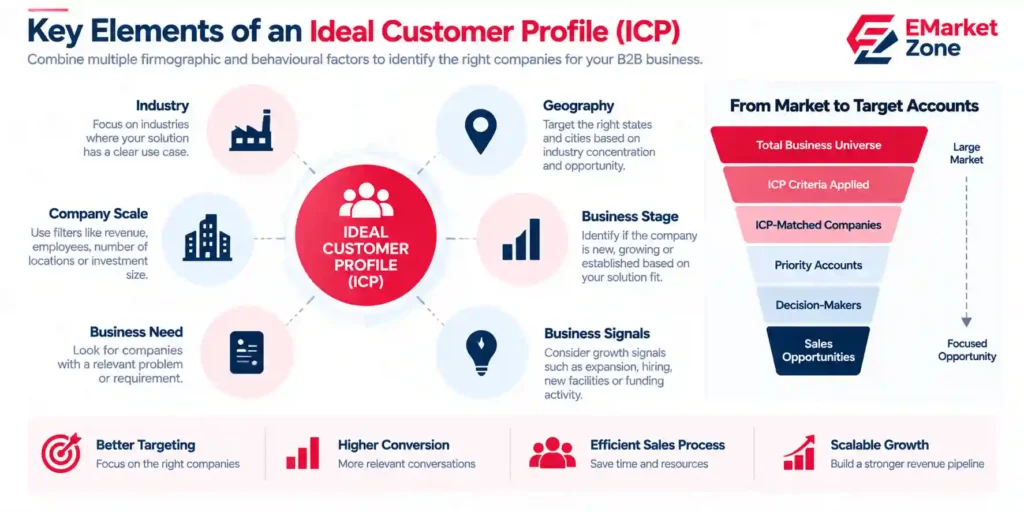
A practical ICP should answer six questions:
| Question | Example |
|---|---|
| Who? | Mid-sized manufacturers |
| Where? | Maharashtra, Gujarat, Tamil Nadu |
| What industry? | Automotive components |
| What scale? | Small and mid-market |
| What problem? | Production efficiency |
| Why now? | Expansion or capacity increase |
If your ICP cannot answer these questions, it is probably still too broad.
ICP Should Connect Marketing and Sales
A good ICP should not remain a document sitting in the marketing department.
It should influence:
Market Selection
→ Lead Generation
→ Account Prioritization
→ Content
→ Outreach
→ Sales Qualification
→ CRM
→ Revenue Analysis
This creates consistency between marketing and sales.
Instead of marketing generating “leads” and sales deciding later whether they are relevant, both teams can work from the same definition of the target account.
For national-level statistics, explore India Business Statistics 2026.
The Key Principle
The purpose of an ICP is not to reduce the market as much as possible.
It is to remove unnecessary ambiguity.
The right ICP should be:
Specific enough to guide targeting
but
Large enough to support commercial growth.
This is why ICP development should come after understanding the wider market.
For a broader view of India’s geography, industries, company segments and commercial opportunity, read the full India B2B Market Opportunity Report 2026.
Frequently Asked Questions
What is an ICP in B2B sales?
An Ideal Customer Profile is a description of the type of company that is most likely to have a strong need and commercial fit for a particular B2B product or service.
What should an Indian B2B ICP include?
A practical ICP can include industry, geography, company type, company scale, business stage, operating characteristics, business need and relevant growth signals.
Is ICP the same as a buyer persona?
No. An ICP describes the company, while a buyer persona describes the individual decision-maker or stakeholder within that company.
How specific should a B2B ICP be?
It should be specific enough to guide targeting but broad enough to provide a commercially meaningful market. An ICP that contains only a handful of potential companies may be too restrictive.
Can one company have multiple ICPs?
Yes. A business serving several distinct customer segments may have multiple ICPs, particularly when the product has different use cases across industries or company sizes.
Related Research
For the broader analysis of India’s business ecosystem, see the India Business Landscape Report 2026.
For state-level business comparisons, see Top Business States in India 2026.
For national-level statistics, explore India Business Statistics 2026.
For detailed MSME data, see State-wise MSME Statistics in India 2026
For city-level business comparisons, see Top Business City in India 2026.
References
Ministry of Micro, Small & Medium Enterprises, Government of India – MSME Performance Dashboard
Ministry of MSME – Annual Report 2025–26
Ministry of Corporate Affairs – Company Statistics
Leave a comment