
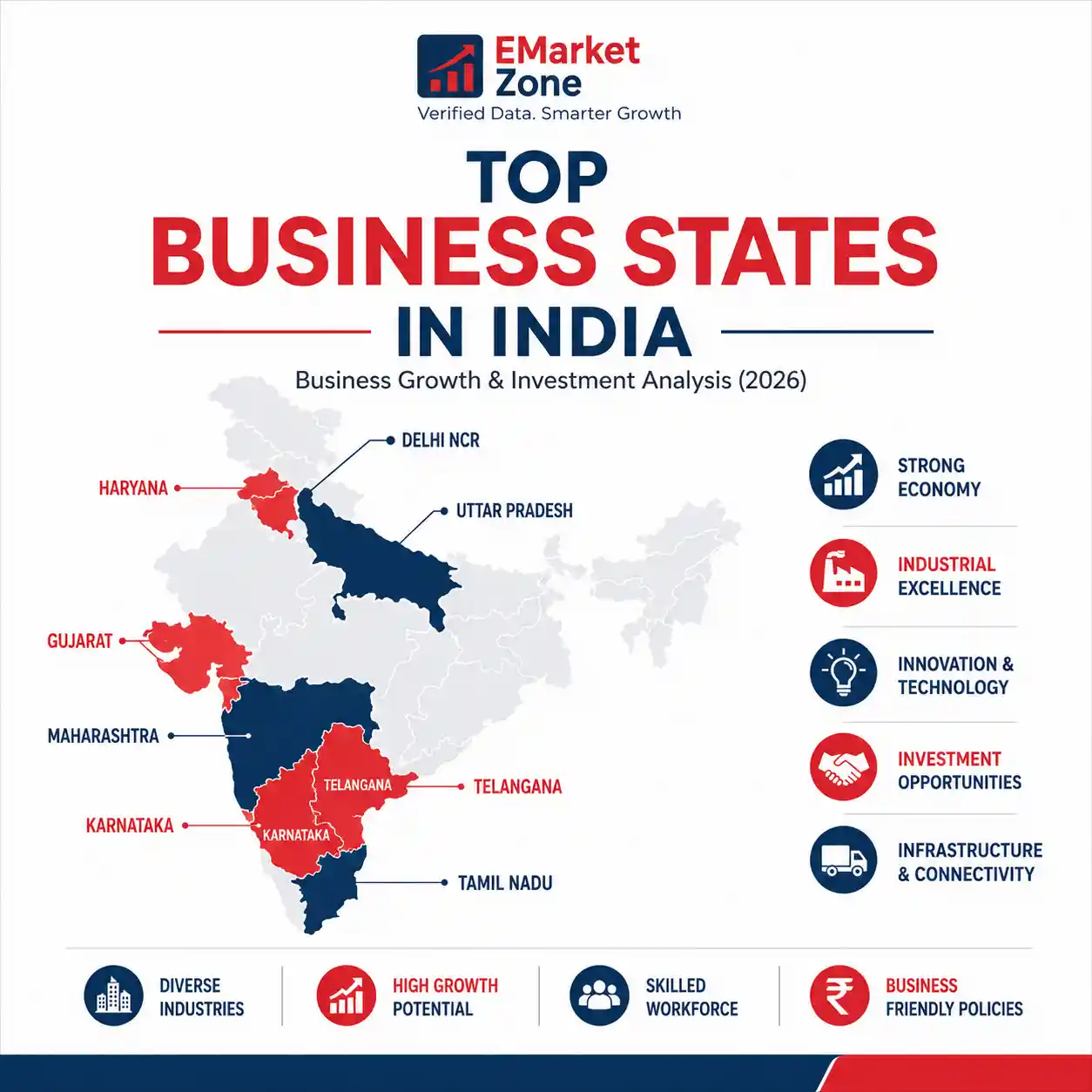
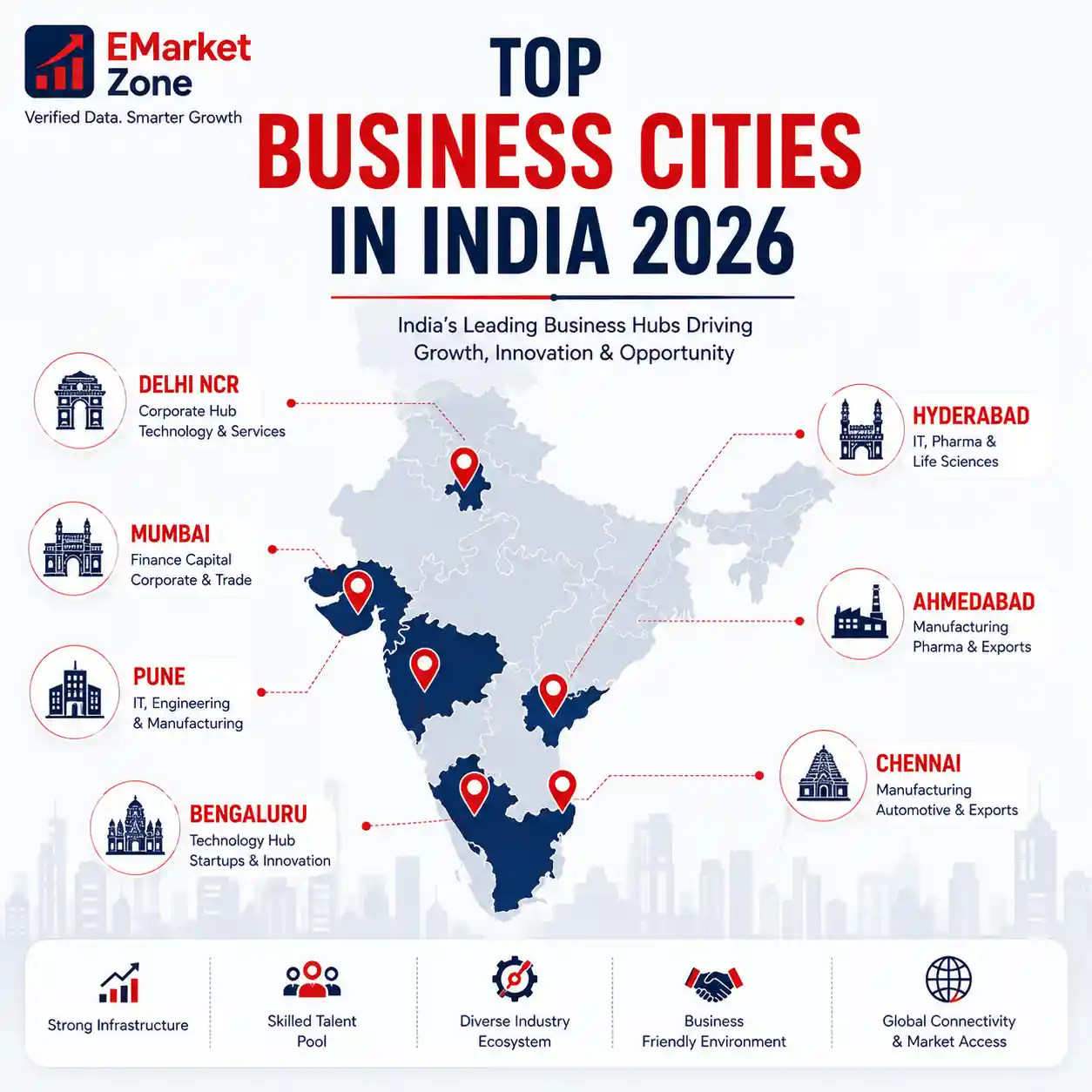
India’s economic growth is driven by a diverse network of states, each contributing through its unique industrial strengths, infrastructure, workforce, and business ecosystem. While states such as Maharashtra, Gujarat, Karnataka, Tamil Nadu, Telangana, and Delhi NCR continue to lead in business activity, several emerging regions are rapidly attracting investments across manufacturing, technology, logistics, healthcare, renewable energy, and services.
This research article examines India’s leading business states through a comparative analysis of industrial development, commercial infrastructure, investment climate, business density, and future growth potential. Whether you’re planning business expansion, market entry, investment, or sales targeting, understanding the strengths of each state is essential for making informed strategic decisions.
Executive Highlights
Key Insights
• Maharashtra remains India’s leading business state, supported by its financial ecosystem, manufacturing base, ports, and corporate headquarters.
• Gujarat continues to strengthen its position as India’s manufacturing and export powerhouse through industrial corridors and business-friendly policies.
• Karnataka leads India’s technology and innovation ecosystem, driven by Bengaluru’s global IT and startup landscape.
• Tamil Nadu has established itself as one of India’s largest manufacturing and automobile hubs with a diversified industrial base.
• Telangana continues to experience rapid growth through investments in information technology, life sciences, and infrastructure.
• Uttar Pradesh and Haryana are emerging as major business destinations due to expanding industrial corridors, logistics infrastructure, and MSME growth.
Key Statistics at a Glance
| Indicator | Leading State |
|---|---|
| Financial Hub | Maharashtra |
| Technology & Startups | Karnataka |
| Manufacturing | Gujarat |
| Automobile Industry | Tamil Nadu |
| Pharmaceuticals & Life Sciences | Telangana |
| Largest MSME Ecosystem | Uttar Pradesh |
| Logistics & NCR Business Hub | Haryana / Delhi NCR |
➡️ India Business Landscape Report 2026
For a comprehensive overview of India’s business ecosystem, explore our India Business Landscape Report 2026.
India's Business Landscape by State
India’s business ecosystem is geographically diverse, with each state contributing through its unique industrial strengths, economic policies, infrastructure, workforce, and investment environment. While no single state dominates every sector, a handful of states consistently lead in manufacturing, technology, finance, logistics, exports, and entrepreneurship, making them the primary engines of India’s economic growth.
Business activity is heavily concentrated in regions that offer strong transportation networks, industrial corridors, ports, airports, skilled talent, reliable power supply, and investor-friendly policies. These factors have enabled states such as Maharashtra, Gujarat, Karnataka, Tamil Nadu, Telangana, Uttar Pradesh, Haryana, and Delhi NCR to attract domestic and foreign investments across multiple industries.
As India continues its rapid economic transformation, businesses increasingly evaluate states based on more than population or market size. Factors such as ease of doing business, digital infrastructure, industrial clusters, startup ecosystems, logistics connectivity, and availability of skilled professionals now play an equally important role in expansion and investment decisions.
Check out latest state-wise B2B Databases
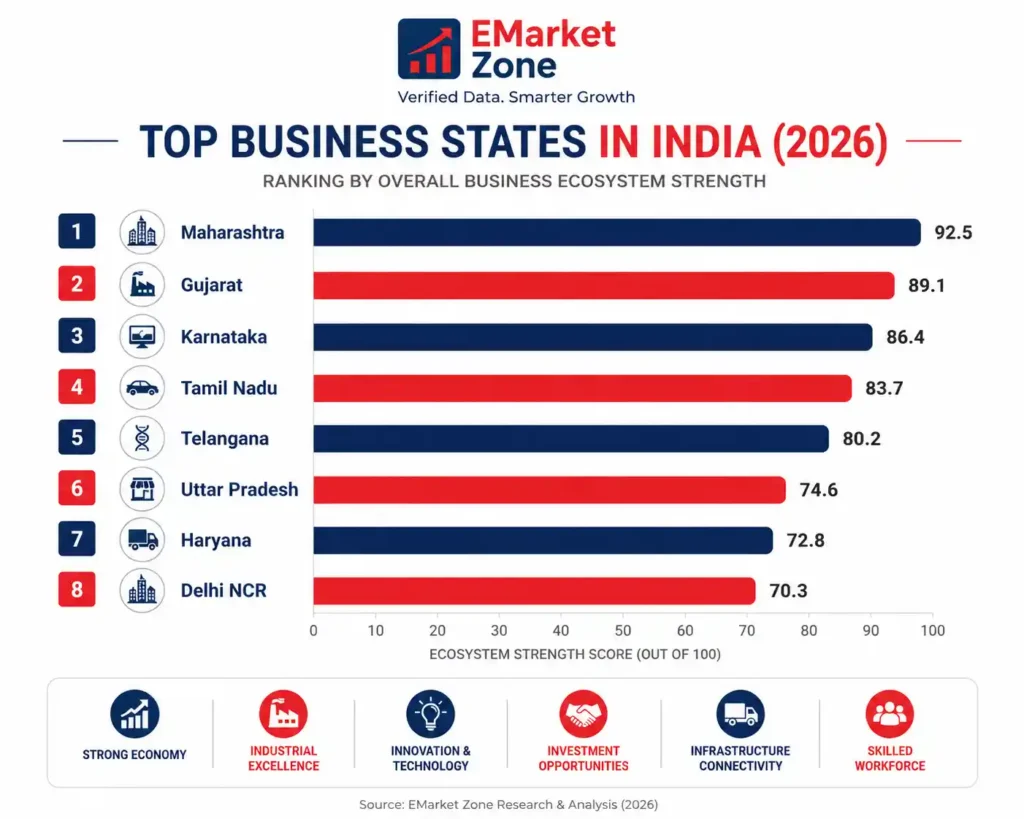
India's Leading Business States (2026)
| Rank | State | Primary Business Strength | Major Industries |
|---|---|---|---|
| 1 | Maharashtra | Finance & Corporate Headquarters | BFSI, Manufacturing, IT, Media |
| 2 | Gujarat | Manufacturing & Exports | Chemicals, Petrochemicals, Engineering, Textiles |
| 3 | Karnataka | Technology & Innovation | IT, SaaS, Electronics, Aerospace |
| 4 | Tamil Nadu | Manufacturing | Automobile, Electronics, Textiles |
| 5 | Telangana | Technology & Life Sciences | IT, Pharma, Biotechnology |
| 6 | Uttar Pradesh | MSMEs & Consumer Markets | Manufacturing, Food Processing, Retail |
| 7 | Haryana | Industrial & Logistics Hub | Automobile, Warehousing, Engineering |
| 8 | Delhi NCR | Services & Corporate Ecosystem | Consulting, Finance, IT, Real Estate |
Business Leads India
https://emarketzone.in/business-leads-india/
Business Ecosystem Comparison
| State | Manufacturing | Technology | Infrastructure | Investment | Business Environment |
|---|---|---|---|---|---|
| Maharashtra | ★★★★★ | ★★★★★ | ★★★★★ | ★★★★★ | ★★★★★ |
| Gujarat | ★★★★★ | ★★★★☆ | ★★★★★ | ★★★★★ | ★★★★★ |
| Karnataka | ★★★★☆ | ★★★★★ | ★★★★☆ | ★★★★★ | ★★★★★ |
| Tamil Nadu | ★★★★★ | ★★★★☆ | ★★★★★ | ★★★★☆ | ★★★★★ |
| Telangana | ★★★★☆ | ★★★★★ | ★★★★☆ | ★★★★★ | ★★★★☆ |
| Uttar Pradesh | ★★★★☆ | ★★★☆☆ | ★★★★☆ | ★★★★☆ | ★★★★☆ |
| Haryana | ★★★★☆ | ★★★★☆ | ★★★★★ | ★★★★☆ | ★★★★☆ |
| Delhi NCR | ★★★☆☆ | ★★★★★ | ★★★★★ | ★★★★★ | ★★★★★ |
Key Insights
• Maharashtra remains India’s financial and corporate capital, supported by Mumbai’s banking, financial services, ports, and corporate headquarters.
• Gujarat continues to dominate industrial production, exports, petrochemicals, and engineering, making it one of India’s strongest manufacturing states.
• Karnataka leads the country’s technology and startup ecosystem, with Bengaluru serving as a global innovation hub.
• Tamil Nadu has one of India’s most diversified manufacturing economies, particularly in automobiles, electronics, and textiles.
• Telangana has rapidly expanded its technology, pharmaceutical, and biotechnology sectors, supported by Hyderabad’s innovation ecosystem.
• Uttar Pradesh benefits from a large MSME base, expanding infrastructure, and a growing consumer market.
• Haryana plays a critical role in logistics, automobile manufacturing, and industrial development due to its proximity to Delhi NCR.
• Delhi NCR remains India’s largest corporate services ecosystem, attracting businesses in consulting, finance, technology, and real estate.
For state business statistics, check Top Business States in India
State-wise Business Analysis
India’s business landscape is shaped by a combination of industrial specialization, infrastructure development, workforce availability, government policies, and investment activity. While every state contributes to the national economy, a select group of states consistently leads across manufacturing, technology, finance, logistics, exports, and entrepreneurship.
The following analysis highlights the business strengths of India’s leading states in 2026 and explains why they continue to attract businesses, investors, and entrepreneurs.
Maharashtra – India's Financial & Corporate Capital
Maharashtra continues to be India’s most influential business state, supported by Mumbai’s position as the country’s financial capital. The state hosts the headquarters of numerous public and private sector companies, financial institutions, multinational corporations, and capital markets. Strong transportation infrastructure, major ports, industrial corridors, and a diversified economy enable Maharashtra to maintain leadership across multiple industries.
Key Business Strengths:
• Financial Services
• Banking & Insurance
• Manufacturing
• Media & Entertainment
• Logistics
• Corporate Headquarters
Explore Maharashtra B2B Database
Gujarat – Manufacturing & Export Powerhouse
Gujarat has built one of India’s strongest industrial ecosystems through large-scale manufacturing, export-oriented industries, petrochemicals, engineering, and textiles. The state’s extensive coastline, modern ports, industrial parks, and investor-friendly policies continue to attract domestic and international investment.
Key Business Strengths:
• Manufacturing
• Petrochemicals
• Chemicals
• Engineering
• Textiles
• Export Industries
Explore Gujarat B2B Database
Karnataka – Technology & Innovation Hub
Karnataka is widely recognized for its leadership in technology, innovation, software development, and startup entrepreneurship. Bengaluru serves as India’s largest technology ecosystem, attracting global technology companies, research institutions, venture capital, and skilled professionals.
Key Business Strengths:
• Information Technology
• Artificial Intelligence
• SaaS
• Electronics
• Aerospace
• Startup Ecosystem
Explore Karnataka B2B Database
Tamil Nadu – Industrial Manufacturing Leader
Tamil Nadu has developed one of India’s most diversified industrial economies, particularly in automobiles, electronics, heavy engineering, textiles, and renewable energy. Strong manufacturing clusters and excellent logistics infrastructure make the state a preferred destination for industrial investment.
Key Business Strengths:
• Automobile Manufacturing
• Electronics
• Engineering
• Textiles
• Renewable Energy
• Export Manufacturing
Explore Tamil Nadu B2B Database
Telangana – Fastest Growing Technology State
Telangana has emerged as one of India’s fastest-growing business destinations, driven by Hyderabad’s thriving IT sector, pharmaceutical industry, biotechnology ecosystem, and startup community. Continued investment in digital infrastructure and innovation has strengthened its position in high-value industries.
Key Business Strengths:
• Information Technology
• Pharmaceuticals
• Biotechnology
• Life Sciences
• Data Centers
• Startup Ecosystem
Explore Tamil Nadu B2B Database
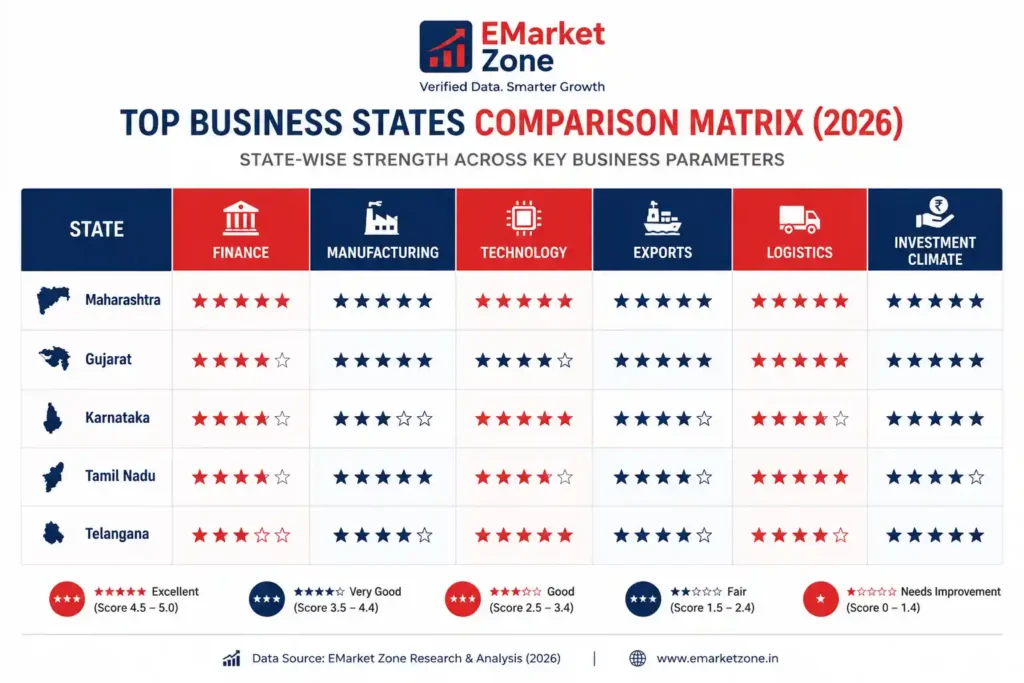
Business Strength Comparison
| State | Finance | Manufacturing | Technology | Logistics | Investment Climate |
|---|---|---|---|---|---|
| Maharashtra | ★★★★★ | ★★★★★ | ★★★★★ | ★★★★★ | ★★★★★ |
| Gujarat | ★★★★☆ | ★★★★★ | ★★★★☆ | ★★★★★ | ★★★★★ |
| Karnataka | ★★★★☆ | ★★★☆☆ | ★★★★★ | ★★★★☆ | ★★★★★ |
| Tamil Nadu | ★★★★☆ | ★★★★★ | ★★★★☆ | ★★★★★ | ★★★★☆ |
| Telangana | ★★★☆☆ | ★★★★☆ | ★★★★★ | ★★★★☆ | ★★★★★ |
Emerging Business States: The Next Growth Engines of India
While Maharashtra, Gujarat, Karnataka, Tamil Nadu, and Telangana continue to dominate India’s business landscape, several emerging states are rapidly strengthening their commercial ecosystems through infrastructure investment, industrial expansion, logistics development, and supportive government policies.
These states are attracting increasing attention from manufacturers, technology companies, exporters, startups, and investors seeking lower operating costs, expanding consumer markets, and long-term growth opportunities.
Uttar Pradesh – India's Largest Consumer & MSME Market
As India’s most populous state, Uttar Pradesh offers one of the country’s largest domestic markets and a rapidly expanding industrial base. Government initiatives, expressway development, industrial corridors, and improvements in logistics have strengthened the state’s attractiveness for manufacturing, warehousing, food processing, and MSMEs.
Major Industries:
• MSMEs
• Food Processing
• Electronics Manufacturing
• Textiles
• Retail & Wholesale
• Logistics
Business Advantages:
• Large consumer market
• Extensive MSME ecosystem
• Growing industrial corridors
• Improving logistics infrastructure
Explore Uttar Pradesh B2B Database
Haryana – Manufacturing & Logistics Hub
Located adjacent to Delhi NCR, Haryana has developed into one of India’s strongest industrial and logistics destinations. The state benefits from excellent road connectivity, industrial parks, automobile manufacturing, warehousing, and proximity to major corporate headquarters.
Major Industries:
• Automobile
• Engineering
• Warehousing
• Logistics
• Industrial Manufacturing
• Real Estate
Business Advantages:
• Delhi NCR connectivity
• Excellent highway infrastructure
• Industrial clusters
• Strong supply chain network
Explore Haryana B2B Database
Rajasthan – Renewable Energy & Industrial Growth
Rajasthan has emerged as a significant destination for renewable energy, mining, cement, and industrial manufacturing. Large-scale solar energy investments and industrial corridor projects continue to strengthen its long-term growth prospects.
Major Industries:
• Renewable Energy
• Mining
• Cement
• Engineering
• Tourism
• Textiles
Explore Rajasthan B2B Database
Andhra Pradesh – Ports & Export-Oriented Industries
With one of India’s longest coastlines, Andhra Pradesh plays a vital role in maritime trade and export-oriented manufacturing. Ports, industrial corridors, food processing, pharmaceuticals, and electronics manufacturing continue to attract investment across the state.
Major Industries:
• Ports & Shipping
• Food Processing
• Pharmaceuticals
• Electronics
• Logistics
• Petrochemicals
Explore Andhra Pradesh B2B Database
Kerala – Services & Knowledge Economy
Kerala has built a service-driven economy supported by healthcare, tourism, education, IT services, and a skilled workforce. The state also benefits from strong international connectivity and a globally connected business community.
Major Industries:
• Healthcare
• Tourism
• Information Technology
• Education
• Food Processing
• Logistics
Explore Kerala B2B Database
Emerging State Comparison
| State | Key Growth Driver | High-Potential Industries | Investment Outlook |
|---|---|---|---|
| Uttar Pradesh | Consumer Market | MSMEs, Electronics, Logistics | High |
| Haryana | NCR Connectivity | Automobile, Warehousing | High |
| Rajasthan | Renewable Energy | Solar, Mining, Manufacturing | High |
| Andhra Pradesh | Ports & Exports | Logistics, Pharma, Electronics | High |
| Kerala | Services Economy | Healthcare, IT, Tourism | Moderate to High |
Key Insight
India’s future business growth will increasingly be driven by emerging states that combine infrastructure development, industrial diversification, and supportive investment policies. These regions offer attractive opportunities for businesses seeking expansion beyond traditional commercial hubs.
Choosing the Right State for Business Expansion
Selecting the right state is one of the most important strategic decisions for any business planning expansion in India. While market size is often a primary consideration, successful expansion depends on aligning business objectives with each state’s industrial strengths, infrastructure, workforce availability, regulatory environment, and customer demand.
Rather than targeting every region, organizations should prioritize states where their products or services have the highest potential for long-term growth. Manufacturing businesses may benefit from established industrial ecosystems, while technology companies often require access to skilled talent, innovation hubs, and digital infrastructure. Similarly, logistics, retail, healthcare, and export-oriented businesses each have different location requirements.
Businesses should evaluate multiple factors before entering a new market, including transportation connectivity, availability of suppliers, labor costs, industrial clusters, government incentives, and overall ease of doing business. A data-driven approach reduces expansion risk and improves long-term commercial success.
Recommended States by Industry
| Industry | Recommended States |
|---|---|
| Manufacturing | Gujarat, Tamil Nadu, Maharashtra |
| Information Technology | Karnataka, Telangana, Delhi NCR |
| Automobile | Tamil Nadu, Haryana, Maharashtra |
| Pharmaceuticals | Telangana, Gujarat |
| Logistics & Warehousing | Haryana, Uttar Pradesh, Maharashtra |
| Food Processing | Uttar Pradesh, Andhra Pradesh |
| Textiles & Apparel | Gujarat, Tamil Nadu, Rajasthan |
| Renewable Energy | Rajasthan, Gujarat, Tamil Nadu |
| Financial Services | Maharashtra, Delhi NCR |
| Export Businesses | Gujarat, Maharashtra, Andhra Pradesh |
State Selection Framework
Before expanding into a new state, organizations should evaluate the following strategic factors:
| Evaluation Factor | Why It Matters |
|---|---|
| Market Size | Determines customer potential and demand. |
| Industry Ecosystem | Provides access to suppliers, partners, and skilled talent. |
| Infrastructure | Improves transportation, logistics, and operational efficiency. |
| Investment Climate | Supports faster business setup and long-term growth. |
| Workforce Availability | Ensures access to qualified professionals and technical talent. |
| Connectivity | Reduces supply chain costs and improves market access. |
Key Recommendations
For Manufacturers
Prioritize states with strong industrial corridors, reliable infrastructure, and access to ports or freight networks.
For Technology Companies
Focus on innovation-driven ecosystems offering skilled professionals, startup communities, and advanced digital infrastructure.
For Service Businesses
Select states with large urban populations, strong corporate presence, and expanding commercial activity.
For Export-Oriented Businesses
Consider coastal states with well-developed ports, logistics networks, and export-focused industrial zones.
Strategic Takeaway
There is no single “best” business state in India. The ideal location depends on industry requirements, customer markets, infrastructure needs, talent availability, and long-term growth strategy. Organizations that align expansion decisions with state-specific strengths are more likely to achieve sustainable business success.
Conclusion
India’s business landscape in 2026 reflects a rapidly evolving economy supported by industrial diversification, digital transformation, infrastructure development, and increasing formalization. While Maharashtra, Gujarat, Karnataka, Tamil Nadu, and Telangana continue to lead the country’s business ecosystem, emerging states such as Uttar Pradesh, Haryana, Rajasthan, Andhra Pradesh, and Kerala are creating new opportunities across manufacturing, technology, logistics, renewable energy, healthcare, and services.
Each state offers distinct competitive advantages, making strategic location selection critical for businesses planning expansion or investment. Organizations that align their industry requirements with regional strengths, supported by reliable market intelligence and business data, will be better positioned to reduce risk and capture long-term growth opportunities.
As India’s economy continues to expand, understanding state-wise business ecosystems will become increasingly important for entrepreneurs, investors, consultants, sales teams, and business decision-makers. A data-driven approach to market selection enables organizations to identify high-potential regions, strengthen customer acquisition strategies, and build sustainable competitive advantages.
Key Takeaways
✔ Maharashtra remains India’s strongest overall business ecosystem.
✔ Gujarat continues to lead manufacturing and export-oriented industries.
✔ Karnataka dominates technology, innovation, and startup activity.
✔ Tamil Nadu remains one of India’s largest industrial manufacturing hubs.
✔ Telangana continues to attract investments in IT, pharmaceuticals, and life sciences.
✔ Uttar Pradesh, Haryana, Rajasthan, Andhra Pradesh, and Kerala represent the next wave of business growth.
✔ Businesses should evaluate market potential, infrastructure, workforce availability, and industry clusters before expanding into a new state.
Related Research
Continue exploring EMarket Zone’s research and business intelligence resources:
Explore Business Data
Reliable market expansion starts with reliable data.
EMarket Zone provides verified business databases covering:
• MSME Businesses
• Private Limited Companies
• Manufacturers
• GST Registered Businesses
• Exporters
• Industry-wise Databases
• State-wise Business Databases
• City-wise Business Databases
Whether you’re planning sales outreach, market expansion, competitive analysis, or investment research, our business intelligence solutions help you connect with the right businesses across India.
FAQs
There is no single best state for every business. Maharashtra leads in finance and corporate activity, Gujarat excels in manufacturing, Karnataka dominates technology, while Tamil Nadu and Telangana are strong in industrial and innovation-driven sectors.
Gujarat and Tamil Nadu are among India’s strongest manufacturing states, supported by industrial corridors, ports, engineering clusters, and export infrastructure.
Karnataka, particularly Bengaluru, remains India’s leading technology hub, followed by Telangana with Hyderabad’s growing IT and life sciences ecosystem.
Uttar Pradesh, due to its large population and expanding economy, offers one of India’s largest consumer markets and a significant MSME base.
Businesses should evaluate market demand, industry clusters, infrastructure, logistics, workforce availability, regulatory environment, and long-term investment potential before selecting a state.
EMarket Zone offers verified business databases covering companies, MSMEs, manufacturers, GST-registered businesses, and industry-specific segments across states and cities in India.
References
This article is based on publicly available information and industry research, including:
• Ministry of Corporate Affairs (MCA)
• Ministry of MSME
• Department for Promotion of Industry and Internal Trade (DPIIT)
• Reserve Bank of India (RBI)
• Ministry of Commerce & Industry
• National Statistical Office (NSO)
• Economic Survey of India
• Government of India Open Data Platform
• EMarket Zone Research & Analysis (2026)
Leave a comment