
Finding newly registered GST businesses in India can help companies research emerging markets, identify potential B2B accounts and understand changes in the registered business landscape. For suppliers, distributors, software providers, financial-service companies and B2B marketers, recent registration information can provide a useful starting point for prospecting.
However, finding a GST registration and building a usable business prospect list are two different tasks. The official GST portal is designed primarily for registration, compliance and taxpayer verification. Aggregate GST statistics help researchers understand registration trends, while business-level datasets serve a different purpose by organising information for market research and prospect identification.
This guide explains how to research newly registered GST businesses, what official sources can tell you, how to assess data quality and how to turn geographic and business information into a more focused B2B prospecting process.
1. What Are Newly Registered GST Businesses?
A newly registered GST business is commonly understood as a business that has recently obtained registration under India’s Goods and Services Tax system.
The term needs some care, however. A new GST registration does not necessarily mean a newly incorporated company or a business that has just started operating. An existing business may register because its circumstances change or because it becomes liable to register. Registration requirements also depend on the nature of the business and the applicable GST provisions.
A GST registration is therefore best treated as a tax-registration event, not definitive proof of a newly created business.
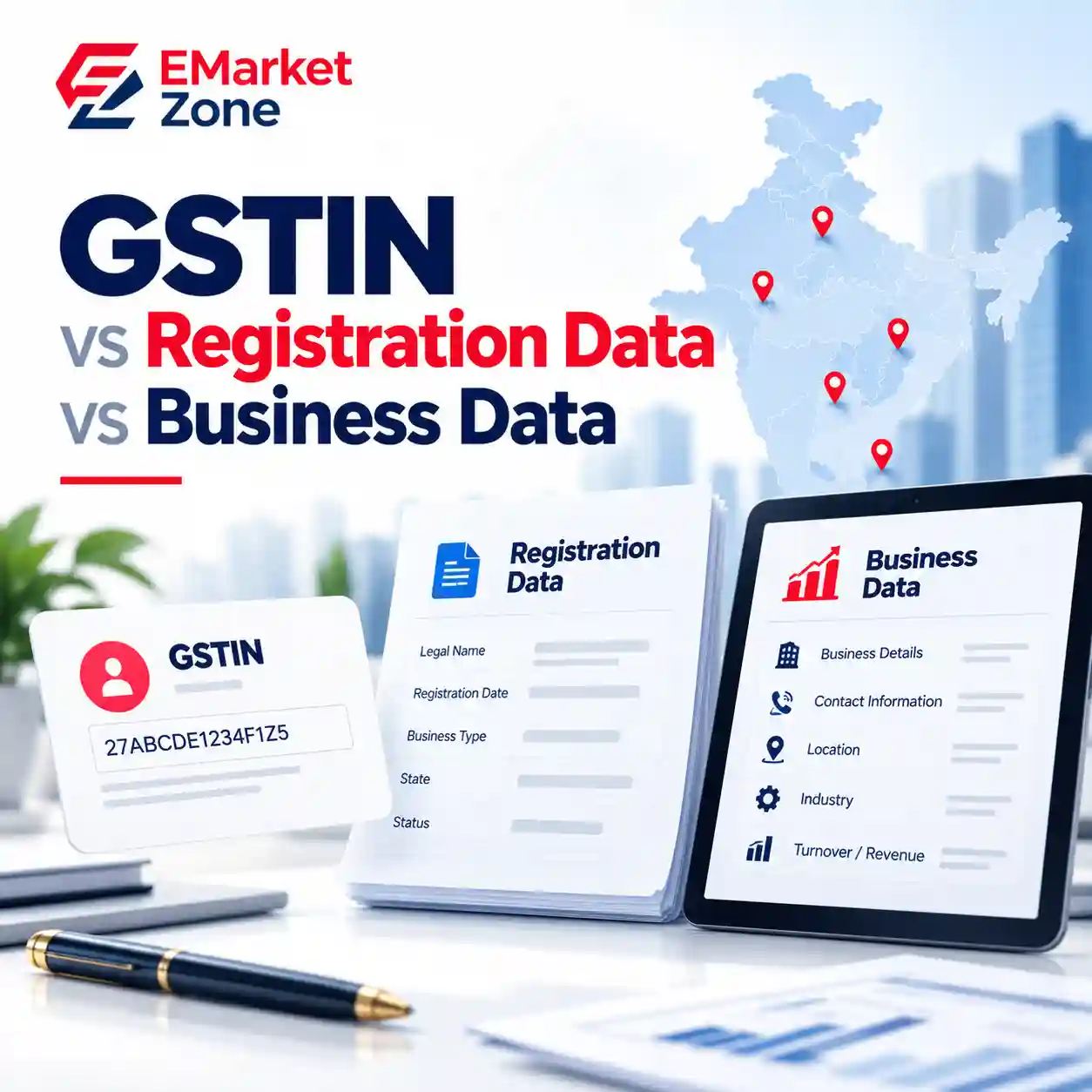
For market research, it is useful to distinguish between three concepts:
| Term | What it means | What it does not automatically prove |
|---|---|---|
| New GST registration | A registration event during a defined period | That a completely new company was established |
| Registered taxpayer | A taxpayer recorded in the GST system | That the business is currently commercially active |
| Potential B2B prospect | A business that may fit a company’s target customer profile | That the business is interested in buying |
These distinctions matter when using registration information for sales, market expansion or lead-generation planning.
2. How to Find and Verify GST Registration Details Officially
The official GST portal is the primary starting point for checking the details of a known GST taxpayer.
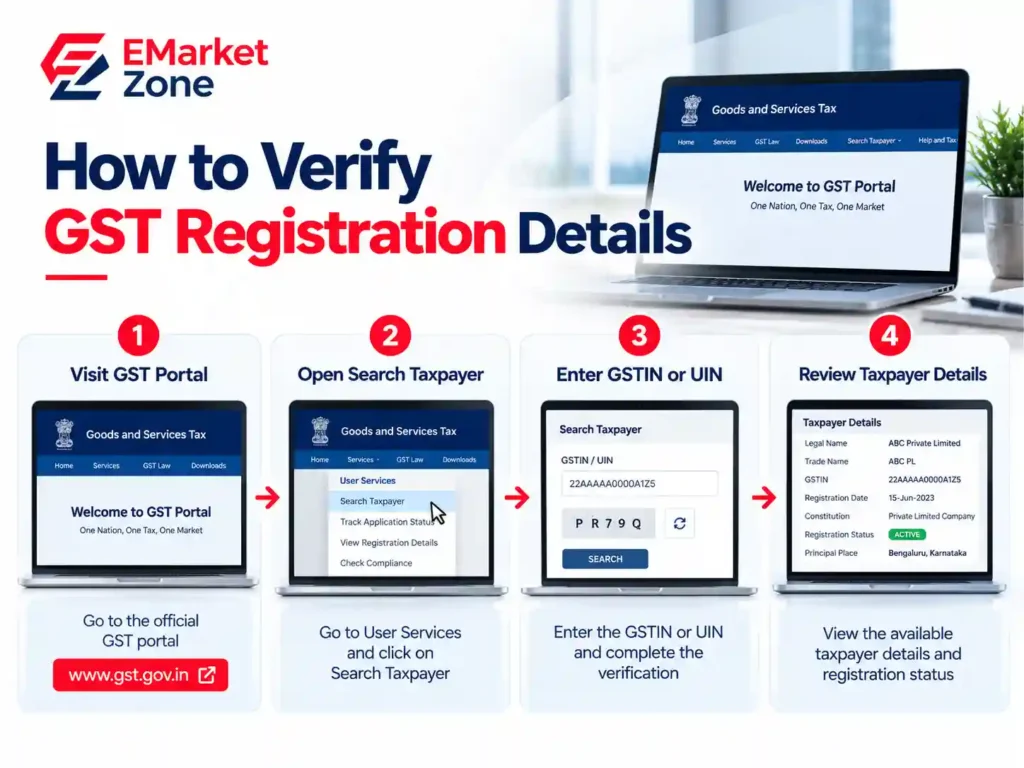
Step 1: Visit the official GST portal
Open the GST Portal.
The portal provides taxpayer services, registration facilities and access to GST-related information.
Step 2: Open Search Taxpayer
Use the taxpayer search facility to look up a known GSTIN or UIN. The GST portal’s official user guide explains how to search for a taxpayer’s details.
Official guide: Search Taxpayer – GST Portal User Manual.
Step 3: Enter the GSTIN or UIN
Enter the identifier for the taxpayer you want to check and complete the verification requested by the portal.
The official guide explains that taxpayer details can be viewed without logging in, subject to the information made available in the pre-login search.
Step 4: Review the available details
Depending on the access available, the portal can display information such as:
• Legal name of the business
• Trade name, where available
• Effective date of registration
• Constitution of business
• Principal place of business
• Registration status
• Cancellation date, if applicable
• Return-filing information available through the portal
The information shown depends on the type of search and the taxpayer record.
Important limitation: This process is designed to verify an identified taxpayer. It is not, by itself, a nationwide search tool that generates a downloadable list of every business registered during a chosen date range.
That distinction is important for anyone researching newly registered GST businesses at scale.
3. Can You Find Newly Registered GST Businesses Through Public Statistics?
Yes, public GST statistics can help you understand registration activity, but aggregate statistics and individual business records serve different purposes.
The Goods and Services Tax Network (GSTN) publishes statistical reports that include taxpayer-related information. Its report 7 Years of GST contains a state-wise table of migrated and new taxpayers for FY 2023–24.
The report records 64,89,906 new taxpayers nationally in the table for that financial year. It also provides state-level figures, including:
• Uttar Pradesh: 8,57,609
• Maharashtra: 8,28,677
• Gujarat: 5,39,568
• Tamil Nadu: 5,31,361
• Karnataka: 4,59,748
Source: GSTN – 7 Years of GST Statistical Report.
These figures are useful for comparing the geographic distribution of the measure reported by GSTN. They do not provide a complete list of individual newly registered businesses.
There is also an important qualification in the report: the relevant taxpayer counts are based on taxpayers who paid tax in cash and exclude those who filed nil returns or paid their full liability through input tax credit. The figures should therefore be interpreted according to the report’s stated methodology, rather than as an unrestricted count of every GST registration event.
For additional analysis of these figures, read EMarket Zone’s New GST Registrations in India 2026 research report.
The report examines registration trends, state-level distribution and the implications for geographic B2B market research.
4. Where to Find Newly Registered GST Business Data in India
If your objective is to identify businesses for prospecting rather than simply verify an individual GSTIN, you need to consider the difference between public verification tools and structured business data.
The official GST portal helps users check identified taxpayer records. Published GSTN reports help researchers understand aggregate trends. Neither should be confused with a dedicated business list organised for a particular prospecting requirement.
EMarket Zone provides a dedicated resource for companies researching newly registered GST businesses.
Explore Newly Registered GST Business Data in India →
This page is relevant for businesses looking for GST-focused business data to support market research, prospect identification and B2B lead-generation activities.
Before selecting any dataset, check its stated coverage, reference period, available fields, update frequency and intended use. Confirm whether the data supports your specific need—for example, researching recent registrations, identifying businesses in a particular location or building a target list for a defined industry.
Do not assume that every dataset marketed as “newly registered” uses the same date definition or coverage. Ask how recency is determined and how records are maintained.
5. How to Narrow Newly Registered GST Business Data by Geography
A national business list may be too broad for a company that sells in specific territories. Geographic segmentation can help turn a large business universe into a more manageable research and prospecting plan.
A practical framework is:
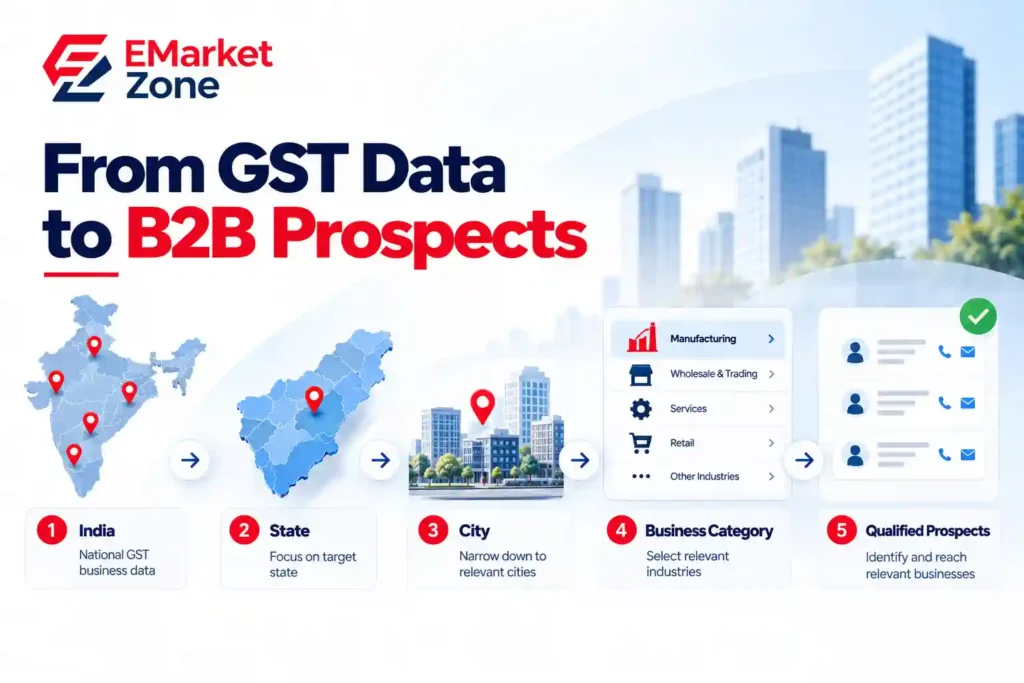
India → State → City → Relevant business segment → Prospect
State-wise targeting
State-level segmentation is useful when deciding which geographic markets to prioritise.
For example, a company expanding its distribution network may first compare states using market research, customer demand, existing sales coverage and the type of businesses it serves.
Explore State-wise GST Business Data for the state-level resource.
City-wise targeting
A state may contain several distinct commercial markets. Narrowing the research to relevant cities can make prospecting more manageable and align the target list with sales territories or service coverage.
Explore City-wise GST Business Data for city-level segmentation.
National research
Companies comparing multiple markets or building a broader prospecting strategy can also explore GST Database India.
The appropriate resource depends on the intended coverage. A nationwide search, a state-specific campaign and a city-level sales initiative are different requirements and should be planned accordingly.
6. How to Evaluate Newly Registered GST Business Data
The usefulness of a business list depends on more than its record count. Before using a dataset, evaluate the following factors.
Recency and reference period
Establish what “newly registered” means in the dataset. Does the date refer to the effective registration date, the date a record was collected or the date the dataset was updated?
These dates are not interchangeable.
Geographic coverage
Confirm whether the data covers India nationally, selected states, particular cities or only a subset of locations. Check how locations are assigned and whether the dataset includes the geographic fields needed for your use case.
Business attributes
Review which fields are included and whether they support your intended segmentation. Do not assume that every dataset includes the same contact information, industry classifications or business details.
Record quality
Ask how duplicates, missing fields, inconsistent names and outdated records are handled. If GSTINs are included and verification is permitted, use the official portal to check relevant taxpayer details.
Active status and commercial relevance
A valid or historical registration does not automatically mean that a business is active, has purchasing capacity or is interested in your product.
Where possible, apply additional qualification criteria before treating a record as a sales prospect.
Appropriate use
Before conducting outreach, ensure that the collection and use of business information comply with applicable law, platform rules and the relevant channel’s requirements. Use contact information responsibly and respect opt-out requests where applicable.
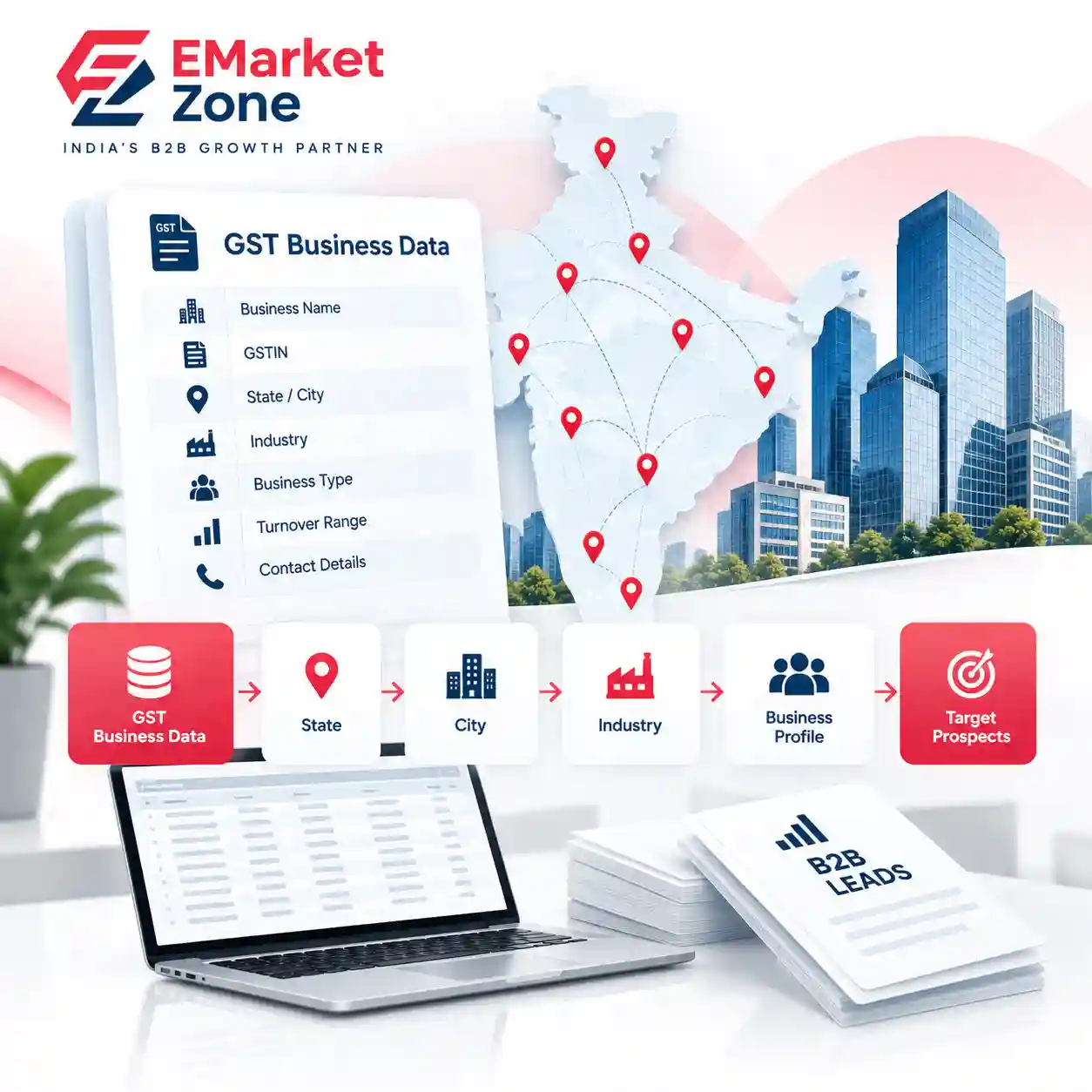
7. How to Turn Business Data into a B2B Prospecting Workflow
Once you have selected an appropriate dataset, use a structured process rather than contacting every record indiscriminately.
1. Define your target customer. Establish the industries, locations and business characteristics relevant to your offering.
2. Select the geographic market. Choose India-wide, state-wise or city-wise coverage according to your sales strategy.
3. Identify relevant businesses. Use the available fields to narrow the business universe to records that fit your criteria.
4. Check data quality. Review recency, duplicate records, missing fields and any verification requirements.
5. Qualify potential accounts. Apply your ideal customer profile and additional business-relevance criteria.
6. Plan appropriate outreach. Choose a suitable sales or marketing channel and use relevant, compliant messaging.
7. Measure results. Track qualified accounts, responses, conversions and data-quality issues so that future targeting can improve.
This process helps separate the identification of registered businesses from the qualification of actual prospects.
Frequently Asked Questions
How can I find newly registered GST businesses in India?
Start with official GSTN statistics for aggregate trends and use the GST portal’s Search Taxpayer facility to verify a known GSTIN or UIN. If your objective is to identify businesses for prospecting, assess a suitable business-data resource and verify its coverage and definition of “newly registered.”
Can I download all newly registered GST businesses from the official GST portal?
The official taxpayer search guide describes searching for a known GSTIN or UIN and reviewing the available taxpayer details. It does not describe a public facility for downloading every newly registered GST business in India as a single nationwide list.
Where can I find state-wise GST registration statistics?
GSTN’s 7 Years of GST report provides state-wise new-taxpayer figures for FY 2023–24. The counts should be interpreted using the report’s definitions and footnotes.
Is a newly registered GST business necessarily a new company?
No. A GST registration event does not necessarily correspond to the incorporation or creation of a new company. Existing businesses may also obtain registrations when required by their circumstances.
Does a GST registration prove that a business is active?
Not by itself. The registration record and its current status should be checked, and additional evidence may be required to assess whether the business is operating and relevant to a particular commercial offering.
Where can I explore newly registered GST business data for B2B prospecting?
Visit Newly Registered GST Business Database India to explore EMarket Zone’s dedicated resource.
Conclusion
Finding newly registered GST businesses requires a clear understanding of what each source provides. Official GST tools help verify known taxpayer records, while GSTN statistical publications provide aggregate information about registration activity. Business-level data can support a different task: identifying and segmenting potential accounts for further evaluation.
For B2B companies, the practical objective is not simply to collect the largest number of records. It is to identify relevant businesses, understand their geographic and business characteristics, assess data quality and qualify prospects before outreach.
Explore Newly Registered GST Business Data in India to learn more about EMarket Zone’s dedicated resource for this use case.
Sources and References
• Goods and Services Tax Portal, Government of India. Official taxpayer services and GST information. https://www.gst.gov.in/
• GST Portal User Guide. “Search Taxpayer using GSTIN/UIN.” Explains the official taxpayer lookup process and the information available through it. https://tutorial.gst.gov.in/userguide/taxpayersdashboard/Search_Taxpayer_manual.htm
• Goods and Services Tax Network (GSTN). 7 Years of GST: A Statistical Report on Completion of 7 Years of GST. Includes the state-wise migrated and new-taxpayer table for FY 2023–24 and its methodology note. https://tutorial.gst.gov.in/offlineutilities/gst_statistics/7YearsReport.pdf
• Central Board of Indirect Taxes and Customs (CBIC). GST registration rules. https://cbic-gst.gov.in/gst-registration-rules.html
• EMarket Zone. New GST Registrations in India 2026: State, Industry & Emerging Business Trends. https://emarketzone.in/new-gst-registrations-in-india/
Research note: Public statistics and taxpayer lookup tools serve different purposes. The GSTN figures quoted above refer to the measure and reporting period stated in the source; they should not be interpreted as a complete census of newly incorporated businesses or qualified B2B prospects.
Leave a comment