
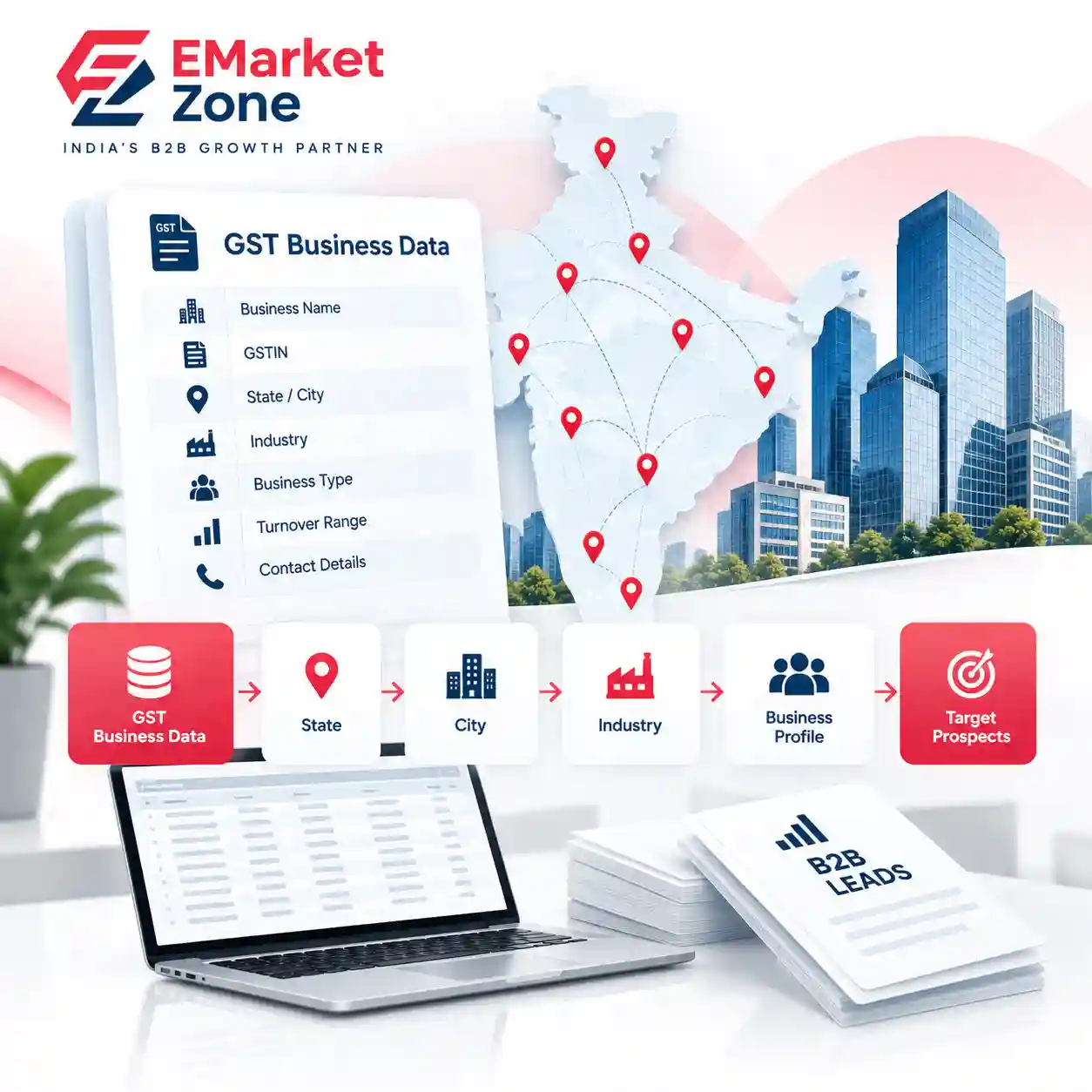
B2B lead generation becomes inefficient when businesses approach too many companies without first deciding which businesses are actually relevant to their product or service.
A large database does not automatically create a strong sales pipeline. The real advantage comes from turning a broad business universe into a focused prospecting list based on factors such as location, industry, business type and other relevant company characteristics.
This is where a GST database can become useful for B2B lead generation.
GST registration is associated with business information such as the legal name, state, district, principal place of business and details relating to the goods or services supplied. The official GST registration process also captures business and location information through different registration fields.
For a sales or marketing team, however, the objective is not simply to collect GST numbers. The objective is to identify businesses that could potentially fit the company’s ideal customer profile, segment them, prioritize them and then approach them through an appropriate sales process.
This article explains how to use GST business data as part of a more structured B2B lead-generation strategy.
What Makes a GST Database Useful for B2B Lead Generation?
The biggest mistake businesses make with databases is treating every record as a lead.
A database is better understood as a prospect universe.
Your actual lead-generation process looks more like this:
Business Data → Segmentation → Targeting → Qualification → Outreach → Response → Sales Opportunity
That distinction matters.
For example, a company selling accounting software may not want to contact every business in India. Its potential market could be narrowed to particular business categories, locations or company profiles.
Similarly, an industrial supplier may be interested primarily in manufacturers within selected states or cities.
The database provides the starting universe. Targeting and qualification determine which businesses deserve attention.
If you want to start with a broader Indian business dataset, you can explore the GST Database India from EMarket Zone, which is positioned for B2B sales, marketing and lead-generation use cases.
1. Start With Your Ideal Customer Profile
Before filtering a GST database, define who you actually want to sell to.
This is the step most companies skip.
Suppose you sell:
• CRM software
• Industrial machinery
• Packaging products
• Business loans
• Insurance services
• Accounting software
• Logistics services
• Digital marketing
• HR software
• Professional services
Your ideal customer will not be “all GST-registered businesses.”
Instead, you may have criteria such as:
Industry: Manufacturing
Location: Gujarat
Business type: Relevant manufacturers
Market: B2B
Company characteristics: Businesses that fit your commercial offering
That gives your sales team a much clearer prospecting universe.
The more precisely you define the customer profile before extracting or selecting prospects, the less time your team spends dealing with irrelevant businesses.
2. Segment the GST Database Before Starting Outreach
A large contact list becomes much more useful when it is divided into smaller, meaningful segments.
For example:
| Segmentation | Example |
|---|---|
| Country | India |
| State | Gujarat |
| City | Ahmedabad |
| Industry | Manufacturing |
| Business type | Manufacturer |
| Revenue/business characteristic | Selected range |
| Target market | B2B |
This approach allows a company to move from:
“Find businesses in India”
to:
“Find businesses in Ahmedabad that match our target industry and customer profile.”
That is a much more practical starting point for B2B prospecting.
Professional CRM platforms also use segmentation to group records according to characteristics and criteria so businesses can create more targeted workflows and messaging.
For example, HubSpot’s segmentation documentation explains how records can be grouped using defined criteria, while Salesforce’s B2B marketing guide discusses segmentation based on characteristics such as company size, company type and buyer stage.
The same principle can be applied earlier in the prospecting process: segment the business universe before asking your sales team to work it.
3. Use Geography to Build Targeted B2B Markets
Geography can be one of the most useful filters for companies that sell regionally.
A company may not have the resources to approach businesses across the entire country at once.
Instead, it can create a market expansion sequence:
India → State → City → Business Segment → Prospect
For example:
India → Karnataka → Bengaluru → Target Industry → Potential Businesses
or:
India → Gujarat → Ahmedabad → Manufacturing → Potential Businesses
This creates a territory-based prospecting strategy.
Instead of giving a salesperson thousands of unrelated records, the business can assign a defined market segment.
EMarket Zone also provides state-focused GST business datasets. For example, the Rajasthan GST business contact database is structured around businesses in Rajasthan for targeted B2B outreach and sales prospecting.
Similarly, businesses targeting larger regional markets can use datasets such as the Karnataka GST business contact database or the Delhi NCR GST business contact database.
This is particularly useful when the sales strategy is organized around territories rather than one nationwide campaign.
4. Segment by Industry Instead of Contacting Everyone
Geography alone is not enough.
Imagine a company selling industrial automation equipment.
Its sales team might be interested in manufacturers, factories or other relevant industrial businesses.
Sending the same offer to retailers, professional-service firms and unrelated businesses creates unnecessary outreach.
A better approach is:
Location + Industry + Business Profile
For example:
Maharashtra + Manufacturing + Relevant Business Segment
or:
Ahmedabad + Manufacturing + Target Business Type
This allows the marketing team to create different messaging for different prospect groups.
Example
A software company could divide its prospecting universe into:
Segment A: Manufacturing businesses
Segment B: Wholesale businesses
Segment C: Retail businesses
Segment D: Professional services
Each segment can then receive messaging based on its likely business needs.
The goal isn’t simply to increase the number of contacts reached.
The goal is to increase the relevance of the businesses being approached.
5. Build Different Prospect Lists for Different Offers
One database does not have to produce one campaign.
It can produce several targeted prospect lists.
For example, a company selling business software could create:
Campaign 1 – Manufacturers
Target:
Manufacturing + selected states + selected company characteristics
Campaign 2 – Wholesalers
Target:
Wholesale + selected cities + relevant business characteristics
Campaign 3 – Retail Businesses
Target:
Retail + selected locations
Campaign 4 – New Market Expansion
Target:
Businesses in a new state or city
This approach allows the same underlying business data to support multiple campaigns without sending identical messaging to everyone.
6. Use the Database to Support Account-Based Prospecting
For higher-value B2B products, a company may not want thousands of prospects.
It may want a smaller number of highly relevant accounts.
The process could look like this:
1. Define target market
↓
2. Identify relevant businesses
↓
3. Segment businesses
↓
4. Select priority accounts
↓
5. Research the company
↓
6. Identify relevant decision-makers
↓
7. Create personalized outreach
↓
8. Track responses
This is closer to account-based prospecting than mass lead generation.
The GST database helps with the business identification stage. Additional research and qualification should happen before a company treats an account as a high-priority sales opportunity.
7. Combine GST Business Data With Your Existing Lead-Generation Channels
A GST database should not replace your entire marketing strategy.
It can work alongside:
• Search engine optimization
• Google Ads
• LinkedIn prospecting
• Email marketing
• Sales calling
• Referral campaigns
• Content marketing
• Account-based marketing
• CRM workflows
For example:
SEO generates inbound interest
GST business data identifies relevant outbound prospects
CRM tracks interactions
Sales outreach converts qualified opportunities
This creates a more balanced B2B acquisition system.
8. Don't Confuse a Business Record With a Qualified Lead
This is one of the most important points in the entire strategy.
A GST business record is not automatically a qualified lead.
A business becomes more commercially relevant when it matches criteria such as:
• Your target industry
• Your target geography
• Your product/service requirements
• Your company profile
• Your potential need
• Your buying potential
• Your sales qualification criteria
So the process should be:
Database Record
→ Target Match
→ Qualified Prospect
→ Sales Conversation
→ Opportunity
→ Customer
This prevents businesses from measuring success simply by the number of contacts in a database.
9. Build Location-Specific Prospecting Campaigns
Location-based campaigns are particularly useful for companies expanding into new markets.
Suppose a business currently sells primarily in Delhi NCR and wants to expand into Rajasthan.
Instead of launching a nationwide campaign, it could create a Rajasthan-specific prospecting list.
The workflow could be:
Rajasthan
→ relevant cities
→ relevant industries
→ relevant businesses
→ prospect qualification
→ sales outreach
→ response tracking
This is where state and city-level business data becomes commercially useful.
EMarket Zone’s database catalogue includes state-wise GST business datasets alongside broader B2B databases, allowing businesses to work with geographic segments rather than relying only on a nationwide list.
You can view the available database categories through the EMarket Zone database collection.
10. Create a Prospecting Workflow Instead of Simply Buying Data
Buying a database is only the beginning.
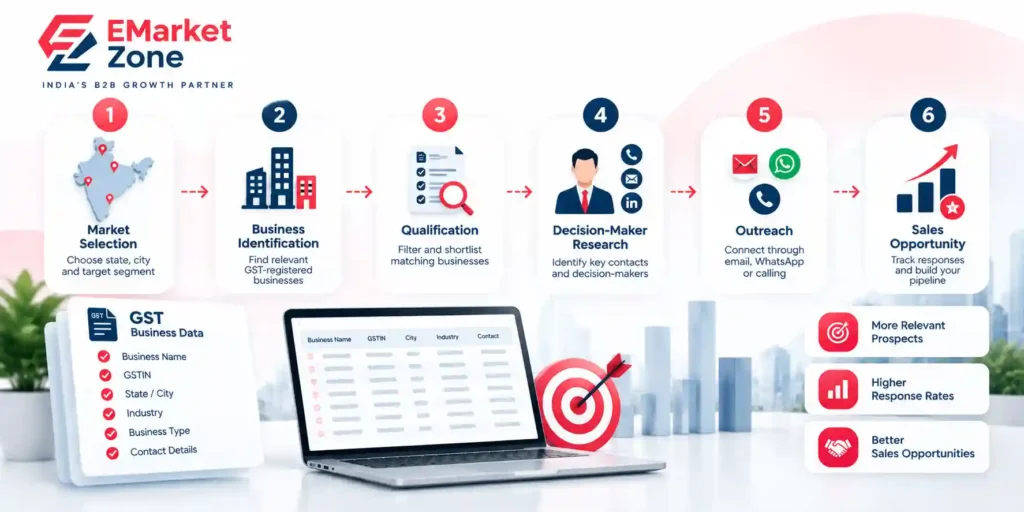
A stronger process is:
Step 1 – Define the market
Who are you trying to reach?
Step 2 – Select the data
Choose the relevant geography, industry and business segment.
Step 3 – Segment
Break the dataset into manageable prospect groups.
Step 4 – Prioritize
Identify which segments deserve the most sales attention.
Step 5 – Qualify
Check whether the business actually fits your customer profile.
Step 6 – Outreach
Use the appropriate communication channel and message.
Step 7 – Track
Record responses, conversations and opportunities in your CRM.
Step 8 – Improve
Measure which segments generate meaningful conversations and refine future campaigns.
This turns a database into a repeatable prospecting system.
11. Why Data Segmentation Matters More Than Database Size
A common mistake in B2B marketing is focusing on the number of contacts.
For example:
1,000,000 broad contacts
may sound more impressive than:
50,000 highly relevant prospects
But the first number doesn’t tell you how many businesses actually fit your customer profile.
A useful database should therefore be evaluated based on:
• Relevant coverage
• Geographic coverage
• Industry coverage
• Available business fields
• Data usability
• Segmentation options
• Data freshness
• Qualification requirements
The question should not be:
“How many contacts do we have?”
It should be:
“How many businesses in this dataset actually match our target market?”
That is a much more useful B2B metric.
12. How EMarket Zone's GST Database Fits Into This Process
EMarket Zone’s GST business database is positioned for businesses that want to reach GST-registered businesses for B2B marketing, sales outreach and lead generation. The current India database page describes coverage across India and highlights business information, location and segmentation use cases.
For businesses that want a ready-to-use business contact dataset, the GST Business Contacts database provides a broader India-focused dataset intended for structured B2B outreach and includes segmentation by industry and location.
The practical workflow is therefore:
Choose the market
→ Choose the relevant business segment
→ Get the appropriate GST business data
→ Segment the prospects
→ Qualify the businesses
→ Start targeted outreach
→ Track sales opportunities
The database is the starting point, not the entire sales process.
13. Use Compliance-Conscious Outreach
Having business contact information does not mean every possible outreach method is automatically appropriate.
Businesses should consider the rules applicable to their communication channel, recipient type and campaign.
For example, India’s Telecom Regulatory Authority of India provides specific guidance concerning commercial communications, including sender registration, headers, content templates and consent requirements for regulated commercial communications.
Before running large-scale SMS or calling campaigns, businesses should review the applicable requirements through TRAI’s official guidance for commercial communication rather than assuming that having a phone number makes unrestricted promotional outreach permissible.
This is also why targeted prospecting is different from indiscriminate bulk messaging.
The objective should be to identify relevant businesses and conduct appropriate, compliant business outreach—not simply send the same promotion to the largest possible list.
14. Example: Turning GST Business Data Into a Targeted Campaign
Consider a company that sells accounting software to small and medium-sized businesses.
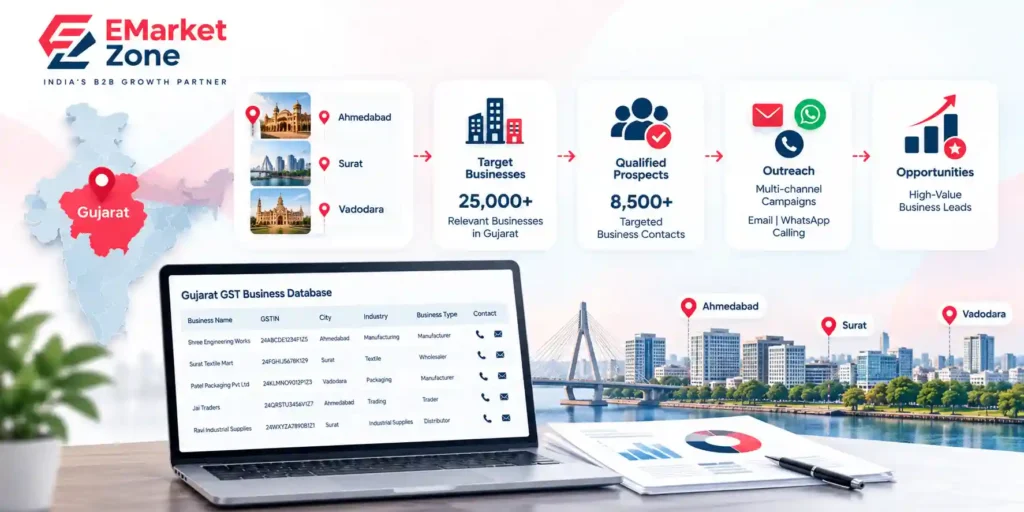
Instead of purchasing a broad list and contacting everyone, it could create a campaign like this:
Market: Gujarat
Target cities: Ahmedabad, Surat, Vadodara
Target segment: Businesses relevant to the software offering
Prospecting stage: Identify businesses matching the selected criteria
Qualification: Remove businesses outside the ideal customer profile
Campaign: Create messaging specifically around accounting, invoicing and business-management requirements
Sales stage: Track responses and qualified opportunities in the CRM
The important part is not the database itself.
The important part is the sequence from market selection to sales qualification.
That is how business data becomes commercially useful.
15. What Should You Measure?
Don’t judge a GST database campaign only by how many contacts were reached.
Track:
Database coverage
How many businesses fit your target criteria?
Contactability
How many records can actually be reached through your permitted outreach channels?
Qualification rate
How many businesses match your ideal customer profile?
Response rate
How many prospects respond?
Meeting rate
How many responses turn into sales conversations?
Opportunity rate
How many conversations become genuine opportunities?
Conversion rate
How many opportunities become customers?
This creates a much clearer picture of whether your prospecting strategy is working.
GST Database for B2B Lead Generation: The Bottom Line
A GST database should not be treated as a shortcut to guaranteed leads.
Its value is in giving B2B businesses a structured starting point for identifying potential business prospects.
The strongest approach is:
Define the ideal customer
↓
Select the relevant geography
↓
Segment by industry and business characteristics
↓
Build targeted prospect lists
↓
Qualify businesses
↓
Run relevant outreach
↓
Track responses
↓
Build the sales pipeline
When this process is followed properly, GST business data can support everything from local sales prospecting to state-level expansion and nationwide B2B market development.
For businesses looking to start with India-wide GST business contacts, you can explore the GST Database India or the GST Business Contacts database.
Frequently Asked Questions
How can a GST database help with B2B lead generation?
A GST database can help businesses identify potential B2B prospects and segment them by factors such as location, industry and business characteristics. This creates a more structured starting point for targeted sales outreach.
Can I use a GST database to find businesses in a specific state or city?
Yes. State- and city-level business data can help companies focus prospecting on specific markets. For example, a business expanding into Gujarat can build a prospecting strategy around relevant businesses in Gujarat and its major cities.
Is every business in a GST database a qualified lead?
No. A database record is not automatically a qualified lead. Businesses still need to filter and qualify prospects based on their industry, location, customer profile, product fit and other sales criteria.
How should businesses segment GST data for lead generation?
Businesses can segment their prospecting data by state, city, industry, business type and other relevant business characteristics. The right segmentation depends on the company’s ideal customer profile and sales strategy.
Can GST business data support sales expansion into new markets?
Yes. Companies can use business data to identify potential prospects in new states or cities, build targeted prospect lists and organize their sales outreach around specific geographic markets. The data should be combined with prospect qualification and an appropriate outreach strategy.
Leave a comment