
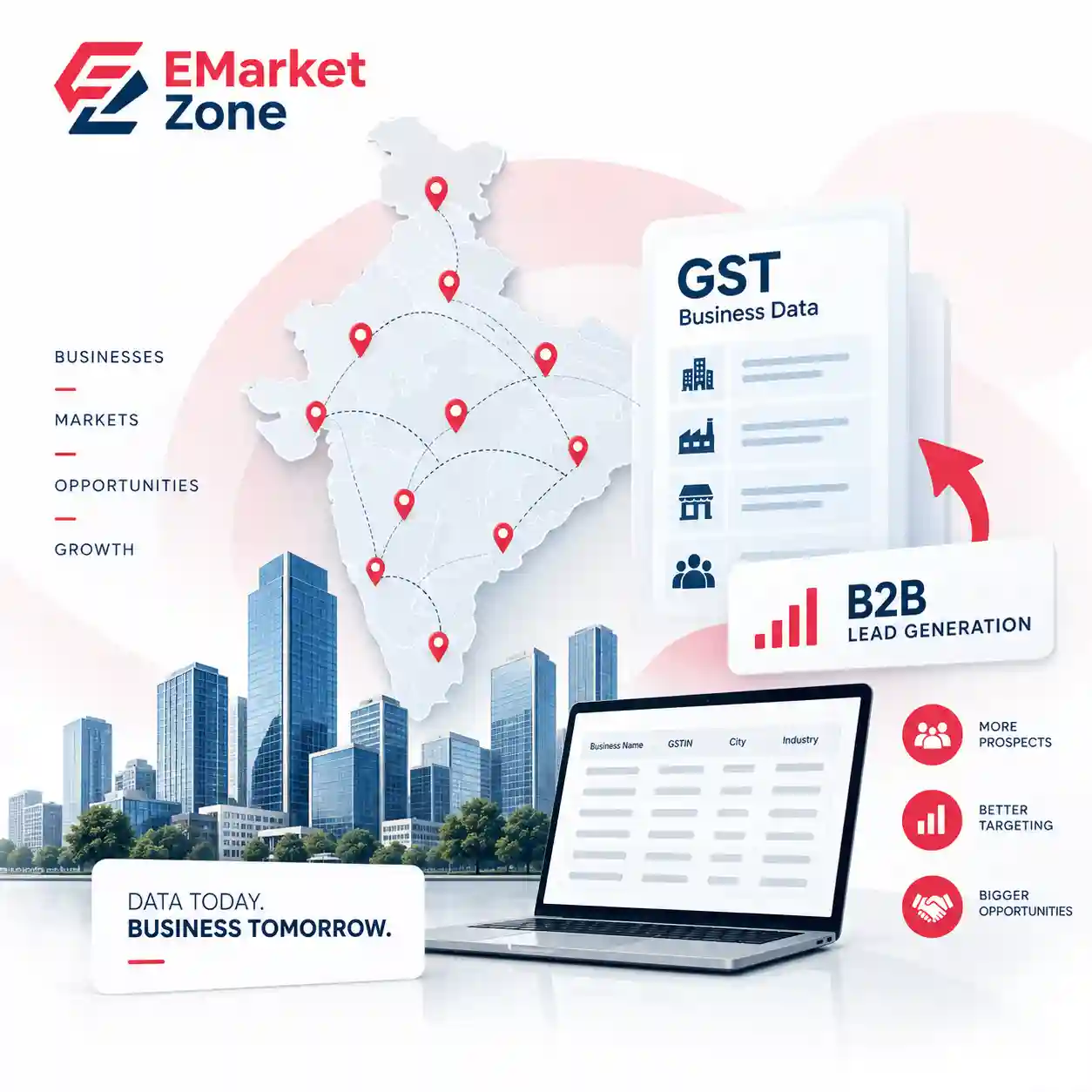
B2B lead generation becomes difficult when businesses rely on broad audience targeting without knowing exactly which companies they want to approach. A more structured approach is to first define the businesses that match the ideal customer profile and then build a prospecting list around those characteristics.
GST business data can be useful in this process because GST registration is associated with identifiable businesses and registration information. The GST Portal’s registration process itself captures business-related information including the legal name, state, district, principal place of business and goods or services information.
For sales and marketing teams, the value isn’t simply having a list of GST numbers. The real opportunity is using business information to identify, segment and prioritize potential B2B prospects.
This guide explains how GST business data can fit into a B2B lead-generation strategy, how businesses can segment prospects, and where this type of data can be useful.
What Is GST Business Data?
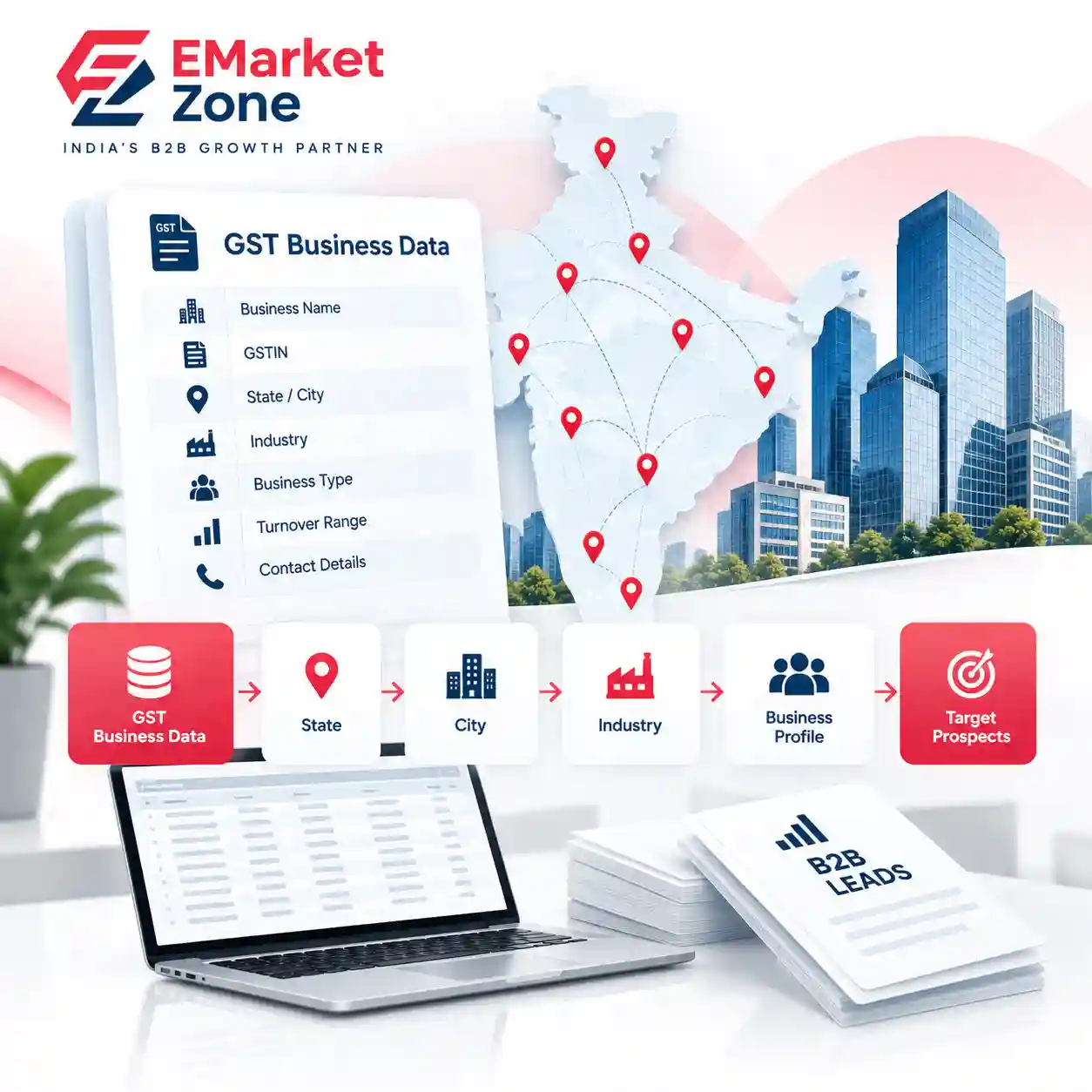
GST business data refers to business information associated with GST-registered entities. Depending on the source and dataset, business records can contain fields such as:
• Business name
• GSTIN
• Business location
• State
• City
• Industry/business activity
• Registration-related information
• Contact information where legitimately available in the dataset
Important: Don’t claim that every GST record automatically contains phone numbers or email addresses. That’s a factual distinction that matters for credibility.
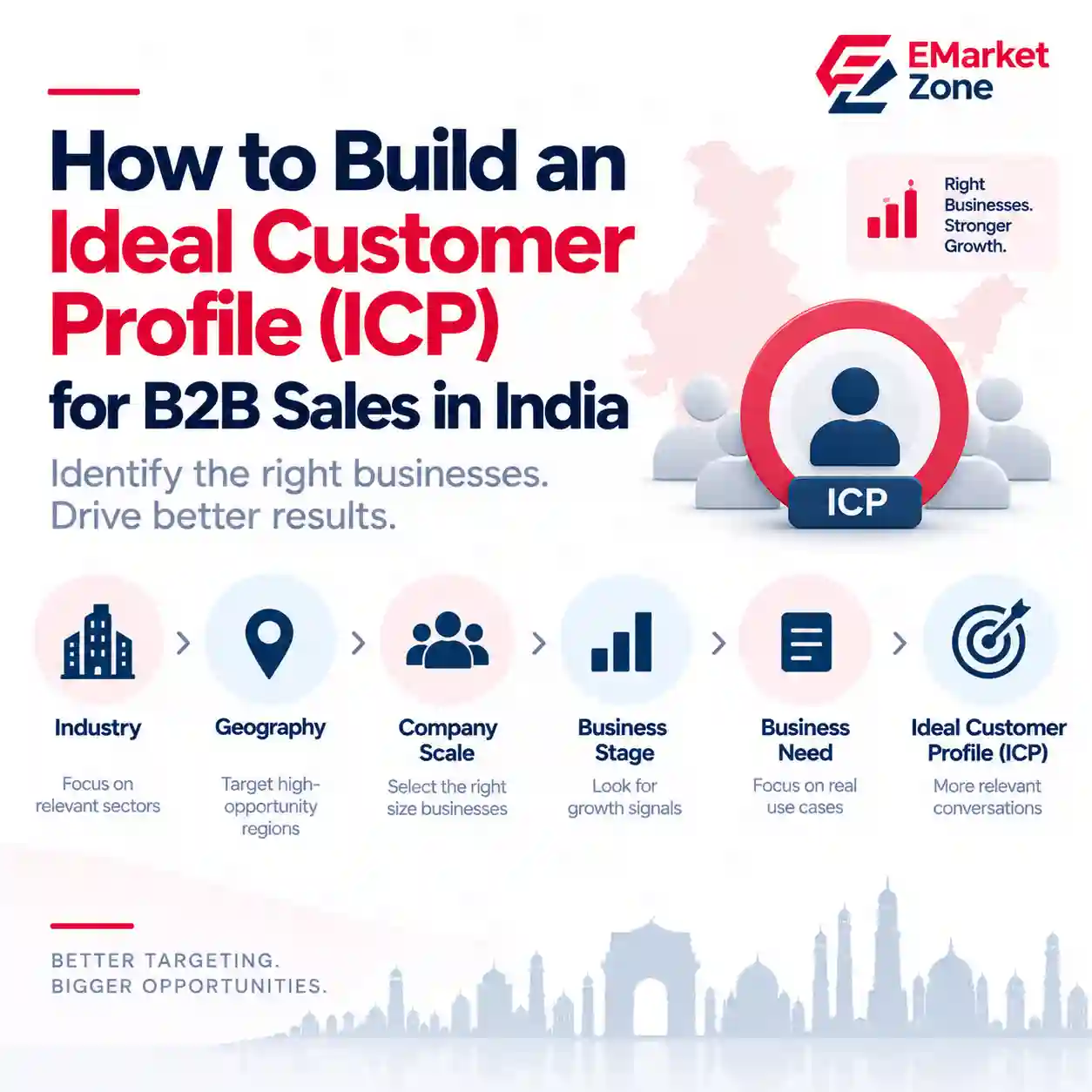
How Do You Build an ICP for the Indian B2B Market?
This should be one of the strongest sections.
Explain that the value comes from business identification and segmentation.
1. Identify Businesses Instead of Targeting Broad Audiences
A B2B company selling software, machinery, packaging, logistics, financial services or professional services may have a specific type of business as its customer.
Instead of saying:
“We want leads from India.”
The company can define:
“We want businesses in Maharashtra operating in manufacturing.”
That changes the prospecting process from broad targeting to a defined business universe.
2. Build Location-Based Prospect Lists
This is especially important for EMarket Zone.
A company expanding into a new region may want to identify businesses in:
• Maharashtra
• Gujarat
• Karnataka
• Delhi
• Tamil Nadu
• Telangana
• Rajasthan
• Uttar Pradesh
Businesses looking for prospects in a specific region can use a Maharashtra GST Database or Gujarat GST Database to narrow their prospecting by market.
How GST Business Data Can Be Used to Build a B2B Lead List
This should be the practical heart of the article.
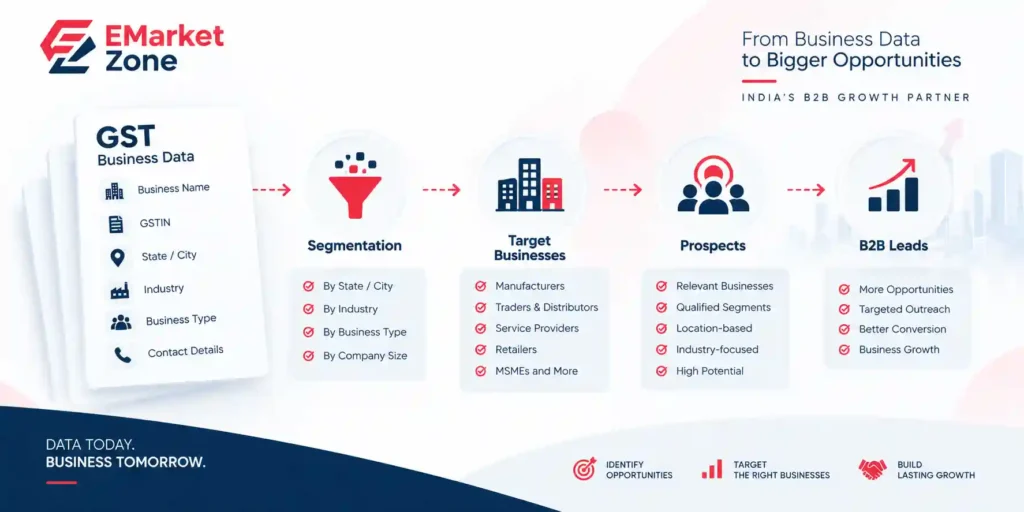
Use a five-step framework.
Step 1 – Define Your Ideal Customer
Before obtaining data, define:
• Industry
• Business type
• Geography
• Company size
• Product/service fit
• Target decision-maker
This prevents the common mistake of treating every business record as a lead.
Step 2 – Select the Target Geography
Start with:
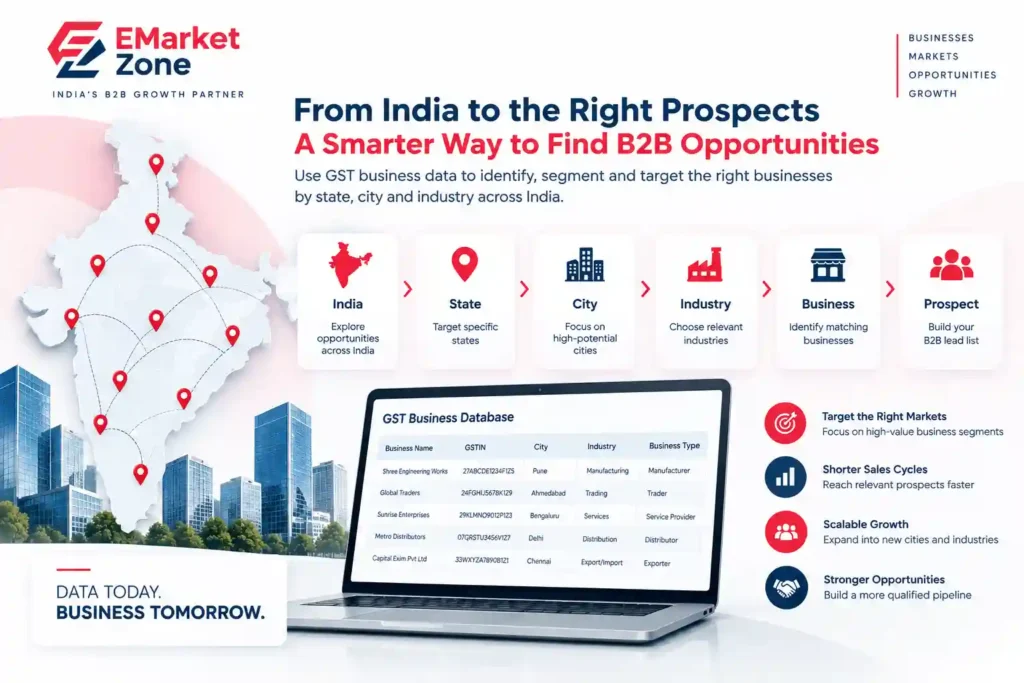
India → State → City → Business segment
For example:
India → Gujarat → Ahmedabad → Manufacturing businesses
That is a much more actionable prospecting universe than “all Indian businesses.”
Step 3 – Segment the Business Data
Possible segmentation criteria:
| Segmentation | Example |
|---|---|
| Geography | Gujarat |
| City | Ahmedabad |
| Industry | Manufacturing |
| Business type | Manufacturer / trader / service provider |
| Company characteristics | Relevant business size/category |
| Market | B2B |
Step 4 – Build the Prospect List
Explain that the database should be treated as a prospecting universe, not as a guarantee that every record is a qualified lead.
A lead still needs qualification.
This distinction will make the article much more credible.
Step 5 – Run Targeted Outreach
Once prospects are segmented, businesses can use appropriate channels such as:
• Email
• Calling
• LinkedIn
• WhatsApp where appropriate and compliant
• Account-based sales outreach
The database helps with who to target. The sales process determines who actually becomes a lead or customer.
How GST Business Data Can Support Different B2B Lead Generation Strategies
Market Expansion
A company can identify businesses in a new state or city before entering that market.
Industry-Specific Prospecting
For example:
A packaging company may want to identify manufacturers, distributors or retailers in a particular market.
Local B2B Sales
A company with a sales team in one city can build a prospect universe around that city.
This will become particularly valuable once your city pages are developed.
Territory Planning
Sales managers can divide prospects by:
• State
• City
• Territory
• Industry
• Business segment
This makes the article relevant to larger sales teams rather than only small businesses.
For national-level statistics, explore India Business Statistics 2026.
GST Business Data vs. Generic Business Leads
| Approach | Typical limitation |
|---|---|
| Generic lead list | May be broad and poorly segmented |
| Random online prospecting | Time-consuming |
| Social media prospecting | Can be difficult to scale systematically |
| GST business data | Provides a structured business universe that can be segmented |
| GST data + qualification | Creates a more targeted prospecting workflow |
How to Choose the Right GST Business Database
To choose the right business prospects is a risky part because most companies share outdated, duplicate and irrelevant contacts. Check below the factor to identity the right gst business database
Coverage
Does the database cover the geography and business segments you need?
Freshness
How recently was the information collected or updated?
Fields
Does it contain the business information required for your prospecting workflow?
Segmentation
Can you identify businesses by state, city, industry or other relevant criteria?
Usability
Can the data be exported and used with your sales/CRM workflow?
Data validation
What quality-control or validation process does the provider use?
If your objective is to build a targeted B2B prospecting list, EMarket Zone provides GST business databases covering Indian businesses across different geographic markets and segments.
Example: Using GST Business Data for B2B Expansion
Suppose a company sells industrial packaging to manufacturers.
Its target market is:
India → Gujarat → Manufacturing businesses
Instead of contacting businesses randomly, the company can:
Define manufacturing as the target segment.
Select Gujarat as the target state.
Narrow the prospect universe to relevant businesses.
Identify cities with suitable prospects.
Build a structured prospect list.
Remove irrelevant businesses.
Prioritize prospects.
Begin sales outreach.
Track responses and qualified opportunities in the CRM.
The important concept:
The database creates the prospect universe; qualification turns that universe into a sales pipeline.
Common Mistakes When Using GST Business Data for Lead Generation
Mistake 1: Treating every business as a qualified lead
A database record isn’t automatically a lead.
Mistake 2: Targeting too broadly
“All businesses in India” is usually too broad for an efficient campaign.
Mistake 3: Ignoring geography
For many B2B products, location is a major qualification factor.
Mistake 4: Not segmenting by industry
A business selling industrial equipment shouldn’t approach every GST-registered entity.
Mistake 5: Sending the same message to everyone
Different business segments require different messaging.
Mistake 6: Not validating data before outreach
Businesses should have a process for checking and qualifying records before using them.
Is GST Business Data Useful for B2B Lead Generation?
Yes, GST business data can be useful for B2B lead generation when it is used as a structured prospecting resource rather than treated as a ready-made list of guaranteed leads.
Its biggest value is helping businesses identify and segment potential business prospects by geography, industry and other relevant characteristics.
The actual quality of the resulting leads depends on the database, targeting criteria, qualification process and sales outreach.
Frequently Asked Questions
What is GST business data?
GST business data refers to business information associated with GST-registered entities. Depending on the dataset, it may include business identification, location, registration and other business-related fields.
Can GST data be used for B2B lead generation?
Can I find businesses by state using GST data?
Can GST business data help with city-level prospecting?
Is every GST-registered business a qualified lead?
No. This is an important distinction. GST registration identifies a business, but qualification depends on whether that business matches your product, geography, industry and customer profile.
Leave a comment