





A few months ago, I was speaking with a business owner who had just purchased a large contact database.
The seller claimed it contained more than 500,000 records.
At first, it sounded impressive.
More contacts should mean more opportunities, right?
Not exactly.
After sending thousands of emails, the business owner discovered a problem.
Many emails bounced.
Several phone numbers were inactive.
Some companies no longer existed.
The issue wasn’t lead generation.
The issue was data quality.
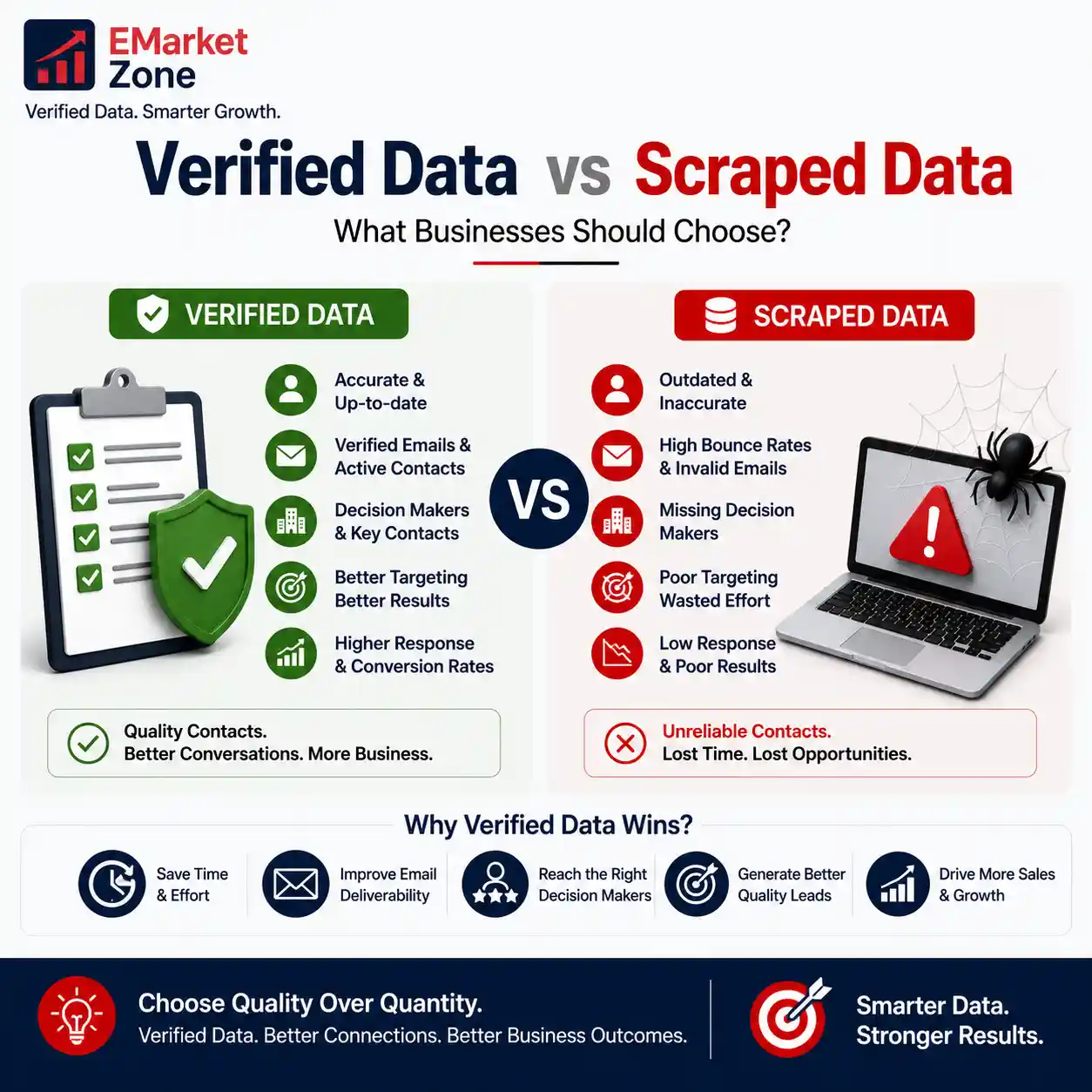
This is where businesses often encounter the difference between verified data and scraped data.
And the difference can be significant.
Why This Matters
Most businesses don’t buy databases because they enjoy collecting contacts.
They buy databases because they want:
• more leads
• more conversations
• more customers
The quality of the database directly affects those outcomes.
Poor data creates friction at every stage of outreach.
Good data improves efficiency.
The challenge is understanding what type of data you’re actually buying.
What Is Scraped Data?
Scraped data is information collected automatically from public sources.
Common sources include:
• websites
• business directories
• social media profiles
• online listings
Software tools gather information and compile it into large datasets.
The biggest advantage is volume.
Scraped databases can contain thousands or even millions of records.
That’s why they’re often marketed aggressively.
The problem is accuracy.
Just because information exists online doesn’t mean it’s current.
The Hidden Problems With Scraped Data
At first glance, scraped data appears attractive.
You get large numbers of contacts at relatively low prices.
But businesses often discover several issues:
Outdated Information
Companies change frequently.
People leave jobs.
Phone numbers change.
Email addresses become inactive.
A scraping tool cannot always identify these changes.
Missing Context
Scraped data may contain contact information.
But it often lacks useful context such as:
• decision-maker roles
• company size
• industry relevance
Without context, targeting becomes harder.
Higher Bounce Rates
One of the biggest complaints about scraped databases is poor deliverability.
Invalid contacts often lead to:
• bounced emails
• wasted outreach
• lower productivity
What Is Verified Data?
Verified data goes through an additional validation process.
Instead of simply collecting information, the goal is to improve accuracy.
Verification may include:
• contact validation
• email verification
• duplicate removal
• data updates
The focus shifts from quantity to quality.
Why Businesses Prefer Verified Data
When businesses run outreach campaigns, they care about outcomes.
Not database size.
Not record counts.
Outcomes.
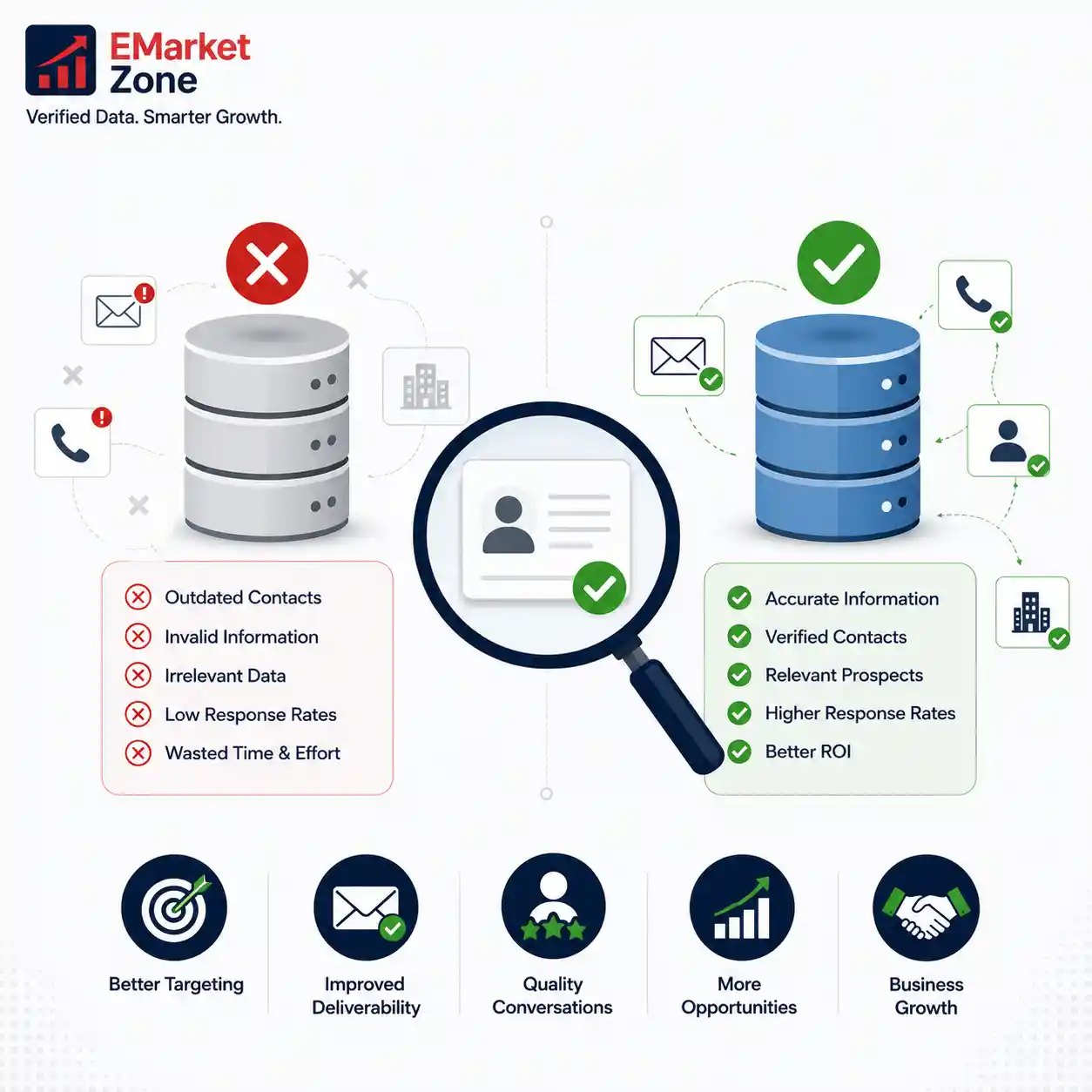
Verified data generally improves:
• response rates
• outreach efficiency
• deliverability
• prospect quality
Because teams spend less time dealing with inaccurate information.
Verified Company Contacts India
https://emarketzone.in/verified-company-contacts-india/
The Real Cost of Bad Data
Many businesses focus only on the cost of buying data.
They ignore the cost of using bad data.
Consider this.
A sales representative spends hours every day:
• sending emails
• making calls
• researching prospects
If a large percentage of contacts are incorrect, that time disappears.
The database may have been cheap.
The wasted effort is not.
Why More Contacts Doesn't Mean More Leads
This is one of the biggest misconceptions in B2B lead generation.
Businesses often compare databases based on size.
For example:
Database A:
500,000 contacts
Database B:
25,000 verified contacts
Many buyers immediately choose Database A.
But if Database B contains more accurate and relevant information, it may generate significantly better results.
Quality usually beats quantity.
What Happens During Outreach?
Let’s compare the experience.
Using Scraped Data
You send 1,000 emails.
A large number bounce.
Several prospects are irrelevant.
Many contacts are outdated.
The campaign becomes inefficient.
Using Verified Data
You send 1,000 emails.
More contacts are active.
More prospects are relevant.
The campaign becomes easier to manage.
The difference may seem small.
But over thousands of outreach attempts, it becomes substantial.
Why Decision-Maker Data Matters
Another issue with scraped data is that it often focuses on company information rather than decision-makers.
Businesses don’t buy from companies.
People make purchasing decisions.
That’s why access to:
• owners
• founders
• directors
• CEOs
can significantly improve outreach results.
Buy Decision Makers Data India
https://emarketzone.in/buy-decision-makers-data-india/
How Verified Data Supports Lead Generation
Lead generation becomes easier when businesses spend less time cleaning data and more time communicating.
Verified data helps by providing:
• better targeting
• improved accuracy
• cleaner outreach lists
• more relevant prospects
Business Leads India
https://emarketzone.in/business-leads-india/
Should Businesses Ever Use Scraped Data?
Scraped data is not always useless.
It can be helpful for:
• market research
• trend analysis
• initial prospect discovery
The problem occurs when businesses assume scraped data is automatically ready for outreach.
In many cases, additional verification is required.
Final Thoughts
The difference between verified data and scraped data is not just accuracy.
It’s efficiency.
Businesses using verified data generally spend less time fixing problems and more time generating opportunities.
Scraped data may provide larger numbers.
Verified data usually provides better results.
And when lead generation is the goal, results matter far more than record counts.
FAQs
Scraped data is collected automatically from publicly available online sources using software tools.
For lead generation and outreach, verified data is generally more effective because it is more accurate and reliable.
Many scraped databases contain outdated or invalid contact information, which can increase email bounce rates.
Yes. Scraped data can support market research and prospect discovery but often requires additional verification before outreach.
Higher-quality data improves targeting, efficiency, response rates, and overall lead generation performance.

Leave a comment