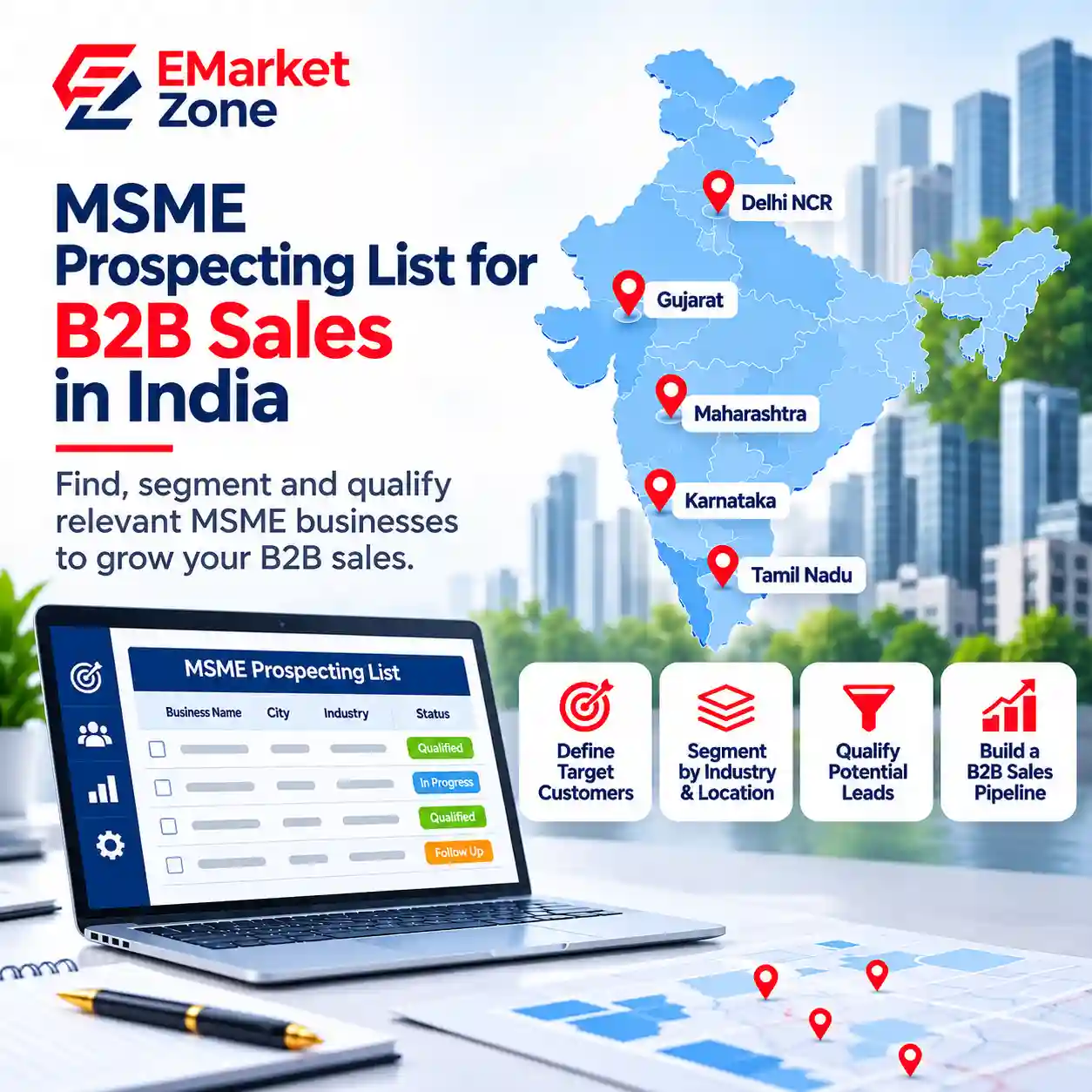
Finding potential business customers is an important part of B2B sales. However, identifying a large number of businesses does not automatically create sales opportunities. Companies need to find prospects that match their products or services, organise relevant business information and prioritise potential customers before starting outreach.
In India, the MSME sector offers opportunities across manufacturing, trading, wholesale, retail and service industries. Businesses selling industrial machinery, raw materials, software, packaging, logistics or professional services can use structured prospecting to identify relevant MSME customers.
A well-planned MSME prospecting list helps sales teams organise potential customers by industry, location, business activity and other relevant criteria.
This guide explains how to build a targeted MSME prospecting list for B2B sales in India, qualify potential customers and improve the effectiveness of business outreach.
1. Define Your Ideal MSME Customer Before Building a Prospecting List
The first step in B2B prospecting is identifying the type of business you want to reach.
Without a clearly defined customer profile, businesses often collect large volumes of irrelevant contacts. This increases research time, outreach costs and the effort required to qualify leads.
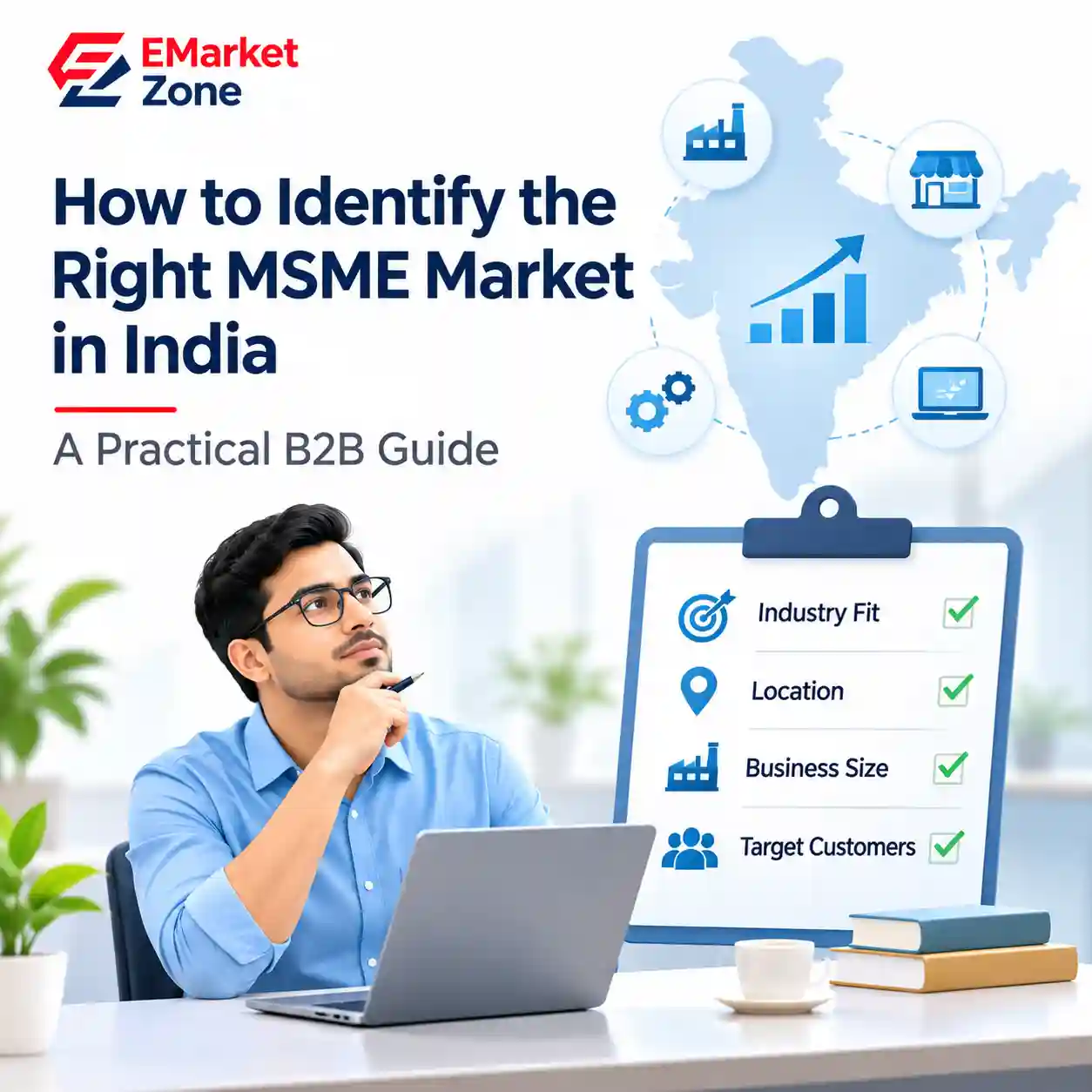
An Ideal Customer Profile (ICP) helps define the characteristics of businesses that are most likely to benefit from your offering.
Consider these factors:
• Industry: Manufacturing, textiles, pharmaceuticals, food processing, engineering, retail or services.
• Business activity: Manufacturer, wholesaler, distributor, retailer or service provider.
• Location: Target state, city or industrial cluster.
• Enterprise category: Micro, small or medium enterprise, where relevant.
• Business requirement: The problem your product or service can solve.
• Potential decision-maker: Business owner, procurement manager, operations manager or another relevant professional.
Example: ICP for an industrial equipment supplier
| Criteria | Target profile |
|---|---|
| Industry | Engineering and manufacturing |
| Business activity | Manufacturing units |
| Location | Maharashtra and Gujarat |
| Enterprise category | Small and medium enterprises |
| Potential requirement | Production machinery and equipment |
| Potential decision-maker | Owner, plant manager or procurement manager |
This profile gives the sales team a clear direction for identifying and qualifying potential customers.
2. Select the Right MSME Industries for B2B Prospecting
Not every MSME industry is suitable for every product or service. Your prospecting strategy should focus on businesses with a genuine reason to consider your offering.
The following examples show how different B2B suppliers can identify relevant MSME segments.
| Your business offering | Target MSME industries | Potential customers |
|---|---|---|
| Industrial machinery | Engineering, textiles and manufacturing | Factories and production units |
| Packaging materials | Food processing, pharmaceuticals and consumer goods | Manufacturers and packaging users |
| Raw materials | Chemicals, plastics, metals and textiles | Manufacturers and processors |
| Accounting software | Retail, wholesale and services | Business owners and finance teams |
| Logistics services | Manufacturing, distribution and wholesale | Suppliers and distributors |
| Digital marketing | Retail, hospitality and professional services | Business owners and marketing teams |
| Industrial components | Automotive, engineering and machinery | Manufacturers and component suppliers |
Start with two or three industries that closely match your offering. Evaluate their response and conversion performance before expanding into additional segments.
3. Choose the Right States and Cities for MSME Lead Generation
Geographical targeting helps businesses concentrate their prospecting activities in markets where suitable customers are more likely to operate.
Instead of approaching businesses across the entire country, identify states and cities that have relevant industrial or commercial activity.
Examples include:
| Location | Business segments worth researching |
|---|---|
| Maharashtra | Engineering, pharmaceuticals, textiles and manufacturing |
| Gujarat | Chemicals, textiles, plastics and engineering |
| Tamil Nadu | Automotive, textiles and industrial manufacturing |
| Karnataka | Technology, electronics and engineering |
| Uttar Pradesh | Food processing, textiles and trading |
| Telangana | Pharmaceuticals, technology and manufacturing |
| Pune | Automotive and engineering |
| Ahmedabad | Textiles, chemicals and pharmaceuticals |
| Surat | Textiles and textile-related trading |
| Coimbatore | Engineering, pumps and machinery |
| Tiruppur | Knitwear and garment manufacturing |
| Ludhiana | Textiles, bicycle components and engineering |
These are examples of markets to research, not rankings of active MSME customers.
For more focused geographical research, businesses can explore:
• State-wise Business Lists in India to research business coverage across Indian states.
• City-wise MSME Business Lists to explore MSME business coverage by city.
Combining location with industry segmentation can help reduce irrelevant prospects and improve the relevance of your sales activities.
4. Identify the Business Information Required for Prospecting
A useful MSME prospecting list should contain information that helps sales teams understand, organise and qualify potential customers.
The required fields depend on the product, industry and sales process.
Common business information fields include:
| Information field | How it helps |
|---|---|
| Business name | Identifies the potential customer |
| Industry | Helps segment businesses by sector |
| Business activity | Distinguishes manufacturers, traders and service providers |
| State | Supports geographical segmentation |
| City | Helps identify local markets |
| GST or registration details, where available | Supports business identification and validation |
| Business contact number, where available | Supports appropriate business communication |
| Email address, where available | Supports relevant email communication |
| Enterprise classification, where available | Helps understand business size |
| Revenue information, where available | Can support commercial segmentation, subject to data quality |
Not every business record will contain every field. Avoid assuming that all contacts have complete or current information.
The most useful prospecting information is not necessarily the information with the most fields. It is the information that helps your sales team identify relevant businesses and make better qualification decisions.
5. Organise MSME Prospects into Relevant Segments
Once potential businesses have been identified, organise them into smaller groups instead of treating the entire prospecting list as one audience.
Segmentation helps sales teams create more relevant communication and prioritise their efforts.
Consider these common MSME prospecting segments:
Industry-wise segmentation
• Textile manufacturers
• Food-processing businesses
• Pharmaceutical companies
• Engineering units
• Chemical manufacturers
• Wholesale traders
• Retail businesses
Location-wise segmentation
• Maharashtra businesses
• Gujarat businesses
• Tamil Nadu businesses
• Pune businesses
• Ahmedabad businesses
• Coimbatore businesses
Business activity segmentation
• Manufacturers
• Wholesalers
• Distributors
• Retailers
• Service providers
Enterprise-size segmentation
• Micro enterprises
• Small enterprises
• Medium enterprises
You can combine multiple filters to create a more focused audience.
For example, rather than targeting all businesses in Gujarat, a machinery supplier could focus on engineering and manufacturing businesses in Ahmedabad and Rajkot.
6. Qualify and Prioritise Your MSME Sales Leads
A prospecting list becomes more valuable when businesses are evaluated according to their suitability.
Not every business matching your industry and location criteria will become a customer. Qualification helps identify prospects worth approaching first.
A simple lead-prioritisation model can use the following scoring system:
| Qualification factor | Maximum points |
|---|---|
| Industry relevance | 3 |
| Product or service requirement | 3 |
| Location suitability | 2 |
| Enterprise-size suitability | 1 |
| Available business information | 1 |
| Total | 10 |
You can divide prospects into three groups:
• High priority (8–10): Strong industry and product fit with suitable business information.
• Medium priority (5–7): Relevant businesses that require additional qualification.
• Low priority (0–4): Limited product relevance or insufficient information.
This is an internal prioritisation framework, not a prediction of purchase intent. Sales teams should confirm actual requirements through appropriate business conversations.
7. Validate Business Information Before Starting Outreach
One of the most important steps in building a targeted MSME prospecting list is checking the quality of the available information.
Business details and contact information can change. Incorrect email addresses, outdated phone numbers, duplicate records and irrelevant companies can reduce the effectiveness of outreach.
Before using a prospecting list, consider the following checks:
Remove duplicates: Identify repeated business records so that the same company is not unnecessarily approached multiple times.
Check business relevance: Confirm that the business operates in an industry suitable for your offering.
Review contact information: Check whether available email addresses and telephone numbers are current and usable.
Validate geographical information: Confirm that the business location matches your target market.
Check registration information where relevant: Use appropriate official sources to validate registration details.
Maintain update records: Record when information was last reviewed and when a prospect was contacted.
For GST-related business identification, the official GST Portal provides taxpayer search facilities. Use appropriate official checks rather than assuming that every third-party business record is current.
8. Choose the Right B2B Prospecting Channels
Once your prospects are segmented and qualified, choose communication channels that are appropriate for your business and the intended audience.
Email outreach
Email can help businesses introduce their products, explain services and start professional conversations. Keep messages relevant to the recipient’s business and follow applicable privacy and communication requirements.
Telephone outreach
Telephone communication can help sales teams understand business requirements and identify potential opportunities. Use professional calling practices and comply with applicable communication rules.
LinkedIn prospecting
LinkedIn can help identify companies, professional roles and relevant decision-makers. It is also useful for researching businesses before approaching them.
WhatsApp Business
WhatsApp can support business communication and customer follow-ups where the recipient has provided the appropriate permission or other valid basis for communication.
Industry events and business networks
Trade fairs, industry associations and local business networks can help companies connect with relevant businesses and understand market requirements.
Do not assume that possessing a business contact number or email address automatically gives permission to send promotional messages. Follow applicable laws, platform rules and communication preferences.
9. Track MSME Prospecting Performance
The purpose of building an MSME prospecting list is to improve the quality of sales opportunities, not simply increase the number of contacts.
Track performance separately for each industry, state, city and prospect segment.
| Metric | What it measures |
|---|---|
| Total prospects identified | Size of the researched audience |
| Industry match rate | Percentage matching your target industries |
| Contactability rate | Percentage of prospects successfully reached |
| Response rate | Percentage responding to outreach |
| Qualified lead rate | Percentage meeting your sales criteria |
| Meeting conversion rate | Percentage progressing to meetings |
| Opportunity conversion rate | Percentage becoming genuine sales opportunities |
| Customer acquisition cost | Cost of acquiring customers |
For example, a campaign targeting 500 relevant manufacturers may generate more qualified opportunities than a campaign targeting 5,000 unrelated businesses.
Use actual campaign results to refine your prospecting criteria and improve future targeting.
10. Common Mistakes to Avoid When Building an MSME Prospecting List
Avoid these mistakes when developing your B2B prospecting strategy.
Collecting contacts without a target audience: A large list without industry and customer segmentation can create unnecessary sales work.
Ignoring business requirements: A business operating in your target industry is not automatically interested in your product.
Using outdated information: Old contact details can reduce contactability and waste outreach resources.
Targeting every state and city: Broad geographical coverage can make prospecting expensive and difficult to manage.
Skipping duplicate removal: Repeated records can result in unnecessary communication and poor campaign management.
Measuring only the number of contacts: Contact volume does not measure lead quality or commercial value.
Ignoring communication compliance: Business prospecting should respect applicable privacy, consent and communication requirements.
Frequently Asked Questions
What is an MSME prospecting list?
An MSME prospecting list is an organised collection of potential micro, small and medium enterprise customers that a business may approach for B2B sales or business development. It can include business names, industries, locations, registration information and available business contact details.
How can I find MSME leads in India for B2B sales?
Start by identifying your target industries, business activities and geographical markets. Then research relevant businesses using official government resources, industry directories and suitable business-list resources. Organise prospects by industry and location, validate important information and qualify them before starting outreach.
What information should an MSME business prospecting list contain?
A useful MSME prospecting list can include business name, industry, business activity, state, city, available contact details and relevant registration information. Depending on the sales strategy, enterprise classification and revenue information may also help with segmentation.
How do I target MSME manufacturers in India?
Define the manufacturing industries relevant to your product, such as textiles, engineering, food processing, pharmaceuticals or chemicals. Select suitable states and industrial cities, identify manufacturing businesses and qualify them according to product requirements, business size and location.
What is the difference between an MSME prospect and a qualified lead?
An MSME prospect is a business that may be relevant to your offering based on initial research. A qualified lead has been evaluated against additional criteria, such as industry fit, business requirements, location and potential purchasing suitability.
How can I segment MSME leads for B2B marketing?
You can segment MSME leads by industry, state, city, business activity, enterprise category and available business information. Combining multiple criteria helps create more focused prospect groups and relevant sales communication.
How can businesses improve the quality of an MSME contact list?
Review business relevance, remove duplicate records, validate available contact information, check geographical details and maintain update records. Also, measure contactability and lead qualification performance to identify areas where list quality needs improvement.
Is a larger MSME prospecting list always better for sales?
No. A larger list does not necessarily produce more sales. A smaller, well-segmented prospecting list with relevant businesses can generate better engagement and more qualified opportunities than a large collection of unrelated contacts.
Conclusion: Build a Better MSME Prospecting Strategy for B2B Sales
Building an effective MSME prospecting list requires more than collecting business names and contact details. Businesses need to define their ideal customers, select relevant industries and locations, organise available business information and qualify potential prospects.
A structured approach helps sales teams focus on businesses that are more relevant to their products or services.
Start with a clearly defined customer profile, segment prospects by industry and location, validate important information and prioritise businesses based on their suitability. Then measure campaign performance and refine your targeting using actual sales results.
The objective is to build a focused B2B sales pipeline with relevant business prospects rather than simply increasing the number of contacts.
Sources and Further Reading
• Ministry of MSME – Government of India
• GST Portal – Taxpayer Search
• India MSME Business Landscape & Opportunity Report 2026
Research note: MSME registration information and business contact information serve different purposes. Registration records can help identify businesses, but they do not independently establish current business activity, purchasing intent or permission for promotional communication. Validate important information and follow applicable privacy and outreach requirements.
Leave a comment