India’s Micro, Small and Medium Enterprises (MSMEs) operate across a wide range of industries, business activities and geographical markets. For companies selling products or services to other businesses, this creates a significant opportunity—but reaching the right businesses requires more than targeting a large audience.
A manufacturer looking for industrial distributors, a software company targeting service businesses and a financial services provider approaching growing enterprises will all need different customer segments.
The practical challenge is identifying which businesses are most relevant, where they operate and how to prioritise them for business development.
This guide explains how to identify the right MSME market in India using industry segmentation, geographical research, enterprise classification and structured business information.
1. Understand the Size and Structure of India's MSME Market
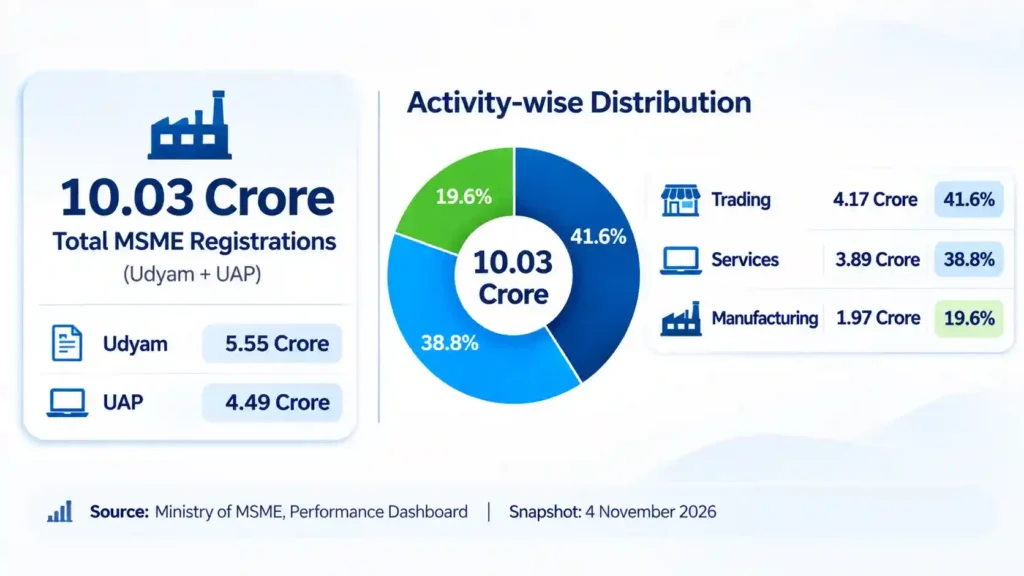
India’s MSME ecosystem is one of the country’s largest business segments. The Ministry of MSME’s registration dashboard recorded approximately 10.03 crore combined Udyam and Udyam Assist Platform registrations as of 4 November 2026.
The dashboard figures included:
| Registration category | Registrations |
|---|---|
| Udyam registrations | 5.55 crore |
| Udyam Assist Platform registrations | 4.49 crore |
| Combined total | 10.03 crore |
These figures provide an indication of the scale of the registered MSME ecosystem. However, registration totals should not be interpreted as the number of unique, currently active businesses or as a direct measure of purchasing demand.
For a B2B company, the more useful question is not simply how many MSMEs exist, but which segments are likely to need its products or services.
For a broader examination of India’s business environment, registration patterns and market opportunities, refer to the India MSME Business Landscape & Opportunity Report 2026.
2. Identify the Industries That Match Your Offering
Industry segmentation is one of the most important steps in MSME market research.
Not every registered business is a potential customer. Your product or service should solve a problem that is relevant to the industry you are targeting.
For example, an industrial equipment supplier may focus on manufacturers, while a business offering billing software may find opportunities among retailers, wholesalers and service providers.
The following table illustrates how different B2B offerings can be matched with relevant MSME segments.
| Business offering | Potential MSME segments | Why they may be relevant |
|---|---|---|
| Industrial machinery | Engineering, fabrication and manufacturing units | Production and equipment requirements |
| Packaging materials | Food processing, pharmaceuticals and consumer goods manufacturers | Packaging and distribution requirements |
| Raw materials | Textile, chemical, plastic and metal businesses | Regular procurement requirements |
| Accounting software | Retailers, wholesalers and service businesses | Financial recordkeeping and business operations |
| Logistics services | Manufacturers, distributors and wholesalers | Transportation and supply-chain requirements |
| Digital marketing | Retail, hospitality and professional services | Customer acquisition and online visibility |
| Financial services | Eligible micro, small and medium enterprises | Working capital and business financing needs |
These are potential customer segments, not guaranteed buyers. Validate demand through customer interviews, existing sales data and small-scale campaigns before investing heavily in a segment.
3. Use MSME Classification to Define Your Target Business Size
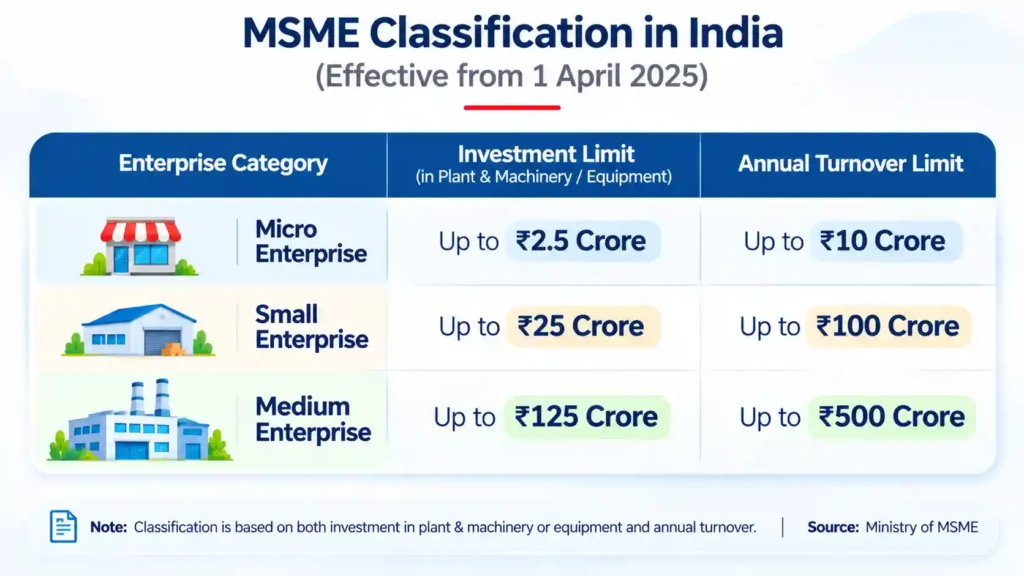
The revised MSME classification criteria came into effect on 1 April 2025. They use both investment in plant and machinery or equipment and annual turnover.
| Enterprise category | Investment limit | Annual turnover limit |
|---|---|---|
| Micro | Up to ₹2.5 crore | Up to ₹10 crore |
| Small | Up to ₹25 crore | Up to ₹100 crore |
| Medium | Up to ₹125 crore | Up to ₹500 crore |
These thresholds help businesses understand the size categories within the MSME ecosystem.
However, enterprise classification alone does not establish whether a business can afford or needs your offering. A micro enterprise in a high-value industrial segment may be a better prospect than a medium enterprise operating in an unrelated industry.
Use classification as one part of your targeting criteria, alongside industry, location, business activity and product relevance.
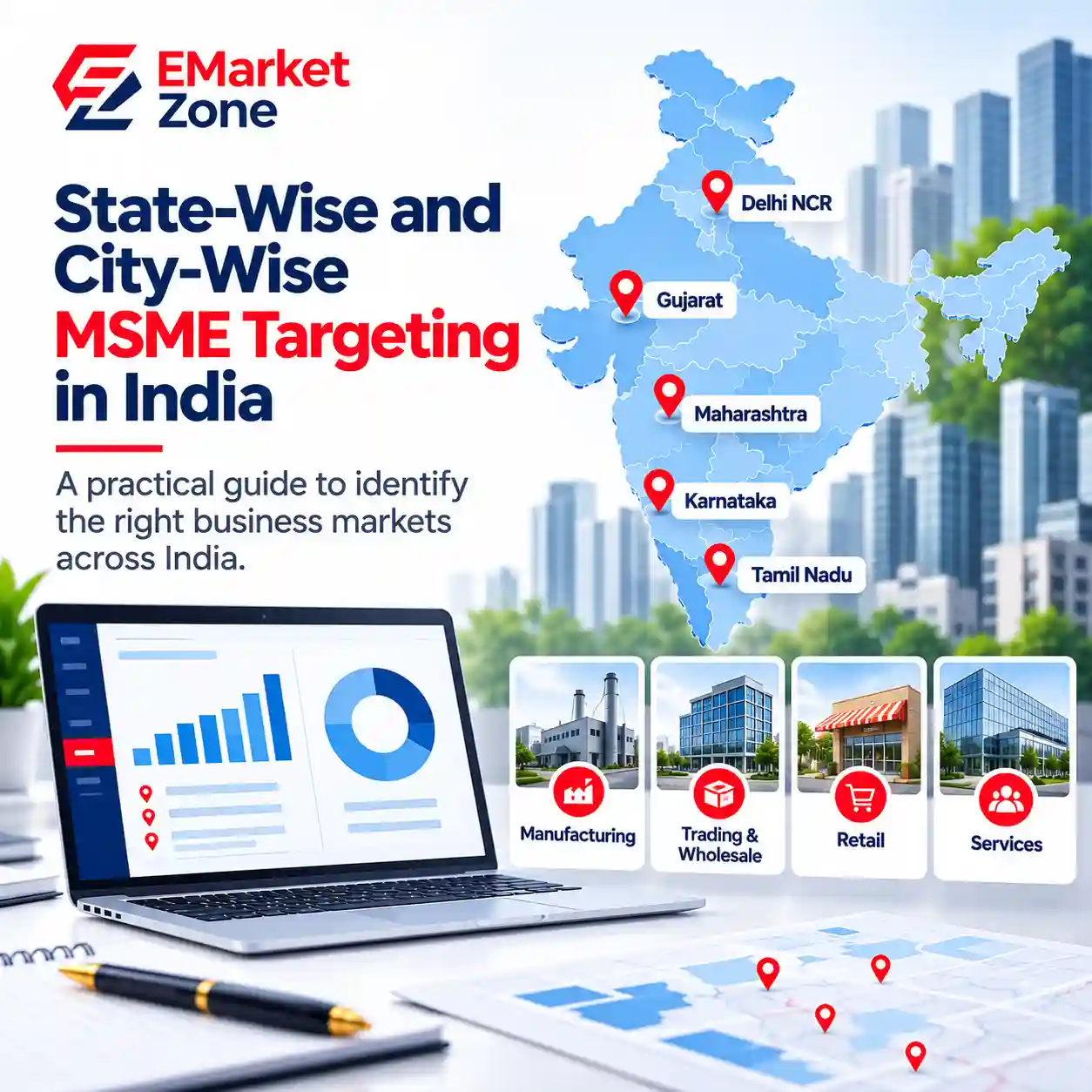
4. Analyse State-wise MSME Markets
Geographical segmentation helps businesses concentrate their sales and marketing activities in locations where relevant customers are more likely to operate.
India’s MSME ecosystem is distributed across states with different industrial strengths, commercial networks and business clusters.
Some examples include:
| State | Important business segments and clusters |
|---|---|
| Maharashtra | Engineering, pharmaceuticals, textiles, food processing and financial services |
| Gujarat | Chemicals, textiles, engineering, plastics and manufacturing |
| Tamil Nadu | Automotive, textiles, engineering and industrial manufacturing |
| Karnataka | IT services, electronics, engineering and manufacturing |
| Uttar Pradesh | Food processing, textiles, handicrafts, engineering and trading |
| West Bengal | Jute, food processing, engineering and wholesale trade |
| Telangana | Pharmaceuticals, engineering, food processing and technology |
| Rajasthan | Textiles, minerals, handicrafts and manufacturing |
The Ministry’s state-wise registration figures can help identify where registered MSME activity is concentrated. However, registration volume should not be treated as proof of demand for a particular product.
A better approach is to combine state-level research with industry-level analysis.
For example, a textile machinery supplier may prioritise textile manufacturing clusters rather than targeting every business in a state.
5. Identify Important MSME Business Cities and Industrial Clusters
State-level targeting provides a broad view, but city-level segmentation can make prospecting more focused.
Several Indian cities are associated with specific industrial and commercial activities.
| City | Major business segments |
|---|---|
| Surat | Textiles, diamonds and textile-related trading |
| Tiruppur | Knitwear and garment manufacturing |
| Coimbatore | Engineering, pumps, machinery and textiles |
| Ludhiana | Bicycle components, engineering and textiles |
| Pune | Automotive, engineering and industrial manufacturing |
| Ahmedabad | Textiles, chemicals, pharmaceuticals and engineering |
| Rajkot | Engineering, machinery and auto components |
| Bengaluru | IT services, electronics and technology businesses |
These clusters can help businesses develop location-specific sales strategies.
For instance:
• A textile machinery supplier could research Tiruppur and Surat.
• An automotive components supplier could prioritise Pune and Coimbatore.
• An engineering software provider could evaluate Pune, Rajkot and Bengaluru.
• A packaging supplier could target relevant manufacturing clusters across several states.
City selection should be based on the industries that match your offering, not simply the size of the city’s business population.
6. Build an Ideal Customer Profile Before Prospecting
An Ideal Customer Profile (ICP) defines the type of business most likely to benefit from your product or service.
Without an ICP, businesses often collect large volumes of irrelevant contacts and waste time on unsuitable prospects.
A practical MSME ICP can include the following criteria:
Industry: Which industries have a genuine need for your offering?
Location: Which states, cities or industrial clusters should you prioritise?
Enterprise size: Are you targeting micro, small or medium enterprises?
Business activity: Are you looking for manufacturers, wholesalers, retailers, distributors or service providers?
Business requirements: What operational problem does your product solve?
Decision-maker: Who is likely to evaluate or purchase your offering?
Example: ICP for an industrial packaging supplier
| Criteria | Target profile |
|---|---|
| Industry | Food processing and manufacturing |
| Location | Gujarat and Maharashtra |
| Business size | Micro and small enterprises |
| Business activity | Manufacturing |
| Requirement | Regular packaging material procurement |
| Potential decision-maker | Owner, procurement manager or operations manager |
This profile gives the sales team a clear direction for research and prospecting.
7. Use Structured Business Information for Market Identification
Once your target market is defined, the next step is identifying businesses that match your criteria.
Structured business information can help organise prospecting around factors such as:
• Business name and registration details
• Industry or business activity
• State and city
• Available contact information
• Enterprise classification, where available
• Other relevant business attributes
The usefulness of this information depends on its coverage, accuracy, freshness and relevance to your target market. Not every field will be available for every business, so validate important details before starting outreach.
Businesses researching MSME prospects across India can explore the MSME Business List for India to review available business information and market coverage.
Use such resources as a starting point for market research, not as a substitute for customer qualification or consent-based communication.
8. Segment and Prioritise Prospects Instead of Treating Every Business Equally
A large prospecting list does not automatically produce better sales results.
Businesses should prioritise prospects based on how closely they match the ICP.
One simple scoring model is:
| Evaluation factor | Weight |
|---|---|
| Industry relevance | 3 points |
| Product or service requirement | 3 points |
| Location suitability | 2 points |
| Enterprise-size suitability | 2 points |
| Maximum score | 10 points |
For example, a manufacturing business located in your priority market and matching your product requirements may receive a higher score than an unrelated business in the same city.
You can classify prospects as:
• High priority: Strong industry fit, relevant requirement and suitable location.
• Medium priority: Some matching characteristics but additional qualification is needed.
• Low priority: Limited relevance or insufficient information.
This approach helps sales teams focus their time on the most promising opportunities.
9. Choose the Right B2B Outreach Channels
After identifying and prioritising relevant businesses, select outreach channels that suit your product, audience and communication strategy.
Common B2B channels include:
Email outreach: Useful for introducing business offerings, sharing product information and starting professional conversations. Use appropriately sourced business contacts and follow applicable privacy and communication rules.
Telephone outreach: Can help sales teams understand business requirements directly. Calls should be relevant, professional and compliant with applicable regulations.
LinkedIn: Useful for identifying professional roles, researching companies and building business relationships.
Industry events and trade associations: Provide opportunities to meet businesses within specific sectors and industrial clusters.
WhatsApp Business: Can support customer communication where businesses have an appropriate basis or permission to contact the recipient.
Do not rely on one channel for every market. Test different approaches and measure the quality of the conversations generated.
10. Measure the Effectiveness of Your MSME Targeting
Market research becomes useful when it improves business decisions and sales performance.
Track the following indicators to understand whether your targeting strategy is working.
| Metric | What it measures |
|---|---|
| Industry match rate | Percentage of prospects matching your target industries |
| Contactability rate | Percentage of prospects you can successfully reach |
| Response rate | Percentage of contacted prospects who respond |
| Qualified lead rate | Percentage of prospects meeting your sales criteria |
| Meeting conversion rate | Percentage of prospects progressing to a meeting |
| Opportunity conversion rate | Percentage progressing into genuine sales opportunities |
| Customer acquisition cost | Cost of acquiring a customer |
Review these metrics by industry, location and business segment. This helps identify which markets generate qualified opportunities rather than simply large contact volumes.
11. Common Mistakes in MSME Market Research
Avoid these common mistakes when developing a B2B targeting strategy:
Targeting every MSME: A broad audience may increase prospect volume but reduce relevance. Define your ideal customer before building a prospecting strategy.
Using registration counts as demand estimates: Government registration figures describe the registered ecosystem. They do not show how many businesses need or can afford your product.
Ignoring geographical clusters: State-level targeting can be too broad when your offering serves a specialised industry.
Relying only on enterprise classification: Micro, small and medium categories do not independently determine purchasing intent.
Skipping prospect validation: Business information can change. Validate important contact and company details before outreach.
Measuring only the number of contacts: A smaller group of relevant prospects can be more valuable than a much larger, poorly matched audience.
Frequently Asked Questions
How can I identify the right MSME market in India?
To identify the right MSME market in India, start by defining the industries that need your product or service. Then narrow your target audience by state, city, business activity and enterprise size. Create an Ideal Customer Profile (ICP), identify businesses matching those criteria and prioritise prospects based on industry relevance, location and potential requirements.
Which industries offer B2B business opportunities in the Indian MSME sector?
Several MSME industries offer potential B2B opportunities, including manufacturing, textiles, food processing, engineering, chemicals, pharmaceuticals, wholesale trade, retail and professional services. The best industry depends on your product or service. For example, industrial machinery suppliers may focus on engineering and manufacturing businesses, while packaging suppliers may target food processing and consumer goods companies.
How do I find MSME businesses by state and city in India?
You can identify MSME markets by combining government registration statistics, industry research and location-based business information. Start with states that have relevant industrial activity, then narrow your research to cities and business clusters. For example, Tiruppur is known for knitwear manufacturing, Surat for textiles and Coimbatore for engineering and machinery-related businesses.
What is the difference between micro, small and medium enterprises in India?
Under the revised MSME classification effective from 1 April 2025, enterprises are classified using investment in plant and machinery or equipment and annual turnover.
– Micro enterprise: Investment up to ₹2.5 crore and turnover up to ₹10 crore.
– Small enterprise: Investment up to ₹25 crore and turnover up to ₹100 crore.
– Medium enterprise: Investment up to ₹125 crore and turnover up to ₹500 crore.
An enterprise must satisfy both applicable limits to qualify for its respective category.
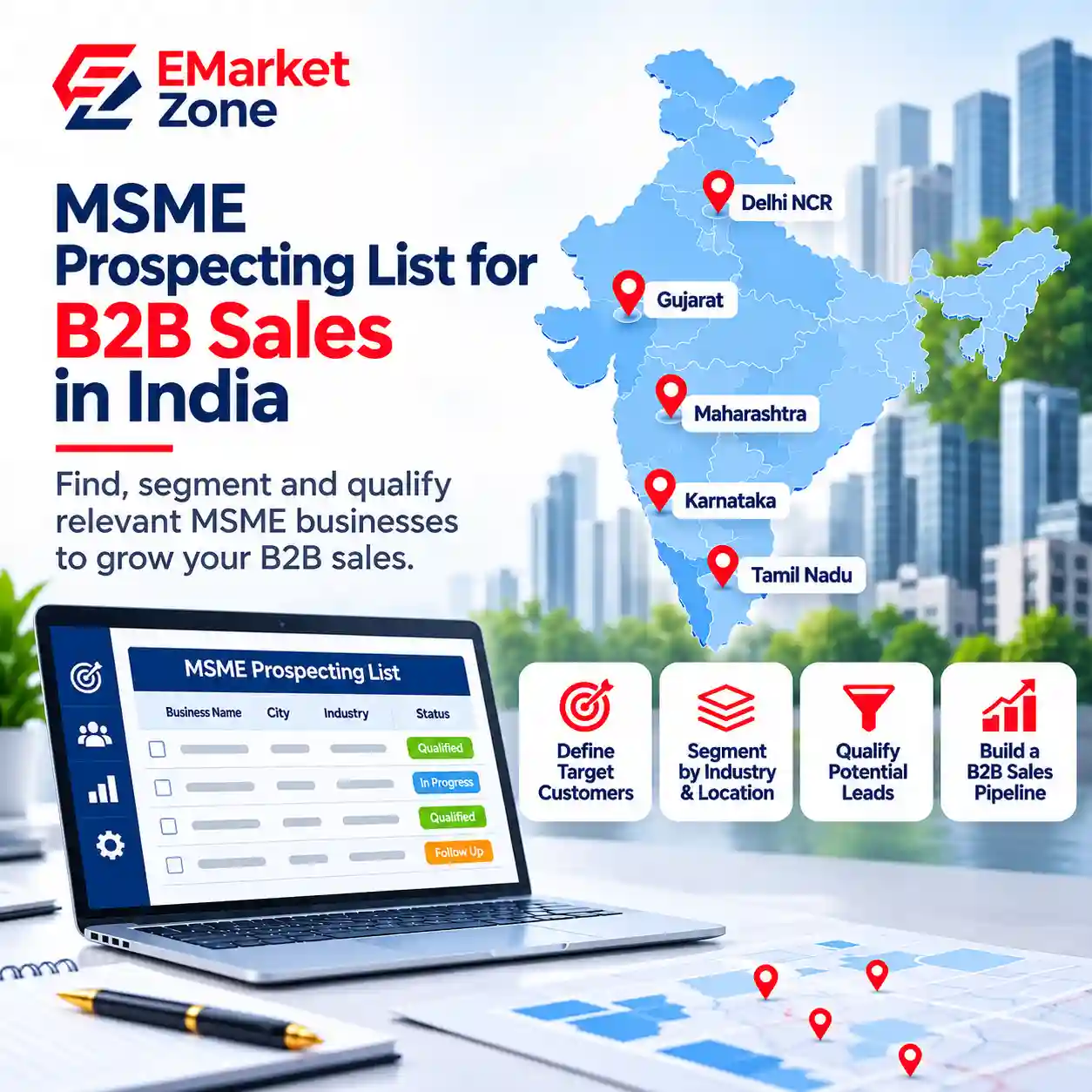
How can businesses build a targeted MSME prospecting list for B2B sales?
Businesses can build a targeted MSME prospecting list by first defining their ideal customer profile. They should identify relevant industries, select priority states and cities, determine suitable enterprise categories and organise available business information by these criteria. Before starting outreach, validate important business and contact details, remove irrelevant prospects and prioritise businesses that match the offering. Outreach should follow applicable privacy, consent and communication requirements.
Conclusion: Build a Focused MSME Market Strategy
India’s MSME ecosystem offers opportunities across manufacturing, trading and services. But identifying the right market requires a structured approach.
Start by understanding the industry your product serves. Narrow the market by state and city, define your ideal customer profile, consider enterprise classification and prioritise prospects based on relevance.
Finally, measure the quality of your outreach and refine your targeting using actual sales results.
The objective should not be to reach the largest possible number of businesses. It should be to identify the businesses most likely to benefit from your offering and build meaningful B2B relationships.
Leave a comment