
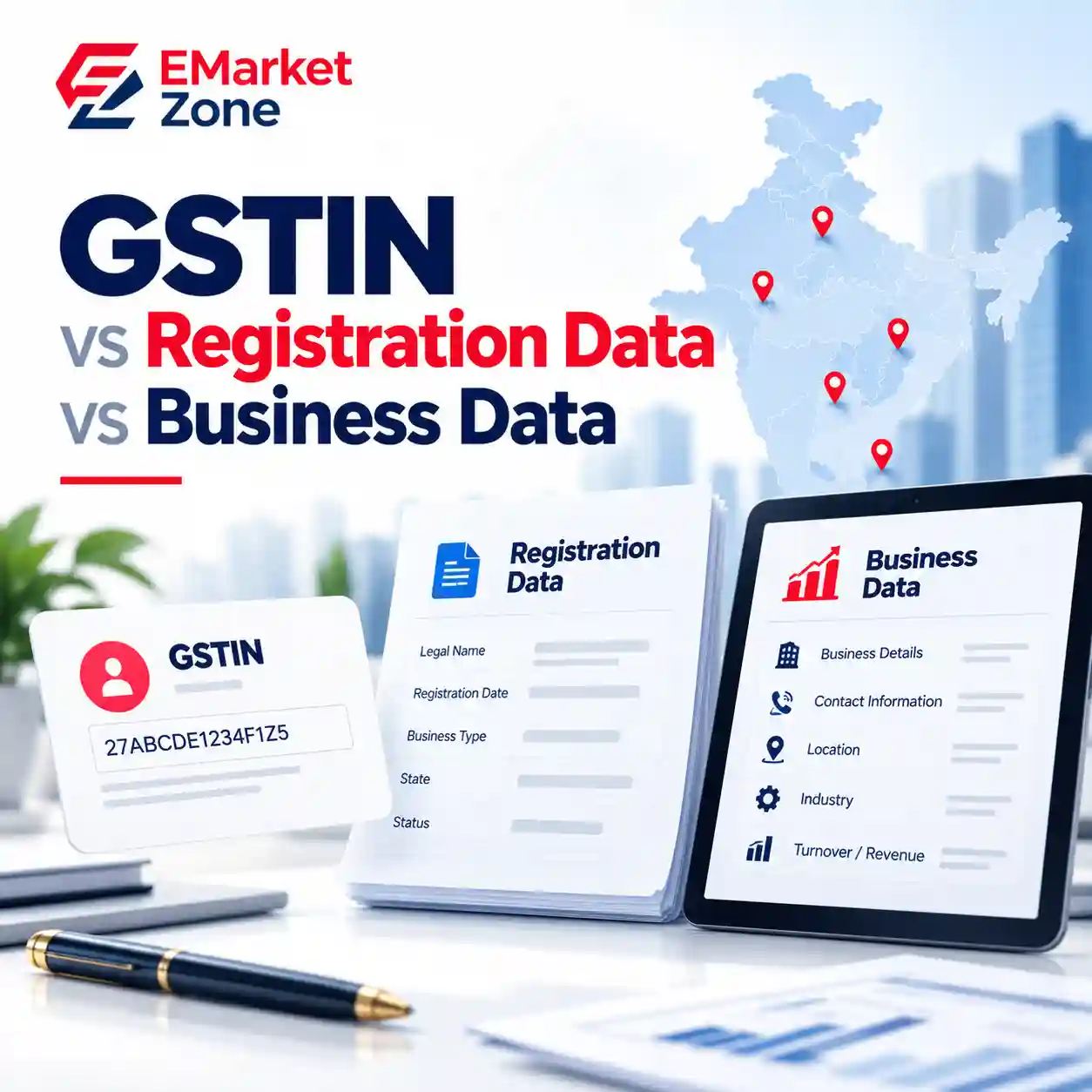
Businesses often use terms such as GSTIN, GST registration data and GST business data interchangeably. However, these terms refer to different things. Understanding the difference helps businesses verify suppliers, research markets and identify relevant companies for B2B sales and marketing.
A GSTIN identifies a taxpayer registered under the Goods and Services Tax system. GST registration data refers to information associated with that registration, while GST business data is a broader term commonly used for organised business information collected or compiled for research, sales prospecting and market analysis.
This guide explains how these concepts differ, what information can be checked through official GST tools and how businesses can use structured GST business data responsibly.
What Is a GSTIN?
GSTIN stands for Goods and Services Tax Identification Number. It is a unique identification number assigned to a taxpayer registered under India’s GST system.
Businesses and other eligible persons use their GSTIN for GST-related activities, including filing returns, issuing tax invoices where applicable and identifying themselves in GST transactions.
A GSTIN is an identifier, not a complete business profile. Knowing a company’s GSTIN does not automatically provide a ready-to-use list of its sales contacts, marketing details or commercial information.
Businesses can use the official GST Portal to search for taxpayer details using a GSTIN or UIN.
What can you learn from a GSTIN?
The GST Portal’s Search Taxpayer functionality can display information such as:
• GSTIN or UIN
• Legal name of the business
• Trade name, where applicable
• Effective date of registration
• Constitution of the business
• Principal place of business
• Registration status and cancellation details, where applicable
• Available return-filing information
The exact information displayed depends on the taxpayer record and the functionality available. Certain additional details may be accessible after login to the GST Portal.
For the official procedure and information fields, refer to the GST Portal’s Search Taxpayer User Guide.
What Is GST Registration Data?
GST registration data is information associated with registrations recorded in the GST system. It can be examined at an individual taxpayer level or in aggregate, depending on the source and the purpose of the analysis.
For example, an individual GST registration record can help a business check a supplier’s registration details. Aggregate registration statistics can help researchers understand changes in the number of taxpayers or compare registration trends across periods and regions.
GST registration data is useful for three main purposes.
1. Taxpayer verification
Businesses can check whether a GSTIN corresponds to the expected legal or trade name and review the registration status shown by the portal.
2. Registration trend analysis
Researchers can examine published GST statistics to understand changes in the taxpayer base or study reported registration trends. These figures must be interpreted according to their reporting period and definitions.
3. Geographic and business research
Where suitable data is available, registration records can help researchers study the distribution of registered taxpayers across states, cities or business categories.
However, aggregate statistics and individual registration records are not the same as a downloadable, contact-enriched list of potential customers.
What Is GST Business Data?
GST business data is a broad commercial term for organised information about businesses associated with GST registration records or other business-information sources.
Depending on the provider, coverage and compilation method, a structured GST business list may contain fields such as:
• Business or legal name
• GSTIN
• State, city or business address
• Business category or industry classification
• Registration-related information
• Turnover or revenue-related fields, where sourced and available
• Business contact fields, where collected and lawfully supplied
Not every GST business list contains all these fields. Coverage, contact availability, update frequency and data quality depend on the particular source and product.
GST registration records should not be assumed to include publicly accessible email addresses, mobile numbers or every detail needed for sales prospecting. These fields may require separate sources or compilation.
For businesses that need organised information for market research and B2B outreach, the important question is not just whether a GSTIN exists, but whether the available records contain the relevant fields for their intended use.
GSTIN vs GST Registration Data vs GST Business Data
The following comparison explains the practical difference.
| Term | What it means | Common use | Key limitation |
|---|---|---|---|
| GSTIN | A taxpayer identification number | Identifying a GST-registered taxpayer | It is an identifier, not a complete business profile |
| GST registration record | Information associated with an individual registration | Checking taxpayer details and registration status | It does not automatically provide a complete prospect profile |
| GST registration statistics | Aggregated figures about registrations or taxpayers | Researching trends and comparing reported figures | Aggregate figures are not individual business contact lists |
| GST business data | Organised business information compiled for research or commercial use | Market research, segmentation and B2B prospecting | Fields, coverage and accuracy vary by source |
The distinction matters because each type of information serves a different purpose. A GSTIN can help identify a taxpayer, a registration record can help verify details, and a structured business list can help organise a broader set of companies for research or outreach.
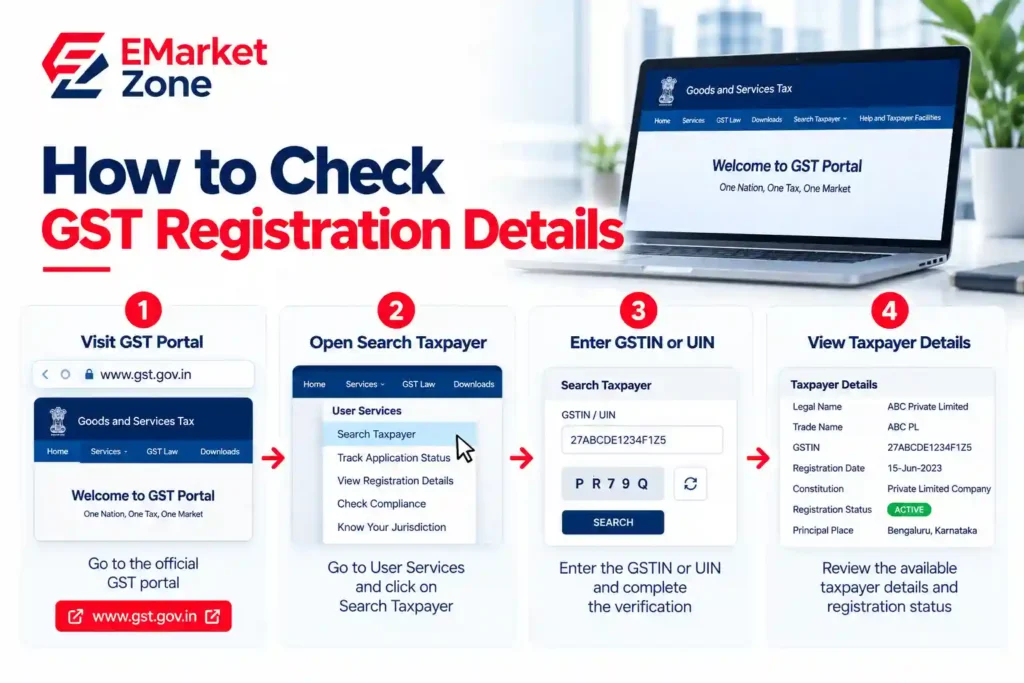
How to Check GST Registration Details on the Official Portal
If you already have a company’s GSTIN, you can use the official GST Portal to check its available taxpayer details.
Step 1: Visit the GST Portal
Open the official website at www.gst.gov.in.
Step 2: Open Search Taxpayer
Select the Search Taxpayer functionality available on the portal.
Step 3: Enter the GSTIN or UIN
Enter the taxpayer’s GSTIN or UIN and complete the displayed verification step if required.
Step 4: Review the taxpayer record
Examine the available business name, registration information and status. Where return-filing information is available, select the relevant financial year to review the displayed details.
Always check that the information corresponds to the business you intend to verify. If a record shows a suspended or cancelled status, investigate the details before relying on it for a commercial decision.
For the complete procedure, consult the official Search Taxpayer manual.
Does GST Registration Data Include Email IDs and Mobile Numbers?
This is an important distinction for businesses looking for B2B leads.
The official GST taxpayer search is primarily intended to display taxpayer and registration-related information. It should not be treated as a universal directory containing every registered business’s email address and mobile number.
A structured GST business list may include contact fields, but their presence depends on the data source, collection method and product specifications. Buyers should check exactly which fields are included rather than assuming that every record contains a working phone number or email address.
Before using a list for outreach, consider these questions:
• Does it include the business fields your sales team needs?
• Are the records organised by state, city or industry?
• Is the source and update period explained?
• Are contact fields included, and how is their quality assessed?
• Are there clear terms governing permitted use and marketing outreach?
These checks help distinguish a basic registration reference from a business list designed to support a defined prospecting workflow.
Is GST Registration Data the Same as Newly Registered Business Data?
No. The terms are related, but they are not interchangeable.
GST registration data can refer to registration information across a broader period. Newly registered business data focuses on registrations that meet a particular definition of being new within a specified period.
When evaluating a newly registered business list, check how the provider defines “newly registered,” which date or period is used, and whether the records reflect original registrations, amendments, reactivations or other changes.
Published statistics also require careful interpretation. A figure for new taxpayers during a financial year may use a specific reporting methodology and should not automatically be treated as the total number of GST registrations issued during that year.
For a deeper look at registration trends, read EMarket Zone’s research report on new GST registrations in India.
Businesses looking specifically for recently registered prospects can also explore the Newly Registered GST Business Data India page, and review its stated coverage and fields before making a decision.
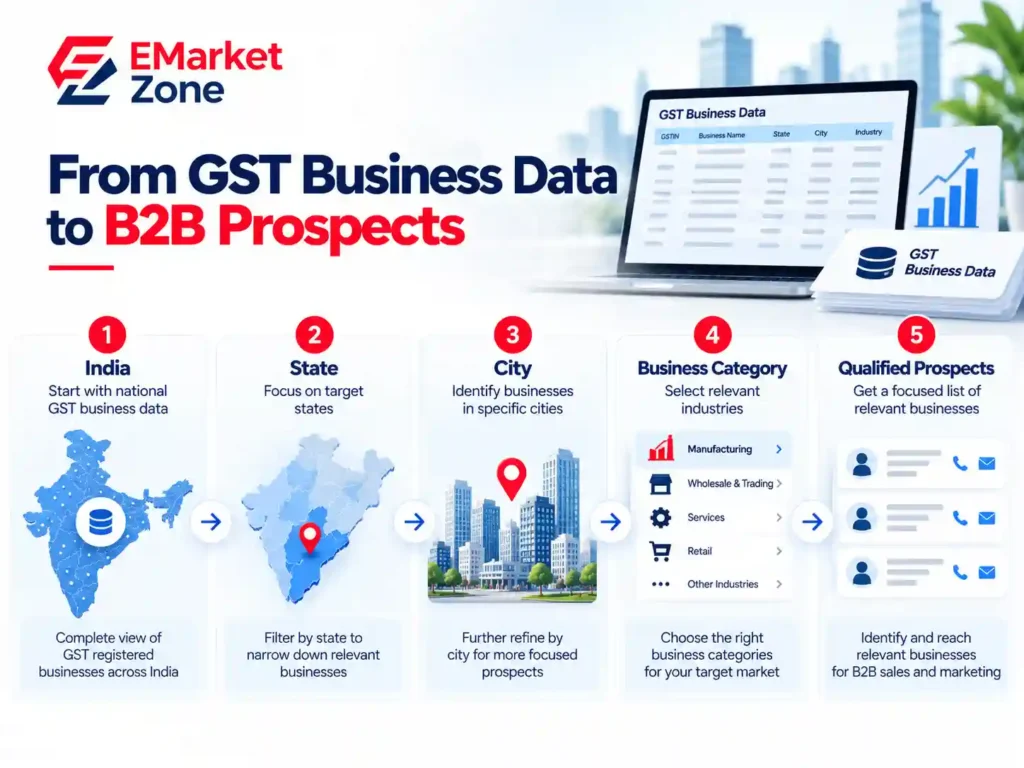
Structured GST business data can support several commercial workflows when it is relevant to the target market and appropriately maintained.
1. Identify businesses in a target market
A company selling accounting software, industrial supplies or business services may want to research businesses within a particular state or city. Geographic segmentation can help narrow the research universe to a more manageable set of potential customers.
2. Build industry-specific prospect lists
Businesses can organise prospects by relevant industry or business category where reliable classification information is available. This helps sales teams focus on organisations that match their products or services.
3. Plan geographic expansion
Companies exploring new markets can use regional business information to support initial research and compare potential areas of focus. Registration counts alone, however, do not establish demand or purchasing power.
4. Support sales and marketing workflows
Where suitable contact information is included and its use is permitted, structured business lists can help teams plan prospecting, prepare outreach segments and organise follow-up activities.
5. Verify records before outreach
GSTIN and registration details can serve as one verification input. Businesses should check relevant records, review contact quality and assess whether each prospect matches their ideal customer profile before starting outreach.
A registration is a starting point for research, not proof that a business is an active buyer or a qualified lead.
How to Evaluate a GST Business List
Before selecting GST business data for research or sales prospecting, evaluate it against your requirements.
Coverage: Check the states, cities, business categories and registration periods included.
Required fields: Confirm whether the list contains GSTINs, business names, addresses, industry details and the contact fields you need.
Freshness: Ask when the records were compiled or last updated. A recent compilation date does not, by itself, guarantee that every record is current.
Accuracy: Check how the provider validates records and whether registration status can be rechecked through official tools.
Duplication: Determine whether records are deduplicated at the appropriate level. One business may have multiple GST registrations, so a record count is not necessarily the same as a count of unique companies.
Methodology: Understand the source, date range and definitions used to compile the list. Treat turnover, revenue and other enriched fields according to their stated source and limitations.
Permitted use: Review applicable privacy requirements, data-use terms and marketing rules before contacting businesses.
For a broader overview of available options, visit EMarket Zone’s GST Database India page or its GST Database Provider India page. Check the product details to determine whether the coverage and included fields match your requirements.
Frequently Asked Questions
What is the difference between GSTIN and GST registration data?
GSTIN is the identification number assigned to a taxpayer under GST. GST registration data refers to the information associated with that registration, such as the business name, registration date and status displayed by the official portal.
Can I find a business using its GSTIN?
Yes. The official GST Portal provides a Search Taxpayer facility that allows users to search using a GSTIN or UIN and view the available taxpayer details.
Can I download all GST business data from the official portal?
The official taxpayer search is designed for checking taxpayer information. It should not be assumed to provide a single, comprehensive downloadable business list containing every registered business and its sales contact details.
Does every GST business list contain phone numbers and email addresses?
No. The fields vary by provider and source. Check the product specifications and contact-data coverage before purchasing or using a list.
Is GST registration data useful for lead generation?
It can support market research, geographic segmentation and initial prospect identification. Effective lead generation also requires a relevant target profile, appropriate contact information, record checks and qualification. GST registration alone does not establish that a business is interested in buying.
How can I find newly registered GST businesses in India?
Start by defining the period and meaning of “newly registered.” Use official resources to understand registration information and published trends, then evaluate any structured business list for its stated period, coverage and fields. See the Newly Registered GST Business Data India page for the relevant product information.
Conclusion
GSTIN, GST registration data and GST business data are related, but they serve different purposes. A GSTIN identifies a taxpayer, an official registration record helps users examine available taxpayer information, and a structured GST business list can organise business records for market research and prospecting.
The right choice depends on your objective. Use official GST tools to check taxpayer details, published statistics to understand registration trends, and appropriately sourced business information when you need to research and qualify potential B2B prospects.
For businesses evaluating structured records, start with the required geography, industry, registration period and contact fields. Verify relevant details before outreach, and remember that a GST registration is a research signal—not a guarantee of a qualified sales lead.
Leave a comment