

Many business owners believe lead generation becomes easy once they purchase a database.
The thinking is simple:
Buy a database.
Send emails.
Make calls.
Generate customers.
Unfortunately, that’s not how B2B lead generation works.
Every year, businesses spend money on business databases, email databases, contact lists, and lead generation tools expecting quick results.
Yet many of them never generate meaningful opportunities.
The surprising part is that the database is often not the problem.
The problem is how the database is used.
A database is not a lead generation strategy.
It is simply one component of a larger lead generation system.
Understanding that difference is where successful businesses separate themselves from everyone else.
The Biggest Misconception About Business Databases
One of the most common assumptions is:
“I purchased thousands of contacts, so I should start getting leads.”
But having access to contacts is not the same as generating business opportunities.
Imagine having the phone number of every business owner in your city.
Would that automatically generate customers?
Of course not.
You would still need:
• proper targeting
• relevant messaging
• credibility
• follow-up systems
• a compelling offer
Without those elements, even the most expensive database becomes ineffective.
This is why businesses often blame the data when the real issue is the process surrounding the data.
What Actually Happens After Buying a Database
The typical sequence looks something like this:
Day 1:
A company purchases a database.
Day 2:
They send the same message to thousands of contacts.
Day 5:
Very few people respond.
Day 7:
The company decides the database doesn’t work.
But after analyzing hundreds of outreach campaigns, a different pattern usually appears.
The real problems are:
• poor targeting
• generic messaging
• weak offers
• unrealistic expectations
• lack of follow-up
The database becomes the easiest thing to blame because it is the most visible part of the process.
Businesses that use a quality business leads database effectively usually build an entire outreach system around it.
Business Leads India
https://emarketzone.in/business-leads-india/
Why Targeting Matters More Than Database Size
Many buyers focus on quantity.
Questions like these are common:
“Do you have 1 lakh contacts?”
“Do you have 5 lakh contacts?”
A better question would be:
“Are these the right contacts?”
A database containing 5,000 highly relevant prospects is often more valuable than a database containing 500,000 random businesses.
For example:
A software company selling inventory management solutions should focus on businesses with inventory challenges.
Sending the same campaign to:
• restaurants
• schools
• hospitals
• travel agencies
usually produces poor results.
The more specific your targeting becomes, the better your outreach tends to perform.
This is why many businesses now prefer an industry-specific business database instead of broad contact lists.
Industry Wise Business Database India
https://emarketzone.in/industry-wise-business-database-india/
Company Database India
https://emarketzone.in/company-database-india/
Why Generic Outreach Fails
Most outreach campaigns sound exactly the same.
Messages often look like this:
“Hello Sir, we provide digital solutions.”
“We help businesses grow.”
“Can we schedule a call?”
Businesses receive dozens of these messages every week.
There is nothing memorable about them.
People rarely respond to services.
They respond to solutions.
Good outreach focuses on:
• business problems
• operational challenges
• measurable outcomes
• industry relevance
The more specific your communication becomes, the higher your response rates usually become.
Businesses using a segmented business email database often perform better because their communication is more targeted.
Business Email Database India
https://emarketzone.in/business-email-database-india/
The Decision-Maker Problem
Another reason many campaigns fail is that businesses contact the wrong people.
Many outreach campaigns target:
• support teams
• generic inboxes
• reception desks
• administrative contacts
instead of actual decision-makers.
The people responsible for business decisions are usually:
• founders
• owners
• directors
• senior management
When outreach reaches the correct person, conversations become significantly more productive.
This is why businesses increasingly focus on business owner contacts and decision-maker data.
Business Owner Contact List India
https://emarketzone.in/business-owner-contact-list-india/
Buy Decision Makers Data India
https://emarketzone.in/buy-decision-maker-data-india/
The Follow-Up Problem Nobody Talks About
Many businesses give up too early.
They send:
• one email
• one LinkedIn message
• one WhatsApp message
and stop.
This creates the false belief that outreach doesn’t work.
The reality is different.
Many prospects are:
• busy
• distracted
• prioritizing other projects
Successful outreach often requires multiple touchpoints before a conversation begins.
Businesses with structured follow-up systems consistently outperform businesses relying on one-time communication.
Why Some Businesses Generate Leads While Others Don't
The businesses generating consistent leads usually have three things:
First, they know exactly who they want to target.
Second, they use accurate and verified contact information.
Third, they follow a repeatable outreach process.
Many companies invest heavily in marketing but overlook the importance of data quality.
Without accurate contact information, even excellent outreach campaigns struggle to perform.
This is why many businesses use verified business leads databases to improve targeting and reduce wasted effort.
Verified Leads India
https://emarketzone.in/verified-leads-india/
Verified Company Contacts India
https://emarketzone.in/verified-company-contacts-india/
Where Databases Actually Create Value
A quality database helps businesses:
• find prospects faster
• improve targeting
• scale outreach
• reduce manual prospecting
• reach decision-makers
What it does not do is automatically generate customers.
The database creates access.
Your outreach process creates acquisition.
This is why two businesses can use the same data and achieve completely different results.
One generates meetings.
The other generates nothing.
The difference is usually the system, not the data.
Businesses targeting small and medium enterprises often use a dedicated MSME business database to improve relevance and outreach efficiency.
MSME Business Database India
https://emarketzone.in/msme-business-database-india/
Final Thoughts
Business databases are valuable tools.
But they are not magic solutions.
Many businesses fail because they expect databases to do the work that strategy, targeting, messaging, and follow-up should be doing.
The companies generating consistent leads understand something important:
A database does not generate customers.
A well-designed outreach system generates customers.
The database simply helps that system scale.
When businesses combine:
• verified contacts
• relevant targeting
• decision-maker outreach
• personalized communication
• consistent follow-up
the results improve dramatically.
That is where most successful lead generation campaigns are built.
FAQs
Many businesses fail because they focus only on acquiring contacts and ignore targeting, messaging, follow-up, and audience segmentation. A database provides access to prospects, but lead generation requires a complete outreach system.
Yes, business databases can be highly effective when they contain verified contacts and are used with proper outreach strategies. The quality of targeting and communication usually has a bigger impact than the size of the database.
The most common mistake is sending the same message to thousands of contacts without segmenting industries, company sizes, or decision-makers. Generic outreach usually produces poor response rates.
Businesses can improve results by:
- targeting specific industries
- contacting decision-makers
- using personalized messaging
- following up consistently
- using verified contact information
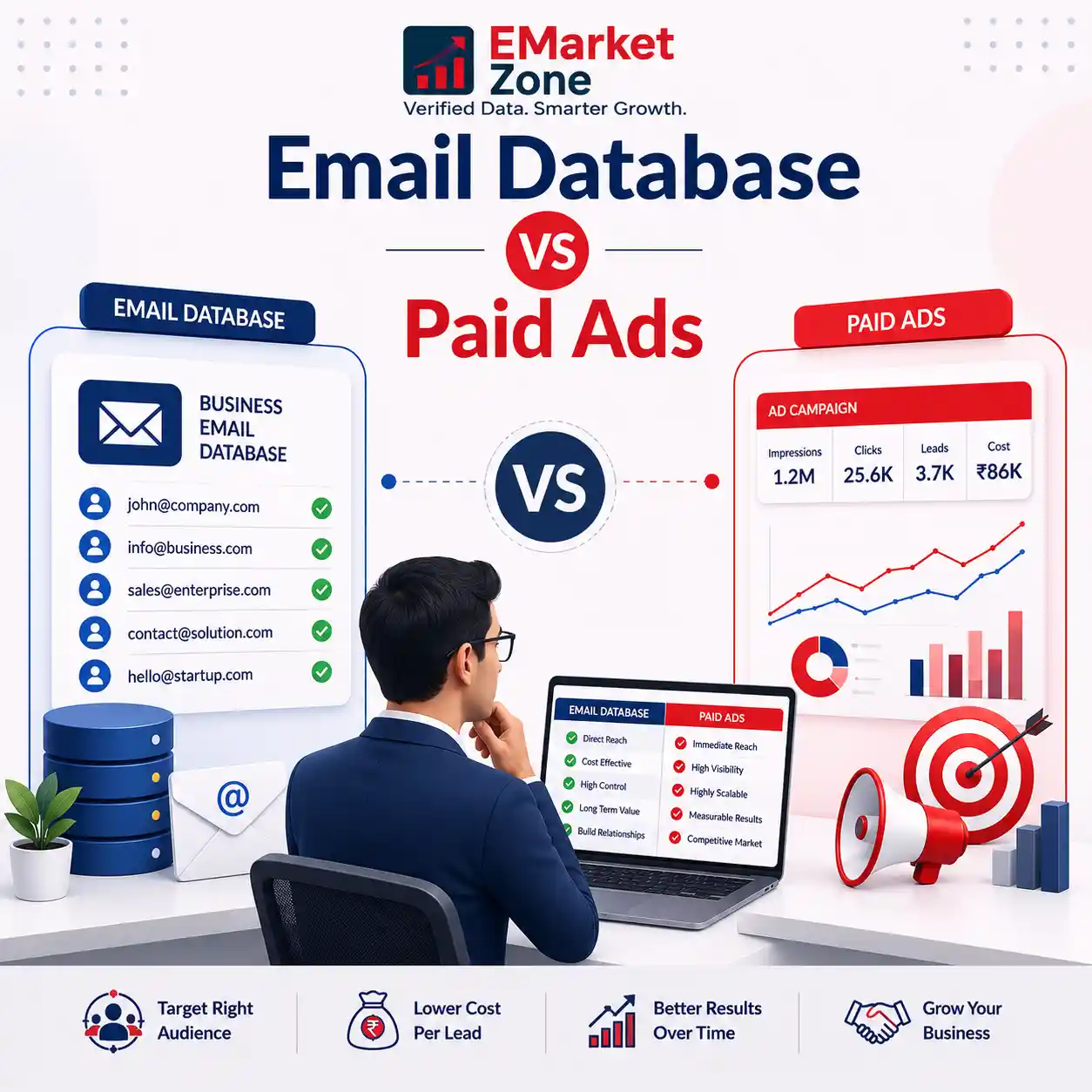
Business databases and paid advertising serve different purposes. Databases help businesses directly reach targeted prospects, while paid advertising attracts potential customers through inbound channels. Many successful companies use both strategies together.
Verified business data reduces bounce rates, improves deliverability, and helps businesses reach active prospects. Poor-quality data often leads to wasted outreach efforts and lower conversion rates.
Leave a comment