
GST Taxpayer Growth in India: 2017–2026 Statistics
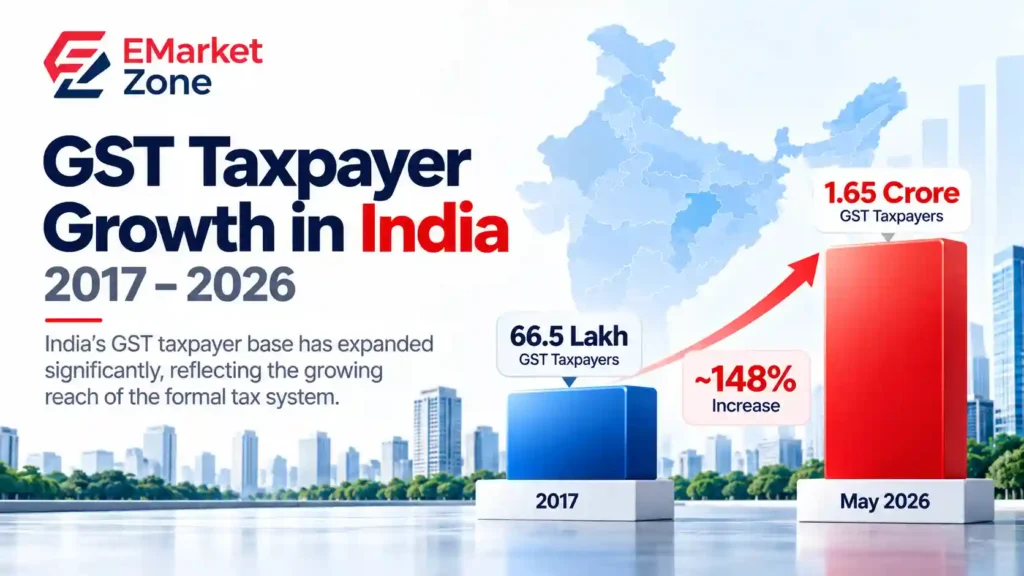
India’s Goods and Services Tax (GST) system has expanded substantially since its introduction in July 2017. The number of GST taxpayers increased from 66.5 lakh in 2017 to 1.65 crore in May 2026, according to the Government of India’s Press Information Bureau (PIB). This represents an increase of approximately 148% over the period.
The expansion provides an important indicator of the growing reach of India’s formal indirect-tax system. However, taxpayer-base growth should not be interpreted as an equivalent increase in newly established businesses, active companies, or commercially qualified prospects.
This article examines the available GST taxpayer statistics, explains the historical comparison and outlines what these figures can and cannot tell us about India’s evolving business landscape.
Key GST Taxpayer Statistics in India
Source: Government of India, Press Information Bureau, “Nine Years of GST: Simplifying Taxation, Strengthening India”; PIB research factsheet on GST and formalisation. Calculations by EMarket Zone. Figures refer to the taxpayer base at the stated dates, not cumulative new registrations.
| Indicator | Figure | Reference period |
|---|---|---|
| GST taxpayer base | 66.5 lakh | 2017 |
| GST taxpayer base | 1.65 crore | May 2026 |
| Absolute increase | Approximately 98.5 lakh | 2017–May 2026 |
| Relative increase | Approximately 148% | 2017–May 2026 |
| Multiple of the original base | Approximately 2.48 times | 2017–May 2026 |
| Latest national figure cited in the July 2026 government factsheet | More than 1.68 crore | 31 July 2026 |
1. GST Taxpayer Base: 2017 vs 2026
GST was introduced on 1 July 2017 to bring multiple central and state indirect taxes into a more integrated framework. Since its implementation, the GST taxpayer base has expanded considerably.
The Government of India’s June 2026 publication reports that the number of GST taxpayers increased from 66.5 lakh in 2017 to 1.65 crore in May 2026.
The comparison indicates:
• 66.5 lakh taxpayers in 2017.
• 1.65 crore taxpayers by May 2026.
• Approximately 98.5 lakh additional taxpayers between the two reported points.
• Approximately 148% growth relative to the 2017 base.
The percentage calculation is:
Percentage increase = (Final figure − Initial figure) ÷ Initial figure × 100
Using the published figures:
(165 − 66.5) ÷ 66.5 × 100 ≈ 148.1%
The figures are rounded government-reported totals, so the calculated increase is also approximate.
This comparison illustrates the expansion of the GST taxpayer base. It does not establish that 98.5 lakh entirely new businesses were created during the period, because changes in the taxpayer base can reflect registrations, cancellations, reactivations, compliance changes and other factors.
2. GST Taxpayer Base Crossed 1.68 Crore by July 2026
A subsequent Government of India factsheet reports that registered taxpayers increased from around 60 lakh in 2017 to more than 1.68 crore as of 31 July 2026.
This is a later reference point than the May 2026 figure of 1.65 crore. It provides further context for the scale of the GST taxpayer base, but it should not be treated as a count of registrations added during July alone.
The distinction matters because three different measures are often confused:
• Total taxpayer base: The number of taxpayers recorded at a particular point in time.
• New taxpayers: The count classified as new taxpayers within a specified reporting period.
• Net change: The difference between taxpayer counts at two points in time.
These measures answer different questions and should not be used interchangeably.
For a more detailed examination of new taxpayers and their geographic distribution, see the EMarket Zone research report, New GST Registrations in India 2026: State, Industry & Emerging Business Trends.
3. What Does GST Taxpayer Growth Indicate?
The expansion of the GST taxpayer base is relevant to understanding the reach of India’s formal tax framework. It can provide context for research into formalisation, compliance and the geographic distribution of registered economic activity.
However, the figures require careful interpretation.
A wider registered taxpayer base
The increase indicates that substantially more taxpayers were recorded within the GST system by 2026 than in 2017. The change is consistent with an expanding formal tax-registration framework.
A useful signal for business-market research
GST statistics can help researchers understand the scale of the registered taxpayer universe. When combined with state-level, city-level and industry-level information from appropriate datasets, they can help identify markets for further investigation.
Not a direct measure of business creation
A larger taxpayer base does not automatically mean an equivalent increase in newly founded companies. A registration can relate to an existing business entering the GST system, a business formalising its operations, or a registration associated with a particular place of business.
The data also does not directly measure revenue, employment, purchasing power or the commercial viability of individual businesses.
4. Why GST Taxpayer Statistics Matter for B2B Companies
For B2B companies, national GST statistics provide useful background, but they are only the first stage of market analysis.
A national figure cannot identify which businesses in a particular city are relevant to a supplier, software company, logistics provider or professional-services firm. More granular analysis is needed to move from the overall taxpayer universe to a defined target market.
A practical research framework is:
National statistics → State-level analysis → City-level targeting → Industry selection → Business identification → Prospect qualification
Each stage answers a more specific question.
• National statistics establish the broader context.
• State-level data helps compare geographic markets.
• City-level analysis narrows the search to relevant commercial centres.
• Industry and business attributes help identify relevant categories.
• Prospect qualification assesses whether an individual business fits the intended customer profile.
GST registration information can support this process, but a registration alone does not establish that a business is active, interested in a product or qualified to buy.
Companies should therefore combine market research with relevant business attributes, appropriate data-quality checks and a clearly defined ideal customer profile.
5. From GST Statistics to Business Data
There is an important difference between knowing how large a registered taxpayer base is and identifying individual businesses within a target market.
Market statistics explain the broader opportunity. Business-level data helps identify businesses to evaluate.
For companies researching the Indian B2B market, geographic segmentation can help narrow a broad national market into more manageable prospecting areas.
Explore the following EMarket Zone resources:
• GST Database India – explore GST-focused business data for B2B prospecting.
• State-wise GST Business Data – explore business data organised by state.
• City-wise GST Business Data – explore geographic segmentation at the city level.
These resources are intended to support business identification and prospecting. They should not be interpreted as a guarantee that every listed registration represents an active buyer or qualified lead.
Frequently Asked Questions
The Government of India’s June 2026 publication reports a GST taxpayer base of approximately 66.5 lakh in 2017.
The PIB reported approximately 1.65 crore GST taxpayers as of May 2026.
A Government of India factsheet reported more than 1.68 crore registered taxpayers as of 31 July 2026.
Using the published figures of 66.5 lakh in 2017 and 1.65 crore in May 2026, the increase is approximately 148.1%. This is a comparison of the reported taxpayer base at two points in time, not a count of newly created businesses.
No. Taxpayer-base growth is not equivalent to new business formation. Registrations can reflect formalisation, changes in registration status and other factors. Additional evidence is needed to measure business creation or commercial activity directly.
The GSTN publication 7 Years of GST contains state-wise new-taxpayer figures for FY 2023–24. EMarket Zone’s research report, New GST Registrations in India 2026: State, Industry & Emerging Business Trends, provides additional analysis and context.
Sources and References
• Press Information Bureau, Government of India. “Nine Years of GST: Simplifying Taxation, Strengthening India.” Published 30 June 2026. Reports 66.5 lakh GST taxpayers in 2017 and 1.65 crore in May 2026. https://www.pib.gov.in/PressReleasePage.aspx?PRID=2279318&lang=1®=3
• Press Information Bureau, Government of India. GST and formalisation research factsheet. Reports more than 1.68 crore registered taxpayers as of 31 July 2026. https://www.pib.gov.in/FactsheetDetails.aspx?Id=150871&lang=2®=48
• Goods and Services Tax Network (GSTN). 7 Years of GST: A Statistical Report on Completion of 7 Years of GST. https://tutorial.gst.gov.in/offlineutilities/gst_statistics/7YearsReport.pdf
Research note: The national taxpayer-base figures above are published by the Government of India. Percentages and absolute differences are EMarket Zone calculations using the rounded published values. Different reference dates and taxpayer measures should not be treated as a continuous new-registration series.