
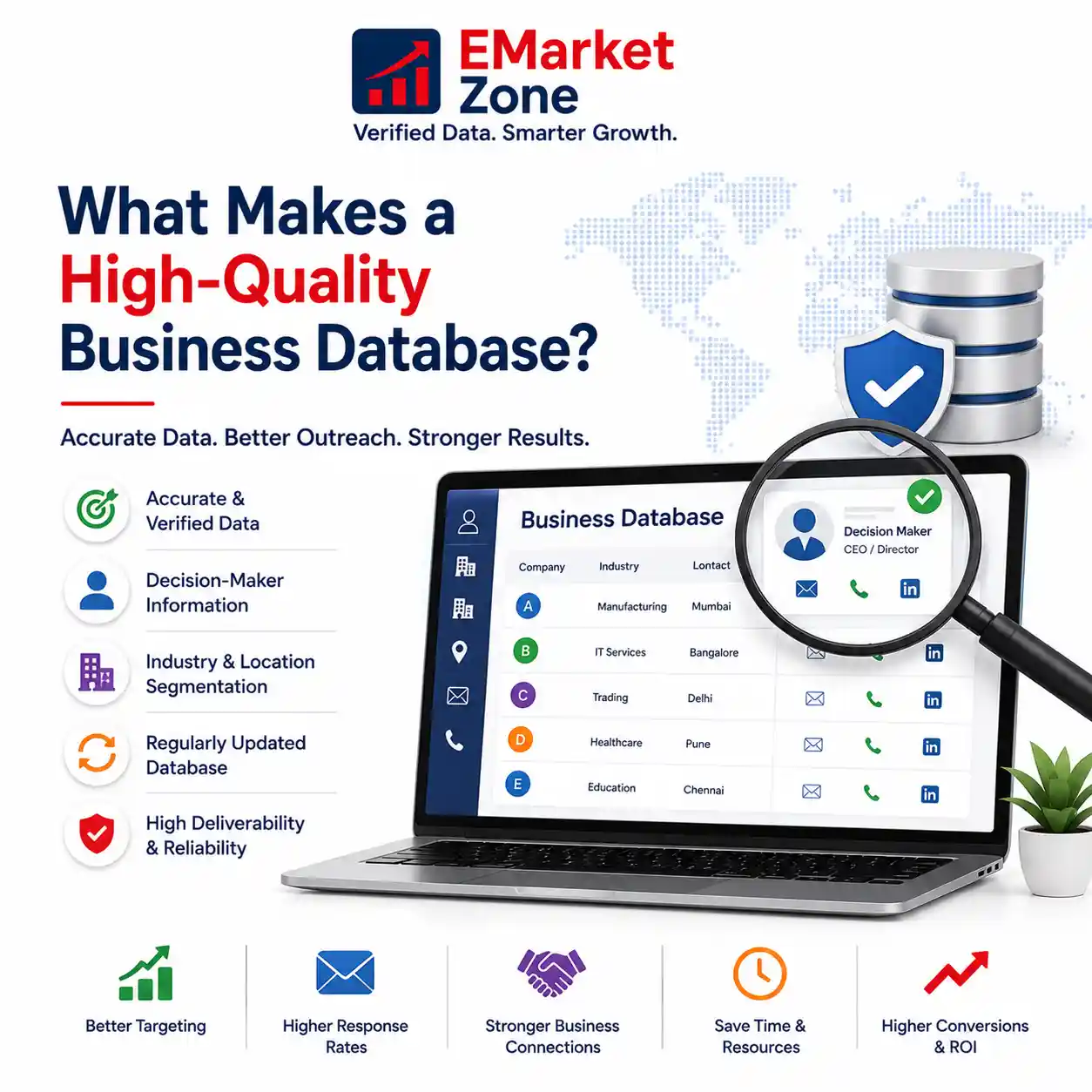
Not all business databases are created equal.
At first glance, many databases look similar.
They contain:
• company names
• email addresses
• phone numbers
• business information
Because of this, buyers often compare databases using only one factor:
The number of contacts.
This is usually a mistake.
A database containing fewer but highly relevant contacts can outperform a much larger database filled with outdated or irrelevant information.
The real value of a business database comes from quality rather than quantity.
Understanding what defines quality can help businesses make better purchasing decisions and generate better results.
Why Businesses Use Databases
Every lead generation strategy begins with one requirement:
Prospects.
Without potential customers, businesses cannot generate inquiries, meetings, or sales opportunities.
This is why many companies use business databases to:
• identify prospects
• find decision-makers
• enter new markets
• improve outreach efficiency
A database helps businesses spend less time researching and more time communicating.
However, that advantage only exists when the data is accurate.
The Biggest Misconception About Databases
Many buyers assume larger databases are automatically better.
This belief often leads to poor decisions.
Imagine two databases:
Database A:
500,000 contacts
Database B:
25,000 highly targeted contacts
Many buyers choose Database A immediately.
But if Database B contains the exact audience a business wants to reach, it may generate significantly better results.
Quality data almost always beats irrelevant volume.
Factor #1: Data Accuracy
Accuracy is the foundation of a useful database.
If contact information is incorrect, outreach becomes inefficient.
Poor accuracy creates:
• bounced emails
• disconnected numbers
• wasted effort
• lower response rates
Businesses should prioritize providers that focus on data verification and updates.
Verified Company Contacts India
https://emarketzone.in/verified-company-contacts-india/
Factor #2: Relevant Targeting
The best database is not necessarily the largest.
It is the most relevant.
Businesses should evaluate whether the database includes:
• target industries
• target locations
• target company sizes
• target decision-makers
The more relevant the audience, the better the outreach potential.
Factor #3: Decision-Maker Access
One of the most valuable characteristics of a business database is access to decision-makers.
Many generic databases only provide company-level information.
High-quality databases often include:
• founders
• owners
• directors
• CEOs
• partners
This helps businesses communicate with people who can influence purchasing decisions.
Business Owner Contact List India
https://emarketzone.in/business-owner-contact-list-india/
Buy Decision Makers Data India
https://emarketzone.in/buy-decision-maker-data-india/
Factor #4: Industry Segmentation
Businesses rarely target every industry.
A recruitment company has different prospects than:
• a software provider
• an exporter
• a consultant
• a manufacturer
Industry segmentation allows businesses to focus outreach more effectively.
This usually improves relevance and response rates.
Industry Wise Business Database India
https://emarketzone.in/industry-wise-business-database-india/
Factor #5: Data Freshness
Business information changes constantly.
Companies:
• relocate
• change leadership
• update phone numbers
• create new email addresses
A database that is never updated becomes less useful over time.
Freshness is one of the strongest indicators of database quality.
Businesses should always consider how frequently data is updated.
Factor #6: Geographic Coverage
Location matters.
Many businesses target:
• specific states
• cities
• regions
• countries
A useful database should support geographic filtering.
This helps businesses avoid wasting resources on irrelevant markets.
Factor #7: Scalability
A database should support growth.
Businesses often begin with one market segment.
As they expand, they may need:
• additional industries
• additional regions
• additional decision-makers
A scalable database allows businesses to increase outreach without rebuilding prospect lists from scratch.
Factor #8: Deliverability Potential
Email outreach remains one of the most common lead generation channels.
However, deliverability depends heavily on data quality.
Poor databases often create:
• bounce issues
• spam complaints
• lower sender reputation
Higher-quality databases generally improve campaign performance because contact information is more accurate.
Business Email Database India
https://emarketzone.in/business-email-database-india/
Why Businesses Often Buy the Wrong Database
Many businesses focus on price.
Others focus on volume.
Very few focus on fit.
The most useful database is usually the one that aligns with:
• business goals
• target audience
• outreach strategy
The wrong database can create thousands of contacts but very few opportunities.
The right database can create meaningful conversations with a much smaller audience.
Why Quality Data Improves ROI
Better data improves efficiency across the entire sales process.
Teams spend less time:
• researching
• cleaning data
• verifying contacts
and more time:
• prospecting
• communicating
• following up
This often improves return on investment.
Business Leads India
https://emarketzone.in/business-leads-india/
What MSMEs Should Prioritize
Most MSMEs operate with limited resources.
They cannot afford large amounts of wasted outreach.
For smaller businesses, database quality is especially important.
Targeted, verified data often produces better outcomes than large generic databases.
MSME Business Database India
https://emarketzone.in/msme-business-database-india/
Final Thoughts
A high-quality business database is not defined by size alone.
The most valuable databases typically provide:
• accurate information
• relevant targeting
• decision-maker access
• industry segmentation
• regular updates
Businesses that evaluate data using these criteria usually make better purchasing decisions and achieve stronger outreach results.
The goal should not be acquiring the most contacts.
The goal should be reaching the right contacts.
FAQs
A high-quality business database contains accurate, relevant, and regularly updated business information that supports lead generation and outreach.
Accurate data reduces bounced emails, wasted outreach, and incorrect contact attempts.
Common fields include company names, industries, locations, phone numbers, email addresses, and decision-maker details.
Decision-makers have purchasing authority and can help move business conversations forward faster.
The more frequently data is updated, the more useful it becomes for outreach campaigns.
No. A smaller but highly targeted database often performs better than a larger, less relevant database.
Business databases help MSMEs identify prospects faster and improve lead generation efficiency without building large sales teams.
Leave a comment