
New GST Registration Statistics in India: Key Numbers and Trends
India’s Goods and Services Tax (GST) system provides an important source of information about the country’s registered taxpayer base. Its statistics help researchers understand the scale of registration activity, compare states and examine changes in the reach of the formal tax system.
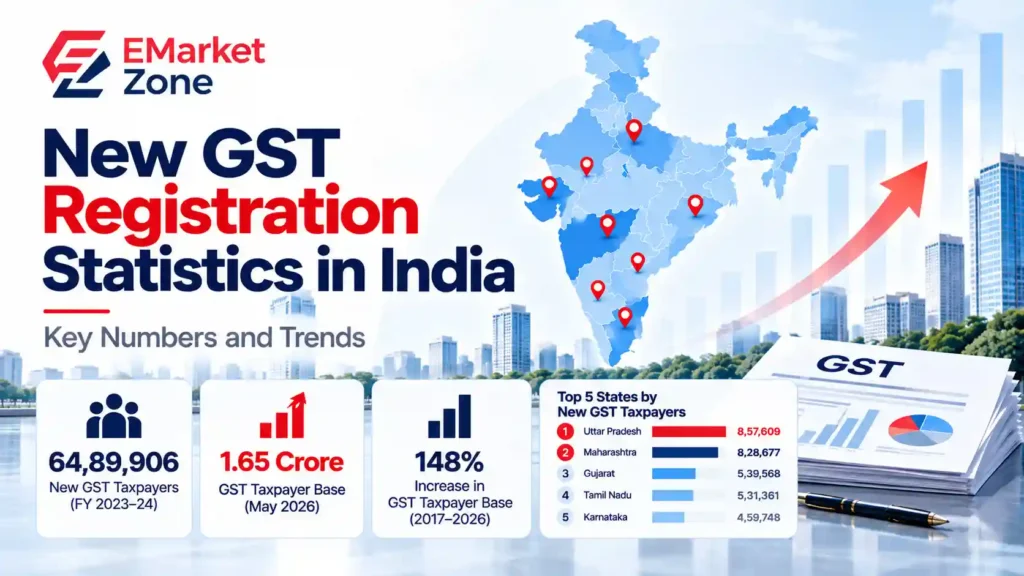
According to the Goods and Services Tax Network (GSTN), India recorded 64,89,906 new taxpayers in FY 2023–24. Separately, the Government of India reported that the national GST taxpayer base reached 1.65 crore in May 2026.
These figures describe different aspects of the GST system. One measures new taxpayers reported during a financial year; the other describes the taxpayer base at a particular point in time.
This article brings together key GST registration statistics, explains how to interpret them and outlines their relevance for geographic market research and B2B prospecting.
Key GST Registration Statistics in India
| Indicator | Reported figure | Reference period |
|---|---|---|
| New taxpayers nationally | 64,89,906 | FY 2023–24 |
| New taxpayers in Uttar Pradesh | 8,57,609 | FY 2023–24 |
| New taxpayers in Maharashtra | 8,28,677 | FY 2023–24 |
| New taxpayers in Gujarat | 5,39,568 | FY 2023–24 |
| GST taxpayer base | 66.5 lakh | 2017 |
| GST taxpayer base | 1.65 crore | May 2026 |
| GST taxpayer base | More than 1.68 crore | 31 July 2026 |
Sources: GSTN, 7 Years of GST: A Statistical Report on Completion of 7 Years of GST; Government of India, Press Information Bureau (PIB). Figures refer to their stated periods and definitions.
1. India Recorded 64.89 Lakh New Taxpayers in FY 2023–24
GSTN reported 64,89,906 new taxpayers nationally in FY 2023–24.
This is a useful reference point for analysing the geographic distribution of the new-taxpayer measure reported by GSTN. State-level figures show that registration activity was not evenly distributed across India.
The largest reported state counts included:
• Uttar Pradesh: 8,57,609
• Maharashtra: 8,28,677
• Gujarat: 5,39,568
• Tamil Nadu: 5,31,361
• Karnataka: 4,59,748
These figures can help researchers identify states for further investigation. However, the number of new taxpayers in a state does not directly measure its revenue potential, number of newly founded companies or demand for a particular product.
For the full ranking and state-level shares, see our detailed article on state-wise new GST taxpayers in India.
Source: GSTN, 7 Years of GST. Reference period: FY 2023–24.
2. India's GST Taxpayer Base Expanded Between 2017 and 2026
Government of India figures show a substantial increase in the reported GST taxpayer base since the tax system was introduced.
The PIB’s June 2026 publication reported the following comparison:
| Reference date | GST taxpayer base |
|---|---|
| 2017 | 66.5 lakh |
| May 2026 | 1.65 crore |
Using these rounded figures, the taxpayer base increased by approximately 98.5 lakh, or 148.1%, between the two reported points.
The calculation is:
Percentage increase = (Final figure − Initial figure) ÷ Initial figure × 100
The resulting percentage describes the change between the two reported taxpayer-base figures. It does not represent the number of new registrations during that period.
A separate Government of India factsheet reported more than 1.68 crore registered taxpayers as of 31 July 2026. This later figure provides additional context but should not be treated as the count of registrations added during July alone.
For a detailed examination of the national trend, see GST Taxpayer Growth in India: 2017–2026 Statistics.
3. Which States Accounted for the Largest New-Taxpayer Counts?
The state-wise GSTN figures identify Uttar Pradesh and Maharashtra as the two leading states in FY 2023–24.
| Rank | State | New taxpayers |
|---|---|---|
| 1 | Uttar Pradesh | 8,57,609 |
| 2 | Maharashtra | 8,28,677 |
| 3 | Gujarat | 5,39,568 |
| 4 | Tamil Nadu | 5,31,361 |
| 5 | Karnataka | 4,59,748 |
These five states together recorded 27,16,963 new taxpayers, approximately 41.86% of the national total of 64,89,906.
This calculation shows the concentration of reported new-taxpayer counts among the five leading states. It does not establish that these states account for the same share of active businesses, economic output or commercial demand.
A company considering geographic expansion should combine state-level figures with more specific information about cities, industries and the characteristics of its intended customers.
4. Three GST Metrics That Should Not Be Confused
GST statistics are easier to interpret when the underlying measure is clearly identified.
Total taxpayer base
This is the reported taxpayer count at a particular point in time. For example, the Government of India reported 1.65 crore taxpayers in May 2026.
New taxpayers
This is the measure reported as new taxpayers for a defined period. GSTN recorded 64,89,906 new taxpayers nationally in FY 2023–24.
Net change in the taxpayer base
This is the difference between taxpayer counts at two points in time. It is not necessarily equal to the number of new registrations because cancellations, changes in registration status and other factors can affect the total.
These measures answer different questions. A taxpayer-base comparison cannot substitute for a new-registration count, and neither measure should automatically be interpreted as the number of newly established companies.
5. What Can GST Registration Statistics Tell Us?
GST statistics can support research into the scale and geographic distribution of registered taxpayer activity.
They can help researchers:
• Compare state-level new-taxpayer counts.
• Understand the size of the reported taxpayer base at different dates.
• Identify geographic markets for further investigation.
• Establish context for research into formalisation.
• Develop questions for more detailed business and industry analysis.
However, GST registration statistics do not independently establish whether a business is currently active, its revenue, the number of employees it has, its purchasing capacity or its likelihood of becoming a customer.
GST registration statistics are a market-research input, not a complete measure of business activity.
6. From GST Statistics to Geographic B2B Research
For B2B companies, national statistics are useful for understanding the broader market, but they do not identify individual businesses that match a particular sales objective.
A more targeted approach moves through several levels:
India → State → City → Industry → Business → Prospect
State-level research helps compare geographic markets. City-level analysis narrows the search to relevant commercial centres. Industry and business-level information can then help identify accounts that fit a company’s target customer profile.
EMarket Zone offers GST-focused business-data resources that can support this process:
• GST Database India – explore GST-focused business data for national prospecting.
• State-wise GST Business Data – explore business data organised by state.
• City-wise GST Business Data – explore geographic segmentation by city.
Business data can help identify potential accounts, but records should be assessed for relevance and data quality. A GST registration alone does not establish that a business is an active buyer or a qualified lead.
Frequently Asked Questions
GSTN reported 64,89,906 new taxpayers nationally in FY 2023–24.
The Government of India’s June 2026 publication reported 1.65 crore GST taxpayers as of May 2026.
Uttar Pradesh ranked first in the GSTN FY 2023–24 state-wise dataset, with 8,57,609 new taxpayers.
No. The taxpayer base is a count at a particular point in time, whereas new taxpayers refers to a measure reported for a defined period. Net changes in the base are another distinct measure.
Not by themselves. They provide market context, but identifying qualified prospects requires relevant business-level information, suitable selection criteria and additional qualification.
Sources and References
• Goods and Services Tax Network (GSTN). 7 Years of GST: A Statistical Report on Completion of 7 Years of GST. State-wise new-taxpayer figures and national total for FY 2023–24.
https://tutorial.gst.gov.in/offlineutilities/gst_statistics/7YearsReport.pdf
Methodology note: State rankings use the FY 2023–24 new-taxpayer counts reported by GSTN. National shares and the combined top-10 share are EMarket Zone calculations. Figures are rounded where applicable. These counts should not be treated as measures of active businesses, revenue or commercial potential.