
About This Report
This report examines the landscape of Micro, Small and Medium Enterprises (MSMEs) in India, with a focus on enterprise classification, geographic distribution, industry composition, business clusters, and emerging commercial opportunities. The analysis explores India’s MSME ecosystem at the national, state, city, and industry levels, using available official data and information for the selected research period through 2026.
MSMEs play an important role in India’s economic activity, contributing to manufacturing, services, trade, employment, and regional business development. Their distribution across states, industries, and enterprise categories provides valuable insight into the structure of India’s business ecosystem. However, MSME registrations should not be interpreted as a direct measure of active business operations, revenue, or commercial performance.
The research is intended for B2B companies, manufacturers, suppliers, sales and marketing teams, market researchers, investors, consultants, and business-data users seeking to understand India’s MSME landscape, evaluate industry and regional opportunities, and identify relevant business segments for targeted market development.
Prepared by EMarket Zone
Business Data • Market Intelligence • B2B Lead Generation
Executive Summary
India’s Micro, Small and Medium Enterprises (MSMEs) form a broad and diverse part of the country’s business ecosystem. They contribute to manufacturing, services, trade, employment and exports, while supporting business activity across urban, semi-urban and rural markets. Their scale and distribution make the sector important for understanding India’s regional economic structure and identifying commercial opportunities.
1. India's MSME Landscape at a Glance
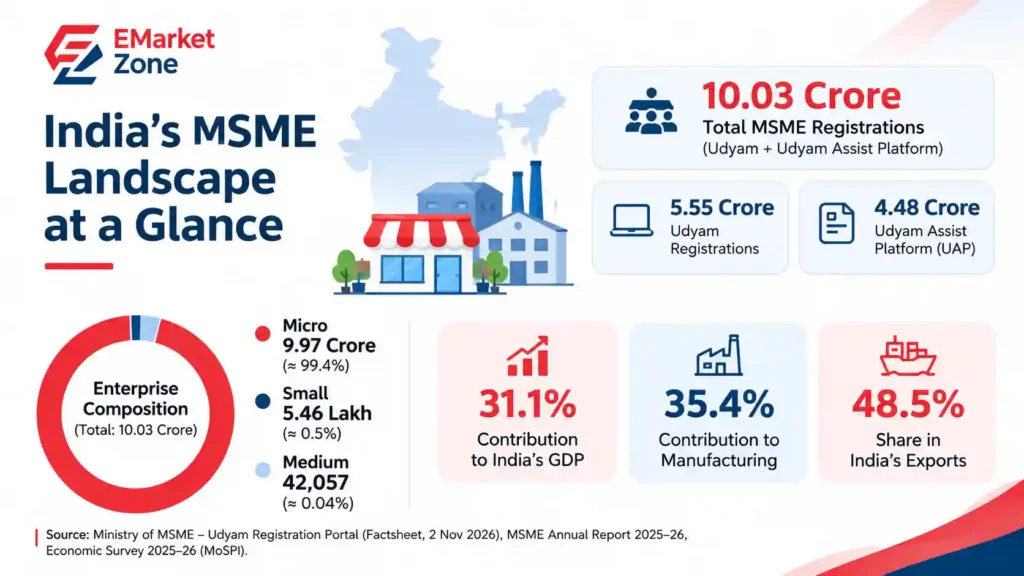
As of 2 November 2026, the Ministry of MSME’s Udyam Registration factsheet reported approximately 10.03 crore combined registrations across the Udyam Registration Portal and Udyam Assist Platform (UAP). Of these, around 5.55 crore were recorded on the Udyam Registration Portal and 4.48 crore on UAP. The combined classified figures showed approximately 9.97 crore micro enterprises, 5.46 lakh small enterprises and 42,057 medium enterprises.
The figures demonstrate the scale of formalisation and registration activity within India’s MSME ecosystem. However, combined Udyam and UAP registrations should not be interpreted as a count of unique, currently operating businesses. UAP specifically supports the formalisation of informal micro enterprises, and its figures need to be distinguished from standard Udyam registrations when comparing enterprise populations.
2. Key Findings and Market Patterns
The MSME sector has a significant role in India’s economic structure. The Ministry of MSME’s Annual Report 2025–26 reports that the sector contributes approximately 31.1% of India’s GDP and over 48.5% of exports. The Economic Survey 2025–26 also reports an estimated 35.4% contribution to manufacturing. These indicators underline the sector’s importance to domestic production and India’s participation in global trade.
The registration profile also highlights the dominance of micro enterprises. The official factsheet recorded approximately 9.97 crore micro enterprises across Udyam and UAP combined, compared with substantially smaller registered counts for small and medium enterprises. By reported business activity, the MSME dashboard showed substantial representation across manufacturing, services and trading.
Geographic and industry-level distribution adds another dimension to the analysis. State-wise registration data published by the Ministry provides a basis for examining regional concentration, while activity classifications help distinguish the broad composition of the MSME ecosystem. These figures describe registrations and reported classifications; they do not independently establish the revenue, productivity or current operating status of individual enterprises.
3. Major Opportunities and Report Highlights
India’s MSME ecosystem presents opportunities across manufacturing, services, trading, wholesale distribution and supporting business services. Understanding where enterprises are concentrated, which industries are represented and how business activity varies by region can help companies identify relevant markets and develop more focused commercial strategies.
For manufacturers, suppliers, distributors, financial institutions, technology providers and B2B service companies, MSME segmentation can support market assessment and customer identification. State-wise, industry-wise and enterprise-category analysis can help narrow broad markets into more relevant business segments.
This report examines these dimensions through eight chapters covering India’s MSME framework, state-wise distribution, industry structure, enterprise classification, major business hubs, growth drivers, commercial opportunities and market intelligence. Its objective is to present a structured view of the MSME ecosystem and explain how reliable market information can support better business decisions.
Sources and references for this section 1.
1. Ministry of Micro, Small and Medium Enterprises – Udyam Registration Portal and MSME Factsheet. Factsheet dated 2 November 2026.
2. Ministry of MSME – Annual Report 2025–26.
3. Government of India, Press Information Bureau – Economic Survey 2025–26: MSME sector contribution.
4. Ministry of MSME – MSME Performance Dashboard.
5. Ministry of MSME – State-wise Udyam Registration Data.
Data note: Registration figures are point-in-time portal records. Udyam and UAP are presented separately where relevant. GDP, export and manufacturing contribution figures are published estimates from the cited government reports and may relate to different reference periods.
Chapter 01 - Understanding India's MSME Ecosystem
India’s Micro, Small and Medium Enterprises (MSMEs) represent a diverse network of businesses operating across manufacturing, services and trading. From small local enterprises to specialised industrial units and growing service providers, these businesses contribute to economic activity across different regions and market segments.
Understanding the MSME ecosystem requires more than looking at registration numbers. It involves examining how enterprises are classified, the role they play in the economy and the government framework used to bring businesses into the formal registration system.
This chapter establishes the foundation for analysing India’s MSME landscape, including its classification structure, economic contribution and registration framework.
1.1 MSME Definition and Classification in India
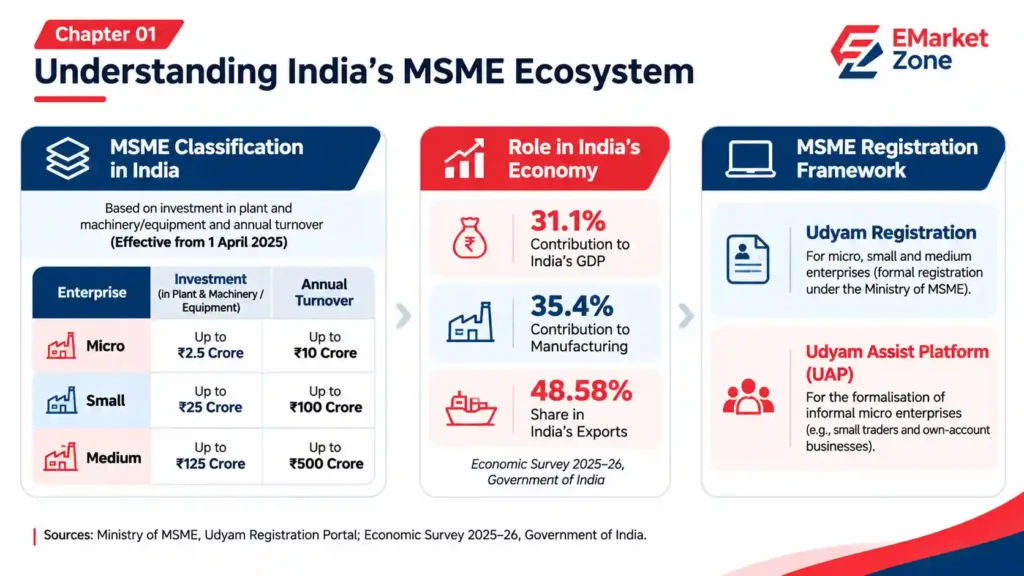
India’s MSME classification is based on two financial parameters: investment in plant and machinery or equipment, and annual turnover. The framework applies to both manufacturing and service enterprises, providing a common basis for classifying businesses according to their scale of operations.
Under the revised classification effective from 1 April 2025, the Government of India increased the investment and turnover limits. The change allows growing enterprises to expand their operations without moving out of the MSME category as quickly as under the earlier thresholds.
Udyam Registration Portal+1
Revised MSME classification in India
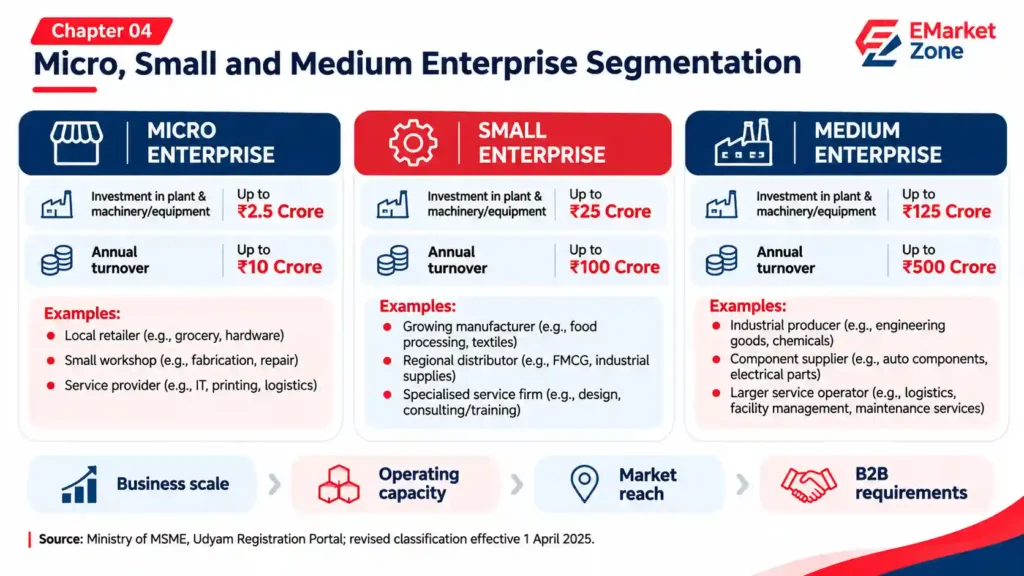
Enterprise category Investment limit Annual turnover limit
Micro Up to ₹2.5 crore Up to ₹10 crore
Small Up to ₹25 crore Up to ₹100 crore
Medium Up to ₹125 crore Up to ₹500 crore
Source: Ministry of MSME, revised classification effective 1 April 2025.
The classification uses a composite criterion, meaning both investment and turnover are considered. An enterprise exceeding the applicable ceiling in either parameter may be classified in the next higher category, subject to the prescribed rules. This makes the framework more comprehensive than a classification based only on employee count, business revenue or investment.
The revised thresholds are important when analysing MSME statistics across different years. Data published before April 2025 may have been classified using the earlier limits. Direct comparisons should therefore account for the change in definition.
1.2 Role of MSMEs in the Indian Economy
MSMEs contribute to India’s economic activity through production, services, trade, employment and participation in domestic and international supply chains. Their presence across different industries also supports regional entrepreneurship and creates business relationships between smaller enterprises and larger companies.
According to the Economic Survey 2025–26, MSMEs account for approximately:
– 31.1% of India’s GDP.
– 35.4% of manufacturing output.
– 48.58% of India’s exports.
These figures highlight the sector’s importance beyond small-business ownership. MSMEs are also part of the country’s manufacturing base, export ecosystem and wider industrial supply chain.
Three important dimensions of MSME contribution
1. Economic activity: MSMEs participate in manufacturing, services and trading, supplying products and services to consumers, businesses and institutions.
2. Industrial development: Smaller enterprises operate as manufacturers, component suppliers, contractors and ancillary units supporting larger industrial businesses.
3. Trade and exports: MSMEs contribute to India’s export activity through direct exports and participation in supply chains serving domestic exporters and international markets.
The sector’s economic contribution is not distributed evenly across all enterprises. Micro, small and medium businesses differ in investment capacity, production scale, technology adoption and market reach. Understanding these differences is important when assessing their commercial role and identifying potential business opportunities.
1.3 Registration Framework: Udyam and Udyam Assist Platform
The Government of India introduced the Udyam Registration system on 1 July 2020 to provide a simplified, online process for registering micro, small and medium enterprises. It replaced the earlier Udyog Aadhaar Memorandum (UAM) registration framework and established a unified system for recognising eligible enterprises.
The Udyam process is designed to reduce administrative requirements. Registration is free, paperless and based on self-declaration. An enterprise receives a permanent Udyam Registration Number and an online certificate. The portal uses PAN- and GST-linked information, where applicable, to obtain investment and turnover details from government databases. Registration does not require periodic renewal.
Alongside Udyam, the Government launched the Udyam Assist Platform (UAP) on 11 January 2023. Its purpose is to bring informal micro enterprises into the formal system and support their access to benefits, including Priority Sector Lending through the prescribed framework. UAP therefore extends formalisation efforts to micro enterprises that may not have entered the conventional registration system.
Udyam and UAP serve related but distinct purposes
Framework | Primary purpose |
|---|---|
Udyam Registration | Formal registration of eligible micro, small and medium enterprises |
Udyam Assist Platform | Formalisation of informal micro enterprises and facilitating access to eligible benefits |
These two systems are important when interpreting official MSME statistics. Combined Udyam and UAP figures provide a wider view of formalisation activity, but they should not automatically be treated as a count of unique active businesses. Their coverage and registration mechanisms differ, and the source and reporting date should always accompany any figures used in market analysis.
For researchers and businesses, this distinction matters. Registration records can help describe the scale and distribution of formalised enterprise activity, but additional information is needed to assess whether an enterprise is currently operating, what it sells, its commercial capacity or its suitability as a potential customer or supplier.
Sources and references - Chapter 01
Chapter 02 - State-wise Distribution of MSMEs
India’s MSME ecosystem is spread across states with different industrial strengths, business structures and levels of economic activity. Some states have large concentrations of registered enterprises supported by manufacturing, trading and service industries, while others have specialised regional clusters built around textiles, food processing, engineering, handicrafts and other sectors.
Examining this distribution helps explain where MSME activity is concentrated and how regional business ecosystems differ. State-wise registration figures provide an important starting point, although they should be interpreted as registration records rather than a direct count of active enterprises.
This chapter examines the geographic distribution of MSMEs, the states with the largest reported registration numbers and the regional patterns shaping India’s business landscape.
2.1 State-wise MSME Registration Distribution
MSME registrations are distributed across all Indian states and Union Territories, but the scale varies considerably. States with large populations, established industrial bases, extensive trading networks and strong service economies account for substantial shares of the registered enterprise base.
According to a Government of India parliamentary reply, 78.30 million enterprises were registered through the Udyam Registration Portal and Udyam Assist Platform between 1 July 2020 and 28 February 2026. This provides a consistent reference point for comparing registrations across states.
Top 10 states by combined MSME registrations
Rank | State | Registered MSMEs |
|---|---|---|
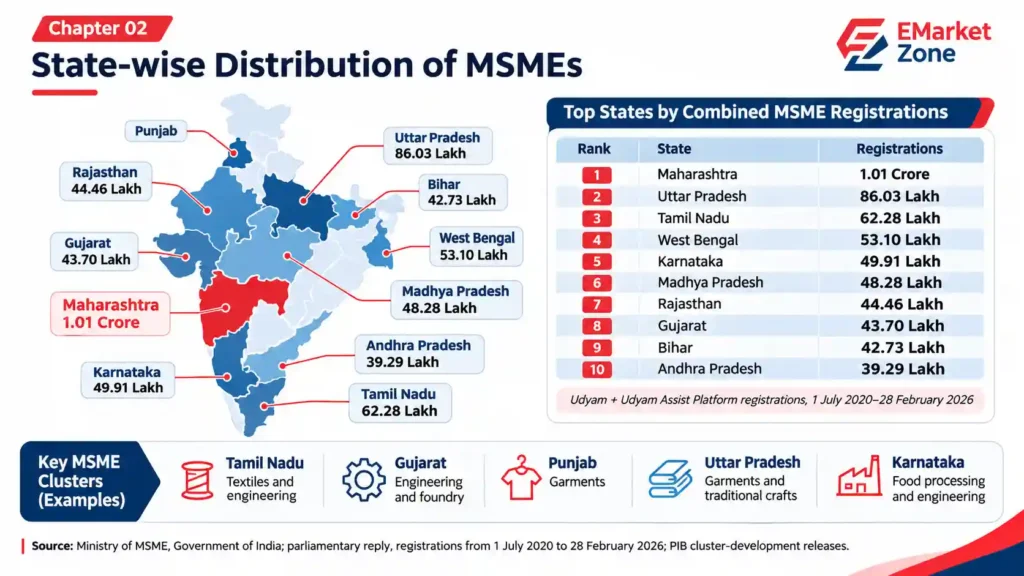
1 | Maharashtra | 1.01 crore |
2 | Uttar Pradesh | 86.03 lakh |
3 | Tamil Nadu | 62.28 lakh |
4 | West Bengal | 53.10 lakh |
5 | Karnataka | 49.91 lakh |
6 | Madhya Pradesh | 48.28 lakh |
7 | Rajasthan | 44.46 lakh |
8 | Gujarat | 43.70 lakh |
9 | Bihar | 42.73 lakh |
10 | Andhra Pradesh | 39.29 lakh |
Source: Ministry of MSME, Government of India, state-wise Udyam and UAP registrations from 1 July 2020 to 28 February 2026, published in a parliamentary reply. Figures rounded.
Maharashtra recorded the highest combined registration count, followed by Uttar Pradesh. Tamil Nadu, West Bengal and Karnataka also reported substantial numbers. Together, these five states accounted for approximately 44% of the registrations in the national total reported for this period.
The figures show the geographic concentration of formalisation activity, but they do not establish that these states necessarily have the highest number of currently active MSMEs, the greatest MSME revenue or the strongest business performance. Registration totals are one measure of the ecosystem and should be interpreted alongside other economic and industry indicators.
2.2 Leading States by MSME Concentration
The leading states have different economic structures, and their MSME registration figures reflect a combination of industrial activity, trading networks, services and enterprise formalisation.
• Maharashtra: Its large business ecosystem includes manufacturing, engineering, financial and professional services, trading and logistics. Mumbai, Pune, Nashik, Nagpur and other industrial centres support a wide range of enterprise activity.
• Uttar Pradesh: Its MSME landscape includes textiles, food processing, leather, handicrafts, engineering and trading. Kanpur, Agra, Lucknow, Noida, Ghaziabad and Varanasi represent different regional business specialisations.
• Tamil Nadu: The state has established manufacturing and industrial networks in textiles, automobiles, engineering, electronics and food processing. Chennai, Coimbatore, Tiruppur, Erode and Hosur are important industrial centres.
• West Bengal: Its business ecosystem includes trading, textiles, engineering, food processing, leather and other manufacturing activities. Kolkata, Howrah, Durgapur and Siliguri serve different commercial and industrial markets.
• Karnataka: Manufacturing, engineering, technology services, food processing and specialised industrial activity contribute to its MSME ecosystem. Bengaluru, Mysuru, Hubballi-Dharwad and Belagavi are notable business centres.
These examples illustrate the diversity of regional economies; they are not a ranking of states by industry output or productivity. State-level registration counts alone cannot establish which industries dominate within each state. That requires industry-specific production, employment and enterprise data.
A useful distinction is that high registration concentration and industrial specialisation are not the same thing. A state may have a large registered MSME base because of its overall business scale, while a smaller state or city may have a particularly strong position in one specialised industry.
2.3 Regional Differences and Emerging Business Centres
India’s MSME activity is shaped by regional advantages such as access to raw materials, skilled labour, transport infrastructure, industrial estates, supplier networks and proximity to customers. These factors influence where enterprises establish operations and how specialised business clusters develop.
The Ministry of MSME’s cluster-development initiatives recognise the importance of geographic concentration. The Micro and Small Enterprises Cluster Development Programme supports common facility centres and industrial infrastructure to improve productivity, technology, skills and competitiveness.
Examples of specialised clusters illustrate these regional differences:
State | Example of cluster or industrial specialisation |
|---|---|
Gujarat | Pump and foundry, engineering and gems and jewellery |
Haryana | Engineering, plywood and agricultural implements |
Karnataka | Food processing, engineering and industrial manufacturing |
Punjab | Garments and textile-related manufacturing |
Tamil Nadu | Textile knitting, weaving, furniture and fabrication |
Uttar Pradesh | Readymade garments and traditional zari-zardozi work |
West Bengal | Refractory bricks, silver filigree and battery manufacturing |
These examples include clusters supported through government cluster-development initiatives. They illustrate specific projects and should not be read as a complete inventory of each state’s industries.
Regional differences also create opportunities beyond manufacturing. Business centres with dense networks of wholesalers, distributors, service providers and professional firms can support commercial activity across several industries. For companies evaluating potential markets, combining state-level information with city, district and industry-level research provides a more useful picture than relying on registration totals alone.
For MSME market research, the practical approach is to move from state-level concentration to city-level business hubs and then to industry-specific clusters. This makes it easier to distinguish broad registration volume from the actual commercial structure of a regional market.
Sources and references - Chapter 02
Ministry of MSME, Government of India – Parliamentary reply: State-wise Udyam and UAP registrations up to 28 February 2026.
Ministry of MSME – State-wise Udyam Registration Dashboard.
Press Information Bureau – MSME Cluster Development Programme.
Ministry of MSME – Approved SFURTI Clusters
Chapter 03 - Industry-wise MSME Structure
India’s MSME sector operates across a wide range of economic activities, including manufacturing, trading and services. These enterprises participate in everything from food processing and textiles to engineering, retail distribution, transportation, professional services and technology.
Understanding the industry structure is important because the MSME sector is not a single market. Each industry has different operating requirements, supply chains, customer groups and business opportunities. Manufacturing enterprises may require machinery, raw materials and industrial suppliers, while trading businesses depend on sourcing and distribution networks. Service enterprises operate across professional, technical, financial and consumer-facing activities.
This chapter examines the broad activity composition of registered MSMEs, the major industries in which they operate and the patterns of industry concentration and business specialisation across India.
3.1 Manufacturing, Services and Trading Composition
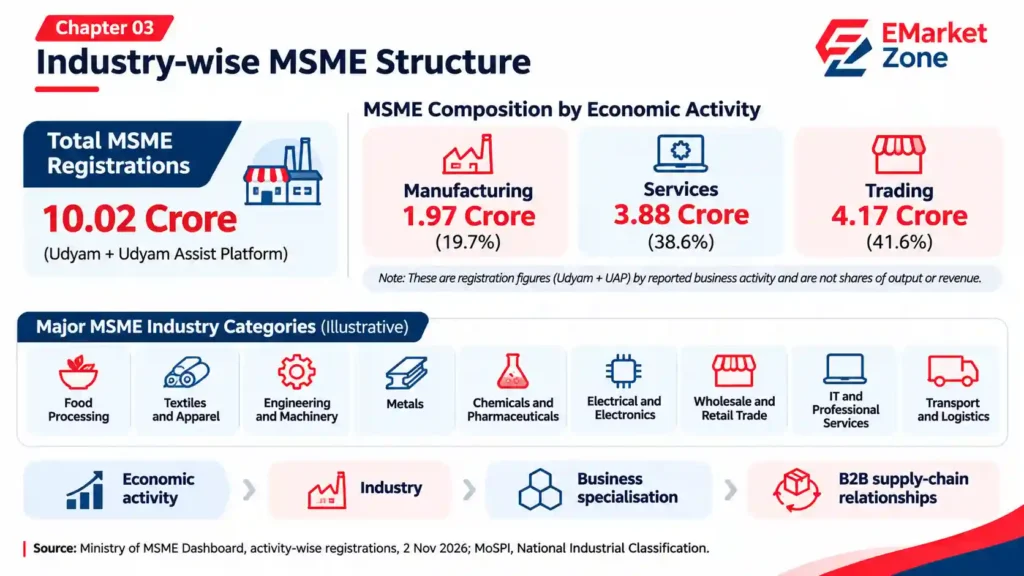
The Ministry of MSME classifies registered enterprise activity into three broad categories: manufacturing, services and trading. The Ministry’s dashboard provides a snapshot of the distribution across these categories.
As of 2 November 2026, the combined Udyam and Udyam Assist Platform dashboard reported the following activity-wise registration figures:
Business activity | Registrations | Approx. share |
|---|---|---|
Manufacturing | 1.97 crore | 19.7% |
Services | 3.88 crore | 38.8% |
Trading | 4.17 crore | 41.6% |
Total | 10.02 crore | 100% |
Source: Ministry of MSME Dashboard, activity-wise registrations, 2 November 2026. Shares calculated from reported figures and rounded.
The distribution shows that trading and services together account for approximately four-fifths of the combined registrations, while manufacturing represents a smaller share. This highlights the broad range of commercial activities included within India’s MSME ecosystem.
Manufacturing enterprises produce goods, process raw materials, assemble components or undertake industrial production. Their activities include textiles, food processing, metal products, machinery, chemicals, pharmaceuticals, furniture and engineering goods.
Service enterprises provide professional, technical, commercial and operational services. Examples include information technology, consulting, transportation, logistics, repair, education, healthcare, hospitality and business support.
Trading enterprises are engaged in buying and selling goods through wholesale, retail, dealership, distribution and other commercial channels. They connect manufacturers, importers, distributors, retailers and end customers.
These figures represent activity classifications in the registration system. They should not be interpreted as each category’s share of MSME GDP, output, employment or revenue. Registration counts measure the recorded enterprise activity, not the economic value generated by each segment.
3.2 Major MSME Industry Categories
MSMEs operate across numerous industries, ranging from traditional manufacturing and local trade to specialised technology and professional services. The National Industrial Classification (NIC), maintained by the Ministry of Statistics and Programme Implementation (MoSPI), provides a standard framework for grouping economic activities. It helps researchers distinguish businesses by their principal activity rather than relying only on broad labels such as manufacturing or services.
Some important industry groups within the MSME ecosystem include:
Industry category | Examples of business activities |
|---|---|
Food and beverage processing | Food processing, packaged foods, bakery products, beverages |
Textiles and apparel | Spinning, weaving, garment manufacturing, textile processing |
Engineering and machinery | Industrial equipment, machine components, tools and fabrication |
Metals and metal products | Steel products, foundries, metal fabrication and components |
Chemicals and pharmaceuticals | Chemical products, formulations, industrial chemicals and related products |
Electrical and electronics | Electrical equipment, components, electronic products and assemblies |
Furniture and wood products | Furniture manufacturing, wood processing and fittings |
Construction and building materials | Fabricated materials, building products and construction-related supplies |
Wholesale and retail trade | Distributors, dealers, wholesalers, retailers and trading businesses |
Business and professional services | IT services, consulting, accounting, design and business support |
Transport and logistics | Freight, warehousing, storage and delivery services |
Hospitality and personal services | Accommodation, food services, repair and personal care |
This list is an illustrative grouping of business activities, not an official ranking of India’s largest MSME industries. Individual enterprises may also operate across multiple activities, while official statistical classifications use more detailed activity codes.
The MoSPI’s Annual Survey of Unincorporated Sector Enterprises (ASUSE) provides another important source for understanding manufacturing, trade and service establishments. Its coverage includes unincorporated non-agricultural establishments and excludes several categories, including incorporated companies and establishments covered by the Annual Survey of Industries. Therefore, ASUSE estimates and Udyam registration figures measure different populations and should not be combined as if they were equivalent.
3.3 Industry Concentration and Business Specialisation
MSME activity is not evenly distributed across industries or locations. Certain regions develop specialised business ecosystems because of access to raw materials, skilled workers, infrastructure, established suppliers, local demand and historical industrial development.
For example, textile manufacturing is prominent in several business centres across Gujarat, Maharashtra, Tamil Nadu and Punjab. Engineering and metalworking businesses are found in established industrial regions, while food processing activity is linked to agricultural production, storage infrastructure and regional supply chains.
These patterns create industry-specific business networks:
• Textile and apparel networks: Connect yarn producers, fabric manufacturers, processors, garment units, wholesalers and exporters.
• Engineering and machinery networks: Include component manufacturers, fabricators, machine-tool suppliers, industrial equipment producers and maintenance providers.
• Food processing networks: Bring together agricultural suppliers, processors, packaging businesses, cold-chain operators, distributors and retailers.
• Trading and distribution networks: Connect manufacturers, importers, stockists, wholesalers, dealers and local retailers.
The structure of these networks matters for B2B market development. A machinery supplier, for example, may target engineering and fabrication businesses rather than the entire MSME population. Similarly, packaging companies may find more relevant prospects among food processors, pharmaceutical manufacturers and consumer-goods producers.
MoSPI’s NIC classification and enterprise surveys provide a consistent framework for studying these activities. The Ministry of MSME’s cluster-development programmes also recognise the importance of geographic and industrial specialisation by supporting common facilities, technology improvements and infrastructure for micro and small enterprise clusters.
For market research, the key is to move beyond broad industry labels and identify the specific business activities, products, services and supply-chain relationships within each segment. This creates a more useful basis for comparing industries and identifying relevant businesses for commercial engagement.
Sources and references - Chapter 03
Ministry of MSME – MSME Performance Dashboard. Activity-wise registration figures as of 2 November 2026.
Ministry of Statistics and Programme Implementation – National Industrial Classification.
Ministry of MSME – Annual Report 2025–26.
Chapter 04 - Micro, Small and Medium Enterprise Segmentation
India’s MSME sector includes enterprises operating at very different levels of scale, investment, turnover and business capacity. A small local trading business, a growing manufacturing unit and an established industrial supplier may all fall within the MSME framework, but their operational requirements and commercial capabilities can be very different.
The classification of enterprises into micro, small and medium categories provides a useful way to understand these differences. It also helps businesses, financial institutions, policymakers and market researchers evaluate enterprise segments according to their scale and potential requirements.
This chapter examines the characteristics of each category, their business activities and their roles in India’s wider commercial and industrial ecosystem.
4.1 Micro Enterprises: Scale and Business Activity
Micro enterprises form the largest segment of India’s registered MSME ecosystem. They operate across manufacturing, services and trading, ranging from home-based businesses and small workshops to local retailers, independent service providers and small production units.
Under the revised MSME classification effective from 1 April 2025, a micro enterprise is one where investment in plant and machinery or equipment does not exceed ₹2.5 crore and annual turnover does not exceed ₹10 crore.
Common business activities include:
• Small-scale manufacturing: Food products, garments, furniture, metal components, handicrafts and other locally produced goods.
• Retail and trading: Shops, small wholesalers, distributors, dealers and local suppliers.
• Business and personal services: Repair services, consulting, transport, design, professional support and other specialised services.
• Local and regional supply: Enterprises supplying products and services to nearby businesses, households and institutions.
Micro enterprises often operate with comparatively limited resources and smaller teams. Their market reach can be local or regional, although some businesses serve wider markets through digital platforms, distribution arrangements or specialised products.
Their large presence makes this segment relevant to companies offering raw materials, packaging, machinery, financial services, software, logistics and other business solutions. However, the micro classification alone does not establish an enterprise’s purchasing capacity, revenue or current operating status.
4.2 Small Enterprises: Expansion and Market Participation
Small enterprises occupy the next level of the MSME classification. They often have more established operating structures, higher production or service capacity and broader customer networks than micro enterprises, although actual capabilities vary considerably by industry.
Under the revised classification, a small enterprise must have investment in plant and machinery or equipment not exceeding ₹25 crore and annual turnover not exceeding ₹100 crore.
Small enterprises can include:
• Growing manufacturers: Businesses producing machinery, engineering components, textiles, processed foods, electrical goods and industrial products.
• Established distributors and wholesalers: Businesses supplying retailers, dealers, institutional buyers and regional markets.
• Specialised service providers: IT companies, logistics operators, professional firms, maintenance providers and technical service businesses.
• Industrial suppliers and contractors: Enterprises providing components, fabrication, packaging, maintenance and other supporting services to larger companies.
At this scale, businesses may have more formalised operations, specialised employees, established supplier relationships and a wider customer base. Some participate in organised procurement networks and supply chains serving large domestic companies or export-oriented manufacturers.
For B2B companies, small enterprises can represent an important customer and supplier segment. Their requirements may include production equipment, technology, credit, raw materials, distribution support and business services. Identifying relevant enterprises therefore requires more than selecting the small-enterprise category; industry, location and business activity also matter.
4.3 Medium Enterprises: Industrial and Commercial Role
Medium enterprises represent the upper segment of the MSME classification. They generally operate at a larger scale than micro and small enterprises and may have more developed production facilities, management structures, technology systems and commercial networks.
Under the revised classification, a medium enterprise must have investment in plant and machinery or equipment not exceeding ₹125 crore and annual turnover not exceeding ₹500 crore.
Medium enterprises can participate in several areas of the economy:
• Industrial production: Manufacturing machinery, engineering products, chemicals, electrical equipment, processed goods and other industrial outputs.
• Supply-chain participation: Supplying components, materials and specialised services to larger manufacturers and institutional buyers.
• Domestic and international markets: Serving customers across multiple states and, where applicable, participating in export supply chains.
• Technology and operational development: Investing in automation, specialised equipment, quality systems and more structured business processes.
The Ministry of MSME identifies MSMEs as important contributors to manufacturing, exports and the wider economy. The Economic Survey 2025–26 reports that the sector accounts for approximately 35.4% of manufacturing output, underlining its role in India’s industrial ecosystem. This is an MSME-wide figure, not a contribution attributable to medium enterprises alone.
For B2B market development, medium enterprises may be relevant to industrial technology providers, machinery suppliers, enterprise software companies, financial institutions, logistics operators and specialised service providers. Their larger operating scale can create more complex procurement and partnership requirements, but the actual opportunity must be assessed at the individual enterprise level.
Sources and references - Chapter 04
Chapter 05 - Major MSME Business Hubs and Clusters
India’s MSME activity is concentrated in a wide network of cities, industrial areas and specialised business clusters. These locations bring together enterprises operating in related industries, creating networks of manufacturers, suppliers, traders, service providers and skilled workers.
Some business centres are known for engineering and machinery, while others have developed around textiles, food processing, garments, metals, jewellery and traditional products. These specialisations influence local supply chains, employment patterns and the types of commercial services required by businesses.
Understanding MSME business hubs and clusters helps identify not only where enterprises are located, but also what they produce, which industries they serve and how they connect with other businesses.
5.1 Important MSME Cities and Business Centres
India’s MSME ecosystem includes established industrial cities as well as smaller centres known for specialised production and commercial activity. These locations often develop around a combination of infrastructure, skilled labour, access to raw materials, transport connectivity and established supplier networks.
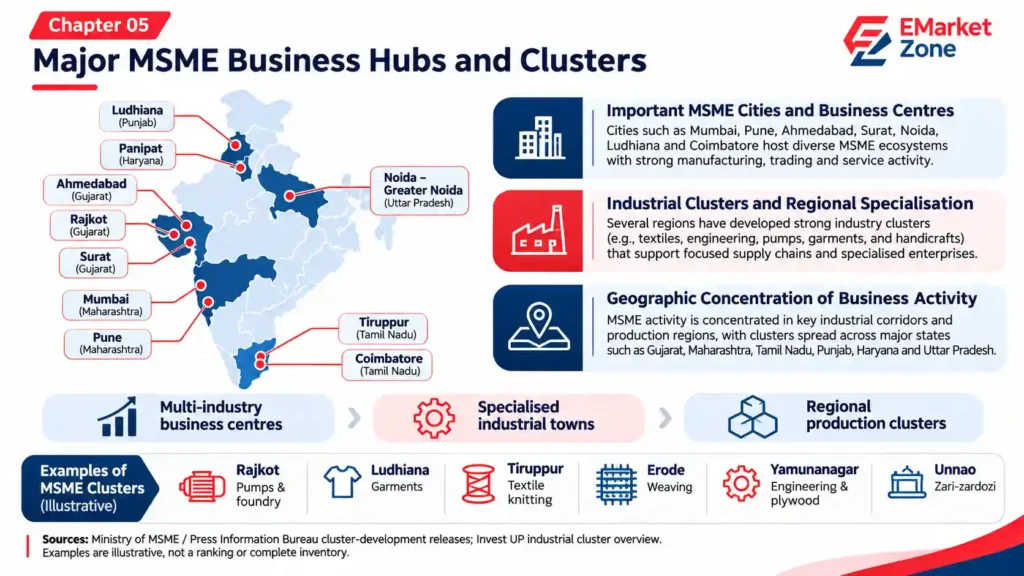
Examples of important business centres include:
City / Business centre | State | Key business and industrial specialisation |
|---|---|---|
Coimbatore | Tamil Nadu | Engineering goods, pumps, textiles and machinery |
Tiruppur | Tamil Nadu | Knitwear and garment manufacturing |
Rajkot | Gujarat | Machine tools, engineering goods and foundries |
Surat | Gujarat | Textiles, synthetic fabrics and diamond-related businesses |
Pune | Maharashtra | Engineering, automotive components and industrial manufacturing |
Mumbai | Maharashtra | Trading, financial services, textiles and commercial services |
Ludhiana | Punjab | Knitwear, garments, bicycles and engineering goods |
Panipat | Haryana | Textiles, home furnishings and carpets |
Noida–Greater Noida | Uttar Pradesh | Electronics, electrical products and manufacturing |
Ahmedabad | Gujarat | Textiles, chemicals, engineering and pharmaceuticals |
These examples represent different types of business ecosystems rather than a formal ranking of India’s largest MSME cities. The range of specialisations also shows why a city-level view can be more useful than treating an entire state as one uniform market.
For businesses assessing potential markets, these centres can provide starting points for identifying manufacturers, component suppliers, wholesalers, distributors and specialised service providers. However, the presence of an established industrial sector does not mean every business in that city operates in the same industry.
5.2 Industrial Clusters and Regional Specialisation
An industrial cluster is a geographic concentration of enterprises operating in the same or related industries. Businesses within a cluster may share suppliers, skilled workers, infrastructure, production facilities, technology and market connections.
The Ministry of MSME supports cluster development through initiatives such as the Micro and Small Enterprises Cluster Development Programme (MSE-CDP). Its objectives include developing common facility centres, upgrading infrastructure, improving technology and strengthening the competitiveness of micro and small enterprises.
Examples of documented clusters illustrate the diversity of India’s regional specialisation:
Cluster / location | State | Specialisation |
|---|---|---|
Rajkot | Gujarat | Pump and foundry |
Karnal | Haryana | Printing, packaging and pharmaceuticals |
Ludhiana | Punjab | Garments |
Tiruppur | Tamil Nadu | Textile knitting |
Erode | Tamil Nadu | Weaving |
Salem | Tamil Nadu | Wooden furniture |
Yamunanagar | Haryana | Engineering and plywood |
Magrahat | West Bengal | Silver filigree |
Jamkhandi | Karnataka | Grapes and raisin processing |
Unnao | Uttar Pradesh | Zari-zardozi |
Source: Ministry of MSME and Press Information Bureau cluster-development releases. These are examples of documented cluster projects, not a complete list of industrial clusters in India.
Regional specialisation can create business advantages. Enterprises operating near related manufacturers and suppliers may benefit from shorter supply chains, shared technical knowledge, access to specialised labour and established distribution networks.
For example, a textile cluster may bring together yarn suppliers, fabric processors, dyeing units, garment manufacturers, packaging businesses and wholesalers. An engineering cluster may include component producers, machine-tool suppliers, metal fabricators, industrial maintenance firms and equipment distributors.
These relationships make clusters commercially relevant beyond the enterprises directly involved in production. They also create opportunities for logistics providers, technology companies, financial institutions, packaging suppliers and other B2B service providers.
5.3 Geographic Concentration of Business Activity
MSME activity is distributed across India’s states and districts, but business concentration is influenced by regional economic conditions and industrial specialisation. Large commercial centres often support diverse business activities, while smaller industrial towns may develop around one or two specialised sectors.
Three geographic patterns are particularly relevant:
1. Multi-industry metropolitan centres
Cities such as Mumbai, Pune, Bengaluru, Chennai, Ahmedabad and Hyderabad support diverse business ecosystems. Their markets include manufacturing, trading, professional services, logistics, technology and corporate activities. These locations can offer access to multiple types of B2B customers and suppliers.
2. Specialised industrial towns
Centres such as Tiruppur, Rajkot, Ludhiana, Panipat and Coimbatore are associated with more specialised industrial activities. Their commercial networks often include manufacturers, raw-material suppliers, component producers, wholesalers and supporting service businesses.
3. Regional and traditional production clusters
Smaller towns and districts also contribute to India’s MSME landscape through activities such as handicrafts, food processing, textiles, metal products and traditional manufacturing. These businesses may serve regional markets, larger industrial networks or national distribution channels.
Geographic concentration is important for market research because the number of registered enterprises in a state does not explain where particular industries are located. District-level and cluster-level information can reveal specialised business networks that are less visible in national or state-level statistics.
For B2B prospecting, this creates a practical approach: begin with the state, narrow the search to relevant cities or districts, and then identify businesses by industry and activity. A company supplying textile machinery, for instance, may find greater relevance in specialised textile centres than in a broad list of enterprises across an entire state.
The Ministry of MSME’s cluster-development records, state industrial department publications and district-level industry information can help identify these locations. However, cluster records should be checked for their approval or implementation status before being described as currently operational.
Sources and references - Chapter 05
Ministry of MSME – Annual Report 2025–26.
Ministry of MSME – Cluster Development Programme.
Press Information Bureau – MSME cluster projects and Common Facility Centres.
Development Commissioner, MSME – Cluster Development Programme: Ongoing Common Facility Centres.
SIDBI and TransUnion CIBIL – MSME Pulse, September 2025.
Invest UP – Industrial clusters and business locations.
Chapter 06 - MSME Growth Drivers and Business Challenges
India’s MSME sector is influenced by a combination of government policies, access to finance, technology adoption, infrastructure and market connectivity. While government initiatives and digital platforms have expanded opportunities for smaller enterprises, many businesses continue to face challenges related to working capital, technology investment, skilled labour, logistics and access to customers.
The growth of MSMEs depends not only on the number of enterprises entering the formal economy, but also on their ability to improve productivity, expand market reach, adopt new technologies and participate in organised supply chains.
This chapter examines the major factors supporting MSME growth, the role of government and institutional programmes, and the operational challenges that affect enterprise development.
6.1 Government Schemes and Institutional Support
Government policies and institutional programmes play an important role in supporting MSME development in India. These initiatives address several areas of enterprise growth, including access to credit, entrepreneurship, technology improvement, infrastructure, skill development and market access.
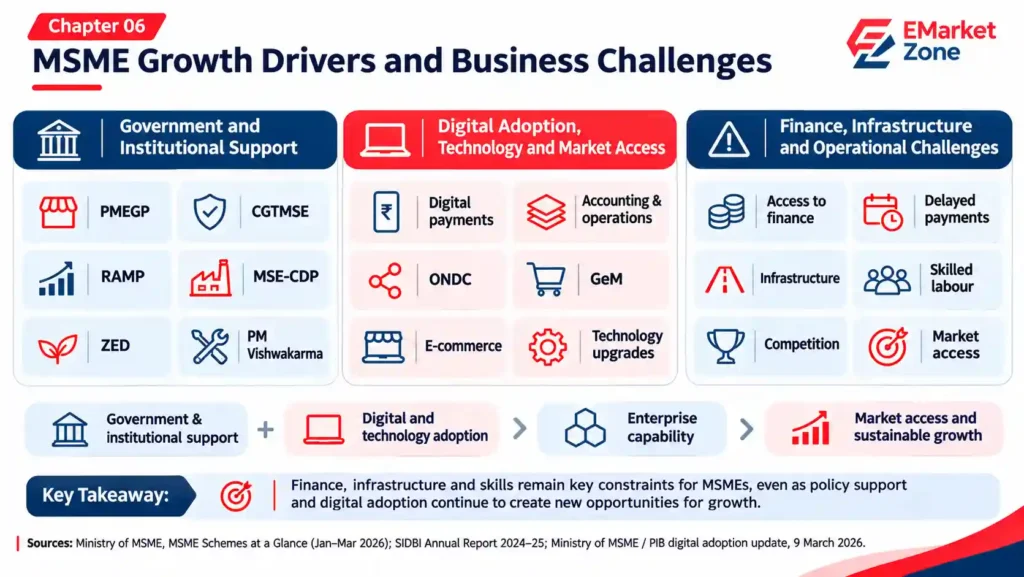
The Ministry of MSME operates programmes designed to support enterprises at different stages, from business establishment and formalisation to expansion and competitiveness. Some of the important initiatives include:
Scheme / Initiative | Primary objective |
|---|---|
Prime Minister’s Employment Generation Programme (PMEGP) | Supports the establishment of new micro enterprises through a credit-linked subsidy programme. |
Credit Guarantee Scheme for Micro and Small Enterprises (CGTMSE) | Facilitates collateral-free credit to eligible micro and small enterprises through credit guarantees to lending institutions. |
Raising and Accelerating MSME Performance (RAMP) | Improves MSME access to markets, finance and technology while strengthening institutional capacity. |
Micro and Small Enterprises Cluster Development Programme (MSE-CDP) | Supports common facilities and infrastructure development in enterprise clusters. |
MSME Sustainable (ZED) Certification | Encourages quality manufacturing, improved processes and environmentally responsible production. |
Procurement and Marketing Support Scheme | Helps eligible MSMEs improve market access and participate in domestic marketing activities. |
PM Vishwakarma | Supports traditional artisans and craftspeople through skill, toolkit, credit and market-related assistance. |
These programmes address different business requirements and have separate eligibility conditions, application procedures and implementation arrangements. Their availability should not be interpreted as automatic financial assistance for every registered MSME.
Institutional support also extends beyond the Ministry of MSME. Organisations such as the Small Industries Development Bank of India (SIDBI), National Small Industries Corporation (NSIC), banks, state industrial development agencies and entrepreneurship institutions contribute through financing, business development, technology support and market facilitation.
The RAMP programme is particularly relevant because it connects several dimensions of enterprise development, including digitalisation, technology upgradation, market access and improved credit delivery. Its approach recognises that MSME growth requires more than access to finance alone.
For enterprises, the practical value of these initiatives depends on understanding which programme addresses their specific requirement. A new entrepreneur seeking support to establish a unit, an existing manufacturer planning technology improvements and a small supplier seeking access to larger procurement markets may need different forms of institutional assistance.
6.2 Digital Adoption, Technology and Market Access
Digital adoption is changing how MSMEs manage operations, reach customers and participate in business networks. Online payments, digital accounting, e-commerce platforms, cloud-based software and digital procurement systems can help enterprises improve efficiency and expand beyond traditional local markets.
The Government of India has introduced initiatives to encourage MSME participation in digital commerce. One example is the Trade Enablement and Marketing (TEAM) Initiative, launched under the RAMP programme in June 2024. It aims to help micro and small enterprises access digital markets through the Open Network for Digital Commerce (ONDC).
Government e-Marketplace (GeM) is another important channel, enabling eligible businesses to participate in government procurement. Such platforms can provide access to buyers beyond an enterprise’s immediate geographic market, although participation does not guarantee orders or commercial success.
The scale of digital participation is reflected in a Ministry of MSME statement published in March 2026. As of 31 December 2025, approximately 2.06 lakh merchants had completed at least one transaction on the ONDC network, while around 6 lakh service providers had made their services available on the network. The Ministry also reported that 3,127 MSMEs had generated more than one lakh transactions through the MSME TEAM initiative during the financial year up to that date.
Technology adoption also extends beyond online selling. MSMEs can use digital tools in several operational areas:
• Business operations: Accounting, invoicing, inventory management, billing and enterprise resource planning.
• Production and quality: Computer-aided design, automation, machine monitoring, testing and quality-control systems.
• Sales and customer management: E-commerce, digital catalogues, customer relationship management and online marketing.
• Supply-chain coordination: Digital procurement, logistics tracking, vendor management and electronic payments.
Technology can improve productivity, record-keeping and market reach, but adoption varies according to enterprise size, investment capacity, employee skills and the nature of the business. A small local service provider may require basic digital accounting and online discovery, while a manufacturing enterprise may need production software, machinery upgrades and quality-management systems.
Market access remains an important part of this transition. Digital platforms can help businesses become discoverable to new buyers, but enterprises still need suitable products, competitive pricing, reliable fulfilment, product information and customer service to convert visibility into sales.
6.3 Finance, Infrastructure and Operational Challenges
Despite improvements in formalisation and institutional support, MSMEs continue to face challenges that can restrict business expansion and competitiveness. These challenges differ across enterprise categories and industries, but access to finance, infrastructure, technology, skilled labour and timely payments remain important concerns.
1. Access to finance and working capital
Smaller enterprises may find it difficult to secure affordable credit, particularly when they have limited collateral, short operating histories, incomplete financial records or irregular cash flows. Working-capital constraints can affect the ability to purchase raw materials, maintain inventory, pay employees and fulfil larger orders.
SIDBI’s Annual Report 2024–25 highlighted an estimated addressable credit gap of approximately ₹30 lakh crore for the MSME sector, based on its sector research. This estimate indicates the scale of unmet formal credit requirements identified in that research; it should not be interpreted as a current outstanding loan shortfall for every MSME.
2. Delayed payments and cash-flow pressure
Delayed payments from buyers can create significant financial pressure, especially for smaller suppliers that depend on regular cash inflows to continue operations. A business may have completed an order and recorded a sale but still lack the cash required to purchase materials or meet its immediate expenses.
The government’s MSME Samadhaan mechanism and related delayed-payment provisions provide institutional channels for eligible micro and small enterprises to pursue payment-related grievances. However, resolving payment disputes and collecting outstanding amounts can still take time.
3. Infrastructure and technology limitations
Enterprises operating in areas with inadequate industrial infrastructure may face higher transportation costs, unreliable utilities, limited storage facilities and difficulty accessing common production or testing facilities. Older machinery and limited technology investment can also restrict productivity, product quality and the ability to meet larger buyer requirements.
Cluster-development initiatives attempt to address some of these constraints through shared infrastructure and common facility centres. Their effectiveness depends on local implementation, accessibility and whether the facilities match the actual requirements of participating enterprises.
4. Skilled labour, competition and market access
MSMEs may also face difficulty recruiting and retaining workers with specialised technical and managerial skills. At the same time, businesses compete with larger manufacturers, organised distributors and domestic and international suppliers. Meeting changing customer expectations, quality requirements and compliance obligations can increase operating complexity.
SIDBI’s research on the Indian MSME sector identifies finance, technology adoption, competition, compliance, market access, infrastructure, supply chains and skilled labour availability among the issues affecting enterprises. These challenges demonstrate why MSME growth depends on several connected business capabilities rather than a single policy intervention.
Overall, the ability of MSMEs to grow depends on how effectively they address these constraints while using available institutional, financial and digital support. Access to credit may support expansion, but sustainable growth also requires reliable suppliers, skilled employees, efficient operations, suitable technology and access to relevant customers.
Sources and references - Chapter 06
Ministry of MSME – MSME Schemes at a Glance, January–March 2026.
Ministry of MSME – Government MSME Scheme Directory.
SIDBI – MSME Pulse: Credit Ecosystem.
Ministry of MSME / PIB – MSME Digital Adoption: E-commerce, GeM and ONDC, 9 March 2026.
MSME RAMP Portal – Trade Enablement and Marketing (TEAM) Initiative.
MSME RAMP Portal – Credit Guarantee Scheme for Micro and Small Enterprises.
Chapter 07 - B2B Business Opportunities in the MSME Sector
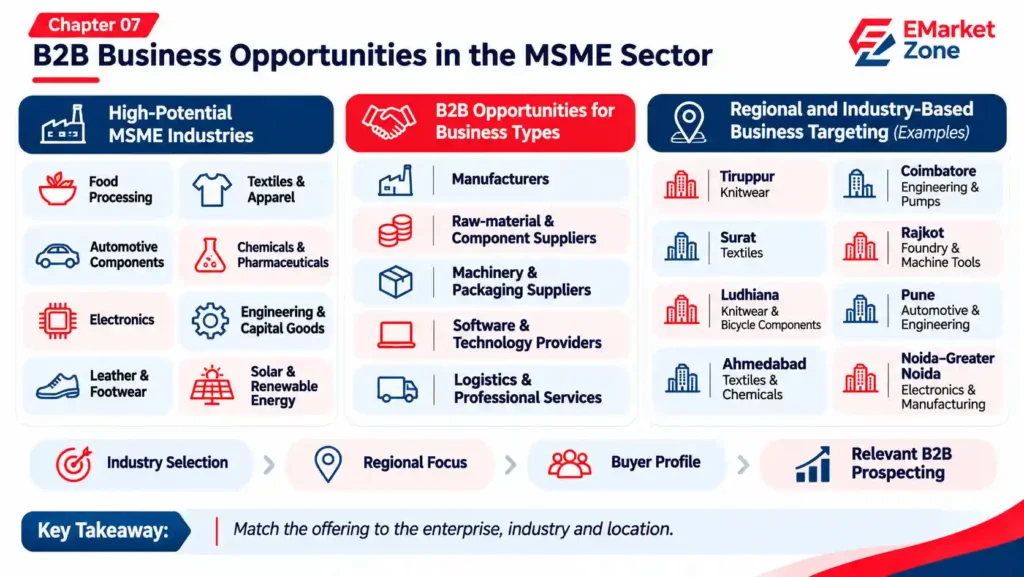
India’s MSME sector offers a broad commercial market for manufacturers, component suppliers, distributors, technology providers, financial institutions and professional service companies. Its opportunity is not limited to the number of registered enterprises. It also comes from the diversity of industries, regional specialisation, supply-chain relationships and the growing need for technology, finance and market access.
The Economic Survey 2025–26 estimates that MSMEs contribute approximately 31.1% of India’s GDP, 35.4% of manufacturing output and 48.58% of exports. These figures demonstrate the sector’s economic significance, although they should not be interpreted as the addressable market for any single B2B product or service.
This chapter examines where commercial opportunities are emerging, which types of businesses can serve MSMEs, and how industry and geographic segmentation can make B2B targeting more relevant.
7.1 Identifying High-Potential MSME Industries
High-potential MSME industries can be identified by examining more than enterprise counts. Relevant indicators include demand from downstream industries, supply-chain requirements, export participation, technology adoption, investment activity and the presence of established industrial clusters.
NITI Aayog’s 2025 report on enhancing MSME competitiveness gives particular attention to textiles and apparel, chemical products, automotive components and food processing. Its findings highlight the importance of sector-specific improvements in productivity, skills, financing, innovation and market access.
A separate NITI Aayog report released in 2026 identifies sectors including electronics, telecom equipment, solar photovoltaic manufacturing, pharmaceuticals, chemicals, automobiles, defence, capital goods, textiles, food processing, steel, and leather and footwear as important to India’s manufacturing ambitions. These are national strategic sectors, not a guarantee that every enterprise in them is an attractive MSME prospect.
Industries with relevant B2B opportunity areas
Industry | Potential business requirements | Relevant B2B suppliers and service providers |
|---|---|---|
Food processing | Packaging, ingredients, machinery, cold-chain and quality systems | Packaging companies, equipment manufacturers, logistics providers |
Textiles and apparel | Fabric, dyes, machinery, accessories and production technology | Textile suppliers, machinery dealers, chemical suppliers |
Automotive components | Precision parts, tooling, testing and industrial materials | Component manufacturers, engineering suppliers, testing providers |
Chemicals and pharmaceuticals | Process equipment, packaging, testing and compliance support | Chemical suppliers, equipment firms, laboratory services |
Electronics and electrical equipment | Components, assembly equipment, testing and automation | Component distributors, electronics suppliers, automation firms |
Capital goods and engineering | Machine tools, industrial components, maintenance and fabrication | Machinery manufacturers, industrial distributors, service contractors |
Leather and footwear | Materials, components, finishing equipment and packaging | Material suppliers, machinery dealers, packaging businesses |
Renewable energy and solar | Electrical components, mounting systems, installation and maintenance | Solar equipment suppliers, electrical distributors, engineering firms |
These opportunity areas are based on the sectors identified in government and institutional research, alongside their typical production and supply-chain requirements. They should be treated as market segments to investigate, not as a ranking of guaranteed demand.
For example, a packaging supplier may find prospects among food processors, pharmaceutical manufacturers and consumer-goods producers. An industrial automation provider may find relevant customers among engineering, automotive-component and electrical-equipment manufacturers. The same enterprise can therefore belong to more than one potential buyer segment depending on its operations and purchasing needs.
What makes an industry commercially attractive?
A practical assessment should consider five factors:
– Demand continuity: Does the industry require recurring purchases of materials, components or services?
– Supplier dependence: Does production rely on external manufacturers, distributors or specialist service providers?
– Technology requirements: Is there a need for machinery upgrades, automation, testing or digital systems?
– Market reach: Does the industry serve multiple states, large companies or export markets?
– Prospect accessibility: Can relevant enterprises be identified and reached through reliable business information and suitable channels?
An industry with a large number of enterprises is not automatically the best target. A smaller segment with recurring procurement needs and clearly identifiable buyers may offer a more practical commercial opportunity.
7.2 Opportunities for Manufacturers, Suppliers and Service Providers
MSMEs participate in interconnected production and distribution networks. A small manufacturer may purchase raw materials from one supplier, use machinery from another, outsource testing or logistics, and sell components to a larger manufacturer. These relationships create opportunities for businesses that can support enterprise operations at different stages of the value chain.
The Ministry of MSME’s cluster development approach recognises this interdependence. It defines clusters around enterprises producing similar, complementary or related products and services, often sharing common infrastructure, technology, skills and market requirements.
A. Opportunities for manufacturers
Manufacturers can target MSMEs that need machinery, production inputs, components, tools and equipment. Potential customer groups include:
– Food-processing units requiring filling, sealing, grading and packaging machinery.
– Textile and garment manufacturers purchasing fabric, dyes, accessories and production equipment.
– Engineering workshops sourcing machine tools, castings, fasteners and precision components.
– Electrical and electronics manufacturers requiring components, cables, enclosures and testing equipment.
– Packaging units purchasing paper, films, printing materials and converting machinery.
The strongest approach is to identify the production activity and the likely procurement requirement. A manufacturer of industrial pumps, for example, should focus on engineering workshops, water-treatment equipment producers and relevant industrial users rather than approaching all registered MSMEs.
B. Opportunities for suppliers and distributors
Suppliers can serve MSMEs through recurring or project-based requirements. Potential categories include:
– Raw materials such as metals, polymers, chemicals, textiles and food ingredients.
– Industrial consumables, tools, safety equipment and maintenance supplies.
– Packaging materials, labels, cartons and printing supplies.
– Electrical equipment, motors, cables and control systems.
– Wholesale products and distribution support for retail and trading enterprises.
Supplier targeting should account for purchase frequency, order size, geographic delivery capability and the buyer’s position in the supply chain. A business supplying industrial chemicals, for instance, needs a different prospect profile from a distributor of retail merchandise.
C. Opportunities for service providers
As MSMEs adopt new technologies and seek wider market access, demand can arise for specialist business services. Relevant opportunities include:
– Accounting, taxation and regulatory support.
– Digital marketing, e-commerce and website development.
– Software for inventory, billing, customer management and production.
– Logistics, warehousing and supply-chain management.
– Product testing, certification and quality-management support.
– Recruitment, workforce training and technical consultancy.
– Energy audits, equipment maintenance and automation services.
The government’s focus on MSME competitiveness, technology adoption, financing and market access reinforces the relevance of these support services. However, the actual demand for each service will vary by industry, enterprise size and location.
Matching business offerings with MSME requirements
B2B business type | Suitable MSME segments | Example of a relevant offering |
|---|---|---|
Machinery manufacturer | Food processing, textiles, engineering | Production and packaging machinery |
Industrial raw-material supplier | Metals, chemicals, plastics, textiles | Materials and production inputs |
Packaging supplier | Food, pharmaceuticals, textiles, consumer goods | Packaging materials and printing |
Software provider | Manufacturing, wholesale, services | ERP, billing, inventory and CRM tools |
Logistics company | Manufacturers, exporters, distributors | Freight, warehousing and delivery |
Professional services firm | Micro, small and medium enterprises | Accounting, compliance and consultancy |
Automation provider | Engineering, automotive, electronics | Industrial automation and process control |
The commercial lesson is that B2B targeting should start with the buyer’s business activity and operational requirement, rather than relying on a broad label such as MSME.
7.3 Regional and Industry-Based Business Targeting
MSME activity is geographically distributed, but industries are not spread evenly across India. Different cities and regions have developed specialised business ecosystems based on local skills, infrastructure, raw materials, supplier networks and market access.
This creates an opportunity for businesses to combine two targeting dimensions:
– Geographic segmentation: State, city, district or industrial cluster.
– Industry segmentation: Manufacturing activity, product category, service type or supply-chain role.
The Ministry of MSME’s cluster development framework supports this way of understanding the market: enterprises within a cluster often share production methods, common needs, suppliers, skills and market challenges.
Examples of regional and industry-based targeting
Business region or cluster | Major business activity | Potential B2B target groups |
|---|---|---|
Tiruppur, Tamil Nadu | Knitwear and garment manufacturing | Textile machinery, yarn, dyes, accessories and packaging suppliers |
Coimbatore, Tamil Nadu | Engineering, pumps and machinery | Component suppliers, industrial tools, automation and maintenance providers |
Surat, Gujarat | Textiles and synthetic fabrics | Yarn, dyes, textile machinery and packaging suppliers |
Rajkot, Gujarat | Engineering, foundry and machine tools | Metal suppliers, tooling companies and industrial equipment providers |
Ludhiana, Punjab | Knitwear, garments and bicycle components | Fabric, accessories, machine parts and industrial suppliers |
Pune, Maharashtra | Automotive, engineering and industrial manufacturing | Precision components, automation, testing and technical services |
Ahmedabad, Gujarat | Textiles, chemicals and engineering | Chemical suppliers, machinery dealers and packaging businesses |
Noida–Greater Noida, Uttar Pradesh | Electronics, electrical equipment and manufacturing | Electronic components, assembly equipment and logistics providers |
These examples illustrate established industrial specialisations; they are not a complete inventory of enterprises or a measurement of current purchasing demand.
Building a practical targeting model
A structured approach can help businesses convert broad market research into a focused prospecting plan:
Targeting stage | What to define | Example |
|---|---|---|
1. Select the industry | Choose the sector relevant to the offering | Automotive components |
2. Select the region | Identify states, cities or clusters with relevant activity | Pune and nearby industrial areas |
3. Define the buyer profile | Specify the type of enterprise to approach | Component manufacturers and engineering units |
4. Apply business filters | Use relevant classification and operational attributes | Enterprise size, activity and location |
5. Validate prospect relevance | Check business fit, contactability and current requirements | Confirm product fit before outreach |
6. Measure campaign performance | Track responses, qualified leads and conversions | Compare results by industry and region |
A manufacturer selling industrial machinery may prioritise established manufacturing clusters. A software company serving small businesses may instead target enterprises across several states, using industry and business-size filters to identify suitable prospects. A logistics provider may focus on manufacturing and trading centres where movement of goods is central to business operations.
From broad market coverage to focused B2B prospecting
The most useful target market is not necessarily the largest one. A focused segment defined by industry, geography and business requirements can make prospecting more efficient and improve the relevance of sales communication.
Business information can support this process by helping teams organise potential customers according to industry, location, enterprise classification and available business attributes. However, registration or listing alone does not establish that a business is active, interested in a product, or ready to purchase. Prospect information should be checked and campaign results measured before expanding outreach.
For B2B companies, the practical opportunity lies in connecting a clearly defined offering with the right enterprise segment, in the right market, through an appropriate sales channel.
Chapter 08 - MSME Market Intelligence and Business Identification
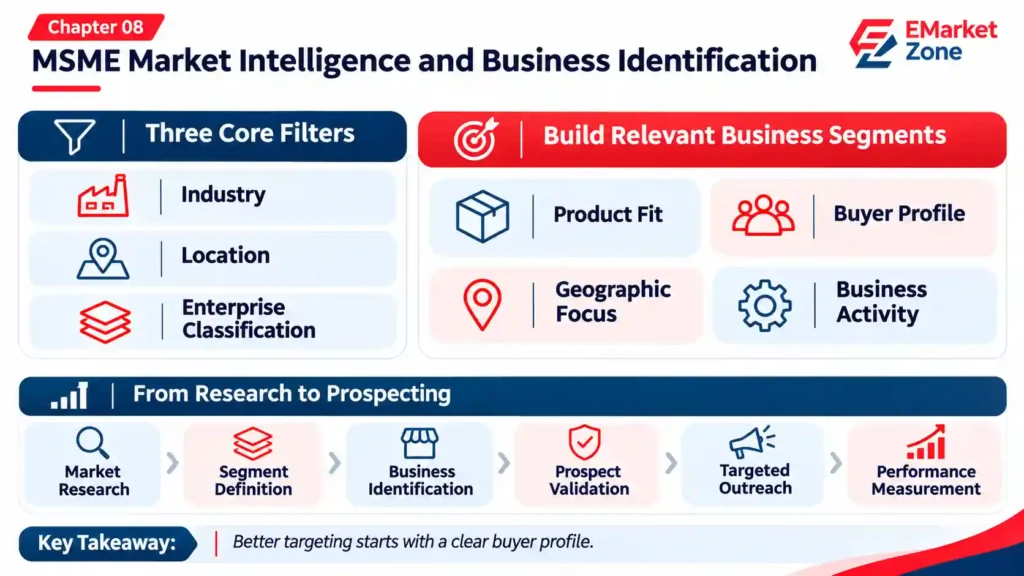
Understanding the size and structure of India’s MSME sector is only the starting point for identifying business opportunities. For manufacturers, suppliers, distributors and service providers, the next challenge is to determine which enterprises are relevant to their offering, where those enterprises operate and how to prioritise them for business development.
Market intelligence helps convert broad industry information into practical decisions. By combining industry activity, geographic location and enterprise classification, businesses can develop clearer target-market profiles, identify potential customer segments and plan more focused B2B prospecting.
This chapter outlines how MSME information can be organised and applied to market research, business identification and targeted sales activity. It also distinguishes between identifying a potential prospect and confirming that the prospect is active, relevant and commercially interested.
8.1 Using Industry, Location and Enterprise Classification
Three dimensions provide a useful foundation for MSME market intelligence: industry, location and enterprise classification. Each answers a different business question.
– Industry: What does the enterprise produce, sell or provide?
– Location: Where does it operate, and which markets or industrial clusters does it serve?
– Enterprise classification: Is it classified as a micro, small or medium enterprise under the applicable MSME criteria?
Used together, these dimensions help businesses move beyond broad market categories and define more relevant prospect groups.
A. Industry-based identification
Industry classification helps identify enterprises according to their principal economic activity. For example, a machinery manufacturer may be interested in engineering and food-processing units, while a packaging supplier may target food, pharmaceutical, textile and consumer-goods manufacturers.
India’s National Industrial Classification (NIC) provides a structured framework for classifying economic activities. It can support industry analysis and the organisation of business segments, although a classification code alone may not fully describe an enterprise’s actual products, procurement needs or current operations.
Examples of industry-based segments include:
Industry segment | Potential business targets | Possible B2B offerings |
|---|---|---|
Food processing | Food manufacturers and processing units | Packaging, ingredients and machinery |
Textiles and apparel | Garment makers, textile processors and fabric units | Yarn, dyes, accessories and equipment |
Engineering | Fabricators, component makers and machine shops | Tools, components and industrial supplies |
Chemicals and pharmaceuticals | Chemical and pharmaceutical manufacturers | Process equipment, packaging and testing |
Electrical and electronics | Electrical equipment and electronics manufacturers | Components, cables and automation |
Wholesale and distribution | Wholesalers, distributors and trading businesses | Products for resale, logistics and business software |
B. Location-based identification
Geographic information helps businesses understand where potential customers are concentrated and whether those markets are practical to serve. A company can segment prospects by state, city, district or industrial cluster, depending on its sales coverage and delivery capabilities.
For example, a textile machinery supplier may prioritise Tiruppur and Surat, while an engineering component supplier may investigate Coimbatore, Rajkot and Pune. These locations provide useful starting points for research because of their established industrial activity; the presence of a cluster does not prove that every enterprise there is a suitable buyer.
Location-based segmentation is especially useful when delivery costs, service coverage, local distribution networks or regional industry specialisation affect the commercial proposition.
C. Enterprise classification
India’s MSME classification distinguishes enterprises by investment in plant and machinery or equipment and annual turnover. From 1 April 2025, the applicable limits are:
Enterprise category | Investment limit | Annual turnover limit |
|---|---|---|
Micro | Up to ₹2.5 crore | Up to ₹10 crore |
Small | Up to ₹25 crore | Up to ₹100 crore |
Medium | Up to ₹125 crore | Up to ₹500 crore |
These categories can help businesses define the scale of enterprise they want to approach. For instance, a low-cost billing solution may be relevant to micro enterprises, while an industrial automation provider may focus on small and medium manufacturers with more complex production requirements.
However, classification is not a direct measure of purchasing power, creditworthiness or demand. A micro enterprise may have a specialised requirement and a substantial procurement need, while a medium enterprise may not be a suitable customer for a particular product.
Combining the three dimensions
Segmentation dimension | Example filter | Business value |
|---|---|---|
Industry | Food processing | Identifies relevant economic activity |
Location | Maharashtra and Gujarat | Focuses outreach on selected markets |
Enterprise category | Small and medium | Narrows the target enterprise scale |
A business selling industrial packaging machinery, for example, could define its target segment as small and medium food-processing enterprises in selected manufacturing regions. This is more actionable than targeting all MSMEs across India.
8.2 Identifying Relevant MSME Business Segments
A large pool of enterprises does not automatically represent a useful sales market. The objective of business identification is to isolate the enterprises whose activities, operating scale, location and likely requirements align with a company’s products or services.
The process should begin with the offering, not with the available list of enterprises. Businesses should first define what they sell, who is most likely to need it and what characteristics indicate a suitable prospect.
A. Start with the buyer’s business requirement
Different products and services require different customer profiles.
Business offering | Relevant MSME segments | Useful identification criteria |
|---|---|---|
Industrial machinery | Manufacturing and processing units | Industry, production activity and location |
Raw materials | Manufacturers and processors | Material requirement and industry |
Packaging products | Food, pharmaceutical and consumer-goods businesses | Product category and manufacturing activity |
Accounting software | Micro and small businesses | Enterprise category and business activity |
Logistics services | Manufacturers, wholesalers and distributors | Location, shipment routes and operating model |
Marketing services | Manufacturers, traders and service providers | Industry, customer market and business scale |
This approach reduces irrelevant outreach. A company supplying textile dyes, for example, should prioritise textile processors rather than approach every enterprise classified as a manufacturer.
B. Build segments using multiple filters
A useful MSME segment can be defined through a combination of attributes:
– Industry or activity: Manufacturing, trading or services, followed by a more specific industry category.
– Geographic coverage: State, city, district or industrial cluster.
– Enterprise category: Micro, small or medium, where reliable classification information is available.
– Business profile: Product type, company structure or operating activity, where available.
– Commercial suitability: Whether the enterprise appears to match the product’s price, service area and customer requirements.
For example, a company offering inventory-management software could target micro and small wholesale businesses in selected cities. A supplier of industrial safety equipment could focus on manufacturing units in engineering, chemicals and metalworking clusters.
C. Prioritise segments instead of treating all prospects equally
Not every segment deserves the same sales effort. Businesses can evaluate potential segments against a small set of commercial criteria.
Evaluation factor | Key question |
|---|---|
Product fit | Does the enterprise’s activity match the offering? |
Market concentration | Are enough relevant enterprises present in the selected area? |
Purchase potential | Is there a plausible recurring or project-based requirement? |
Sales accessibility | Can the business be reached through appropriate channels? |
Service feasibility | Can the company deliver and support customers in that market? |
A simple scoring system can help compare segments. For example, businesses may assign each factor a score from 1 to 5 and prioritise segments with stronger overall fit. The scores should be based on evidence and internal sales experience, not assumed from registration counts alone.
The result is a practical target-market structure: a defined group of enterprises that share relevant business characteristics and are more likely to benefit from the company’s offering.
8.3 From Market Research to Targeted B2B Prospecting
Market research becomes commercially useful when it informs an organised prospecting process. Industry reports, registration statistics, geographic information and enterprise classifications help businesses understand the market. Prospecting then applies that understanding to identify, evaluate and approach potential customers.
A disciplined process connects these activities without assuming that every identified enterprise is ready to buy.
A. Convert market research into a target-market definition
The first step is to translate research findings into a clear customer profile.
For example:
– Offering: Industrial packaging machinery.
– Target industry: Food processing and packaged products.
– Geographic focus: Selected manufacturing clusters in Maharashtra and Gujarat.
– Enterprise profile: Micro, small and medium manufacturing units, depending on machinery capacity.
– Likely requirement: Filling, sealing, labelling or packaging equipment.
This profile provides a basis for selecting relevant enterprises and avoiding broad, untargeted outreach.
B. Identify and validate potential businesses
Once the target segment is defined, businesses can use suitable sources of business information to identify potential prospects. Depending on the research objective, these may include government registration resources, industry associations, trade directories, company websites, exhibitions and other business information sources.
The information should then be checked for:
– Whether the business appears to be operating.
– Whether its products or services match the target industry.
– Whether its location falls within the sales or service area.
– Whether the available contact details are current and appropriate for business communication.
– Whether the enterprise is a plausible buyer, supplier, distributor or business partner.
Registration records and directory listings are useful for discovery, but they should not be treated as confirmation of active operations or purchase intent. Contact information should also be used in accordance with applicable privacy, data-protection and communication requirements.
C. Plan, execute and measure B2B outreach
After validation, businesses can organise prospects into campaigns based on industry, geography and buyer profile. Different segments may require different messages, product demonstrations, pricing approaches and sales channels.
Campaign performance should be measured using commercial outcomes rather than the volume of contacts alone.
Performance indicator | What it measures |
|---|---|
Reachable prospects | Businesses that could be contacted successfully |
Response rate | Share of contacted prospects that respond |
Qualified leads | Prospects that meet the defined customer profile |
Meeting or enquiry rate | Prospects progressing to a sales conversation |
Conversion rate | Qualified prospects becoming customers |
Cost per qualified lead | Sales and marketing cost for each qualified prospect |
These indicators help businesses identify which industries, regions and enterprise segments produce better results. Over time, campaign findings can refine the target-market definition and improve prospect selection.
The market-intelligence-to-prospecting workflow
– Market understanding
Review industry trends, MSME distribution, business activity and regional clusters.
– Segment definition
Select relevant industries, locations and enterprise categories.
– Business identification
Find potential enterprises that match the defined customer profile.
– Prospect validation
Check business relevance, operating status and appropriate contact information.
– Targeted outreach
Run focused sales campaigns with segment-specific messaging.
– Performance measurement
Evaluate qualified leads, responses, conversions and acquisition costs.
The objective is not simply to reach more businesses. It is to improve the relevance of each sales interaction by connecting a company’s offering with enterprises that have a plausible need for it.
Conclusion - India's MSME Opportunity Outlook
India’s MSME sector represents a diverse and geographically distributed business ecosystem spanning manufacturing, services, trading and specialised industrial clusters. Its contribution to economic activity, employment, production and exports makes it an important part of the country’s long-term business and industrial development.
The analysis in this report shows that India’s MSME opportunity cannot be understood through enterprise registrations alone. It requires a broader view of industry composition, enterprise classification, regional concentration, business clusters, operational challenges and changing market requirements.
For businesses seeking to serve this sector, the opportunity lies in understanding where enterprises operate, what they produce, what resources they require and how their business needs connect with available products and services.
India’s MSME Sector: A Diverse Business Ecosystem
India’s MSME landscape includes enterprises at different stages of development, from small local businesses and independent service providers to specialised manufacturers participating in national and international supply chains.
Three characteristics stand out:
– Diversity of business activity: MSMEs operate across manufacturing, services and trading, creating demand for a wide range of products, inputs, technology and professional services.
– Regional specialisation: Industrial clusters and business centres have developed around particular products, skills, supplier networks and infrastructure.
– Different enterprise scales: Micro, small and medium enterprises have different operating capacities, investment requirements and commercial needs.
These differences matter when evaluating the market. A broad national enterprise count can indicate the scale of the ecosystem, but it cannot explain the commercial potential of a particular industry, region or buyer segment.
Emerging Opportunities for B2B Businesses
The MSME ecosystem creates opportunities for manufacturers, raw-material suppliers, machinery dealers, distributors, logistics companies, technology providers and professional service firms.
Several areas deserve attention:
– Industrial supply chains: Machinery, components, tools, raw materials and production inputs.
– Technology and digital services: Business software, automation, digital commerce and operational systems.
– Business support services: Accounting, compliance, logistics, quality management and technical consultancy.
– Regional market development: Serving enterprises in specialised manufacturing centres and emerging business locations.
– Industry-specific solutions: Developing products and services around the requirements of sectors such as food processing, textiles, engineering, automotive components, chemicals and electronics.
However, the presence of a large number of enterprises in a sector does not automatically translate into sales demand. Commercial opportunity depends on the relevance of the offering, purchasing requirements, competition, pricing, service capability and access to potential customers.
Businesses should therefore evaluate segments based on actual customer needs rather than selecting markets solely because they have high registration counts.
Building a More Focused MSME Market Strategy
A practical MSME market strategy should connect market research with business identification and measurable sales activity.
The report’s findings point towards a structured approach:
– Understand the market: Examine industry composition, enterprise categories, state-wise distribution and important business clusters.
– Define the target segment: Select industries and locations that align with the company’s products, services and operating capabilities.
– Identify relevant enterprises: Use suitable business information and classification attributes to develop a focused prospect pool.
– Validate potential customers: Check business relevance, operating status and appropriate contact information before outreach.
– Measure commercial results: Track qualified enquiries, responses, conversions and acquisition costs to improve targeting over time.
Reliable market intelligence can support each stage, but it should be treated as a decision-making resource rather than a substitute for customer validation. Enterprise registrations, industry classifications and business listings provide useful starting points; they do not independently establish purchasing intent or current business activity.
Outlook to 2030
India’s MSME ecosystem is likely to remain important to the country’s manufacturing development, supply-chain expansion, entrepreneurship and regional economic activity. Technology adoption, improved access to markets, infrastructure development, financing and enterprise competitiveness will influence how businesses grow over the coming years.
For B2B companies, the next phase of opportunity will depend less on approaching the largest possible number of enterprises and more on identifying the right business segments. Industry specialisation, geographic understanding and accurate prospect qualification can help companies allocate sales resources more effectively.
By 2030, businesses that combine sector knowledge with disciplined market intelligence and customer-focused execution will be better positioned to identify relevant opportunities across India’s MSME ecosystem.
Final Perspective
India’s MSME opportunity is not simply a matter of market size. It is a question of understanding the businesses within that market, recognising their different requirements and connecting them with relevant products, services and commercial solutions.
This report provides a framework for understanding that opportunity through enterprise classification, industry structure, geographic distribution, business clusters and targeted B2B market development.
Research Resources & References
The following government, institutional and research sources were used to prepare the India MSME Business Landscape & Opportunity Report 2026. They cover MSME registrations, classification, economic contribution, state-wise distribution, industry composition, industrial clusters, government schemes, digital adoption, financing and B2B market opportunities.
1. Ministry of Micro, Small and Medium Enterprises (MSME)
1. MSME Annual Report 2025–26 – MSME sector overview, enterprise distribution, registration trends, government initiatives and programme implementation.
Read the MSME Annual Report 2025–26 (PDF)
2. MSME Performance Smartboard – Udyam and Udyam Assist registrations, enterprise categories, business activities and other registration indicators.
View MSME Performance Dashboard
3. State-wise Udyam Registration – State and Union Territory registration distribution, including Udyam and Udyam Assist Platform figures.
View State-wise MSME Registrations
4. Micro and Small Enterprises Cluster Development Programme (MSE-CDP) – Industrial clusters, common facility centres and infrastructure development.
5. Approved SFURTI Clusters – Traditional industry clusters and regional specialisations across India.
6. MSME Scheme Directory – Government support programmes, including PMEGP, CGTMSE, SFURTI and other schemes.
7. Udyam Registration – Important to Know – Official MSME definitions, classification thresholds and registration information.
View MSME Classification Guidelines
2. Government of India – Economic Survey and Official Releases
8. Economic Survey 2025–26 – National economic analysis and the role of MSMEs in India’s industrial economy.
9. MSMEs Form the Backbone of India’s Industrial Economy – Economic Survey 2025-26 (29 January 2026) – Source for the reported MSME contributions of 31.1% of GDP, 35.4% of manufacturing and 48.58% of exports.
10. Over 7.83 Crore Enterprises Registered on Udyam and UAP (30 March 2026) – National registration figures and state-wise registration annexure as of 28 February 2026.
11. Udyam Assist Platform Launched (23 March 2023) – Background on the formalisation of informal micro enterprises through UAP.
12. Government Periodically Assesses Digital Adoption Among MSMEs (9 March 2026) – Information on ONDC, e-commerce participation and the MSME TEAM initiative.
13. Udyam Assist Platform Registrations Cross 1.50 Crore (4 March 2024) – Official information on the UAP and informal micro-enterprise registration.
3. NITI Aayog – Research and Policy Reports
14. Enhancing Competitiveness of MSMEs in India (2025) – Research on MSME competitiveness, financing, skilling, innovation, market access and selected industry sectors.
15. Key Sectors to Position India as a Global Manufacturing Hub (2026) – Research on strategic manufacturing sectors, value chains and industrial opportunities.
Read the PIB report announcement
16. NITI Aayog Annual Report 2025–26 – Policy research and initiatives relating to MSME competitiveness and medium enterprises.
4. Ministry of Statistics and Programme Implementation (MoSPI)
17. National Industrial Classification (NIC) 2025 – Official framework for classifying economic activities and industry segments in India.
18. MoSPI Classification Resources – Official industrial and product classification resources.
5. SIDBI – MSME Finance and Sector Analysis
19. SIDBI Annual Report 2024–25 – MSME Sector Outlook – MSME credit growth, outstanding credit and the estimated addressable credit gap.
20. SIDBI Annual Report 2024–25 – Part I – Additional institutional analysis of MSME finance, credit access and sector development.
21. SIDBI MSME Pulse – Periodic analysis of MSME credit trends and lending conditions.
6. Government MSME Programme and Digital Market Resources
22. RAMP Programme – CGTMSE – Credit guarantee programme information and institutional support for micro and small enterprises.
23. RAMP – MSME TEAM Initiative – Information on digital market access and e-commerce enablement for MSMEs.
24. MSME Cluster Development Programme – Programme objectives, common infrastructure and cluster-level support.
About EMarket Zone
EMarket Zone is a business-data and market-intelligence platform designed to help companies understand business markets and identify relevant B2B opportunities across India. We bring together business information, geographic insights and market intelligence to help sales and marketing teams move from broad market research to more focused business identification and prospecting.
Our business information resources cover multiple segments, including GST-registered businesses, MSMEs, Pvt Ltd companies, manufacturers and other business categories. These resources help companies explore potential business accounts across India, states, cities, industries and enterprise segments, supporting applications such as B2B lead generation, sales prospecting, market expansion and targeted marketing.
The objective is simple: make business markets easier to understand and easier to reach.
Business Data → Market Intelligence → B2B Lead Generation
Explore Business Information
Turn Market Intelligence Into Action
Understand the market. Identify relevant businesses. Define your target segments. Build your next B2B opportunity.
End of Report
EMarket Zone
Verified Data. Smarter Growth.
Copyright © 2026 EMarket Zone. All rights reserved.