
State-wise New GST Taxpayers in India: Top 10 States
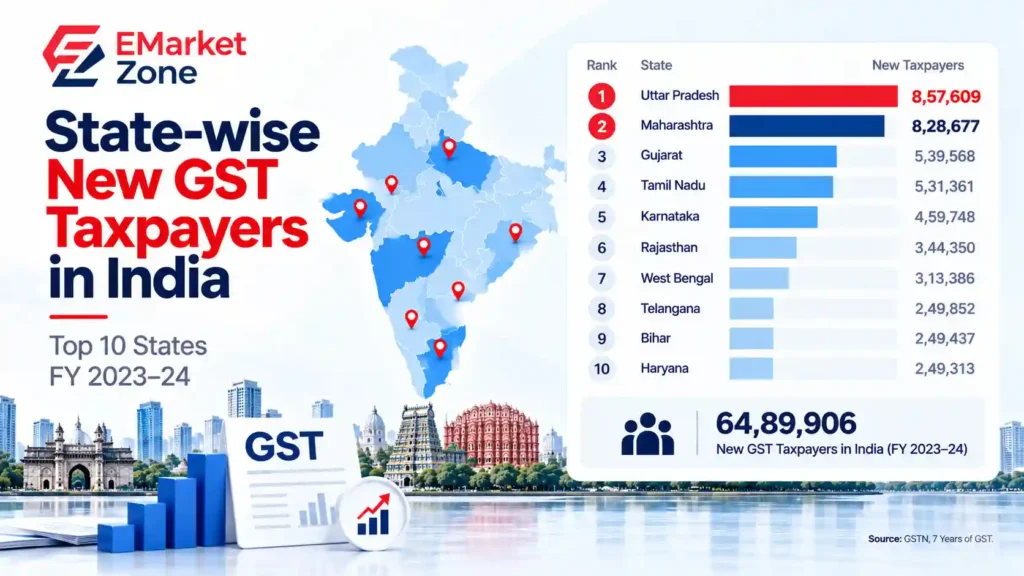
India’s GST registration statistics provide useful insight into the geographic distribution of taxpayers entering the formal tax system. Comparing states helps researchers understand where new taxpayer registrations were concentrated and which markets may warrant closer investigation.
According to the Goods and Services Tax Network (GSTN), India recorded 64,89,906 new taxpayers in FY 2023–24. Uttar Pradesh and Maharashtra led the state-wise ranking, followed by Gujarat, Tamil Nadu and Karnataka.
This article presents the top 10 states, their reported new-taxpayer counts and their approximate shares of the national total. It also explains how these figures can support geographic market research without confusing GST registration activity with actual business creation or commercial opportunity.
Top 10 States by New GST Taxpayers
The following ranking uses GSTN’s reported state-wise new-taxpayer figures for FY 2023–24.
| Rank | State | New taxpayers | Share of national total |
|---|---|---|---|
| 1 | Uttar Pradesh | 8,57,609 | 13.21% |
| 2 | Maharashtra | 8,28,677 | 12.77% |
| 3 | Gujarat | 5,39,568 | 8.31% |
| 4 | Tamil Nadu | 5,31,361 | 8.19% |
| 5 | Karnataka | 4,59,748 | 7.08% |
| 6 | Rajasthan | 3,44,350 | 5.31% |
| 7 | West Bengal | 3,13,386 | 4.83% |
| 8 | Telangana | 2,49,852 | 3.85% |
| 9 | Bihar | 2,49,437 | 3.84% |
| 10 | Haryana | 2,49,313 | 3.84% |
National total: 64,89,906 new taxpayers.
Source: GSTN, 7 Years of GST: A Statistical Report on Completion of 7 Years of GST. Shares calculated by EMarket Zone from the reported national total; percentages are rounded.
1. Uttar Pradesh Ranked First
Uttar Pradesh recorded 8,57,609 new taxpayers, the highest figure among the states listed in the GSTN FY 2023–24 data.
This represented approximately 13.21% of the national total of 64,89,906 new taxpayers.
The result makes Uttar Pradesh an important state to examine when studying the geographic distribution of new GST taxpayer registrations. However, the count alone does not establish that the state had the highest business revenue, the greatest number of newly founded companies or the strongest commercial opportunity for every industry.
Those questions require additional indicators.
2. Maharashtra Ranked Second
Maharashtra recorded 8,28,677 new taxpayers, equivalent to approximately 12.77% of the national total.
The state ranked second, close behind Uttar Pradesh. Together, these two states accounted for approximately 25.98% of the reported national new-taxpayer count.
The figures illustrate the concentration of registration activity in two large states. They do not, on their own, establish the relative quality of business prospects or purchasing potential within either state.
3. Gujarat, Tamil Nadu and Karnataka Completed the Top Five
Three additional states recorded more than 4.5 lakh new taxpayers each:
• Gujarat: 5,39,568
• Tamil Nadu: 5,31,361
• Karnataka: 4,59,748
Gujarat and Tamil Nadu recorded similar counts, while Karnataka ranked fifth.
These comparisons can help researchers identify states for further market analysis. Companies operating in manufacturing, distribution, technology or professional services may then investigate whether the relevant industries and customer segments are concentrated in particular cities or commercial clusters.
The state-level totals should be treated as a starting point rather than a substitute for industry-specific research.
4. Rajasthan and West Bengal Also Ranked in the Top Seven
Rajasthan recorded 3,44,350 new taxpayers, followed by West Bengal with 3,13,386.
Their respective shares of the national total were approximately 5.31% and 4.83%.
These figures broaden the geographic picture beyond the five leading states. A state ranking is useful for identifying the scale of registration activity, but a more complete assessment would also consider city-level distribution, relevant business categories and the needs of the company conducting the research.
5. Telangana, Bihar and Haryana Had Similar Counts
The final three states in the top 10 recorded closely grouped totals:
| State | New taxpayers | Approximate national share |
|---|---|---|
| Telangana | 2,49,852 | 3.85% |
| Bihar | 2,49,437 | 3.84% |
| Haryana | 2,49,313 | 3.84% |
The differences between these three reported counts were relatively small. Their similar totals do not mean that they have identical business environments or customer profiles.
For market planning, each state should be assessed using the industries, cities and business characteristics relevant to the company’s products or services.
6. How Much Did the Top 10 States Account for?
Adding the reported figures for the 10 states gives 46,23,301 new taxpayers.
Compared with the national total of 64,89,906, this represents approximately 71.23% of new taxpayers in FY 2023–24.
This calculation is based on the 10 state-level counts in the table above.
The result indicates that the listed states accounted for a substantial share of the reported new-taxpayer total. It should not be interpreted as a direct measure of their share of India’s active businesses, economic output or commercial demand.
The calculation also illustrates why totals and percentages should be checked against the underlying source data before publication.
7. What Do State-wise GST Registration Statistics Mean for B2B Companies?
State-wise registration figures can support the initial stages of geographic market research. They help identify where new taxpayer registrations were concentrated during the reference period.
However, a national or state-level total cannot identify the businesses most likely to purchase a particular product or service.
A more targeted B2B research process can move through the following stages:
India → State → City → Industry → Business → Prospect
Each stage narrows the market:
• State: Identify geographic markets relevant to the business strategy.
• City: Examine specific commercial centres within those markets.
• Industry: Identify the business categories most relevant to the offering.
• Business: Identify individual businesses matching the selected criteria.
• Prospect: Qualify businesses against the company’s ideal customer profile.
GST-focused business data can support business identification and geographic segmentation, but registration alone does not establish that a business is active, commercially viable or ready to buy.
Businesses should apply suitable qualification criteria and data-quality checks before using records for sales or marketing outreach.
8. Explore GST Business Data by Geography
The state-wise figures provide a national overview. Companies seeking a more granular view can explore business data organised by geography.
EMarket Zone provides GST-focused business data resources for businesses researching potential B2B markets.
• GST Database India – explore GST-focused business data for national prospecting.
• State-wise GST Business Data – explore business data organised by state.
• City-wise GST Business Data – explore geographic segmentation by city.
These resources can support market research and prospecting. The suitability of any business record depends on its coverage, accuracy, relevance and the criteria used to qualify potential customers.
Frequently Asked Questions
Uttar Pradesh ranked first among the states in the GSTN dataset, with 8,57,609 new taxpayers.
Maharashtra recorded 8,28,677 new taxpayers in FY 2023–24, ranking second in the state-wise table.
GSTN reported 64,89,906 new taxpayers nationally for FY 2023–24.
The 10 states listed in this article recorded a combined 46,23,301 new taxpayers, approximately 71.23% of the national total of 64,89,906.
Not necessarily. The reported new-taxpayer measure should not be interpreted as a one-to-one count of newly incorporated companies or newly founded businesses. It measures the taxpayer category reported in the underlying GSTN dataset.
The primary source is GSTN’s 7 Years of GST: A Statistical Report on Completion of 7 Years of GST, which includes state-wise new-taxpayer figures for FY 2023–24.
Sources and References
• Goods and Services Tax Network (GSTN). 7 Years of GST: A Statistical Report on Completion of 7 Years of GST. State-wise new-taxpayer figures and national total for FY 2023–24.
https://tutorial.gst.gov.in/offlineutilities/gst_statistics/7YearsReport.pdf
Methodology note: State rankings use the FY 2023–24 new-taxpayer counts reported by GSTN. National shares and the combined top-10 share are EMarket Zone calculations. Figures are rounded where applicable. These counts should not be treated as measures of active businesses, revenue or commercial potential.