
Every business needs prospects.
The challenge is finding them efficiently.
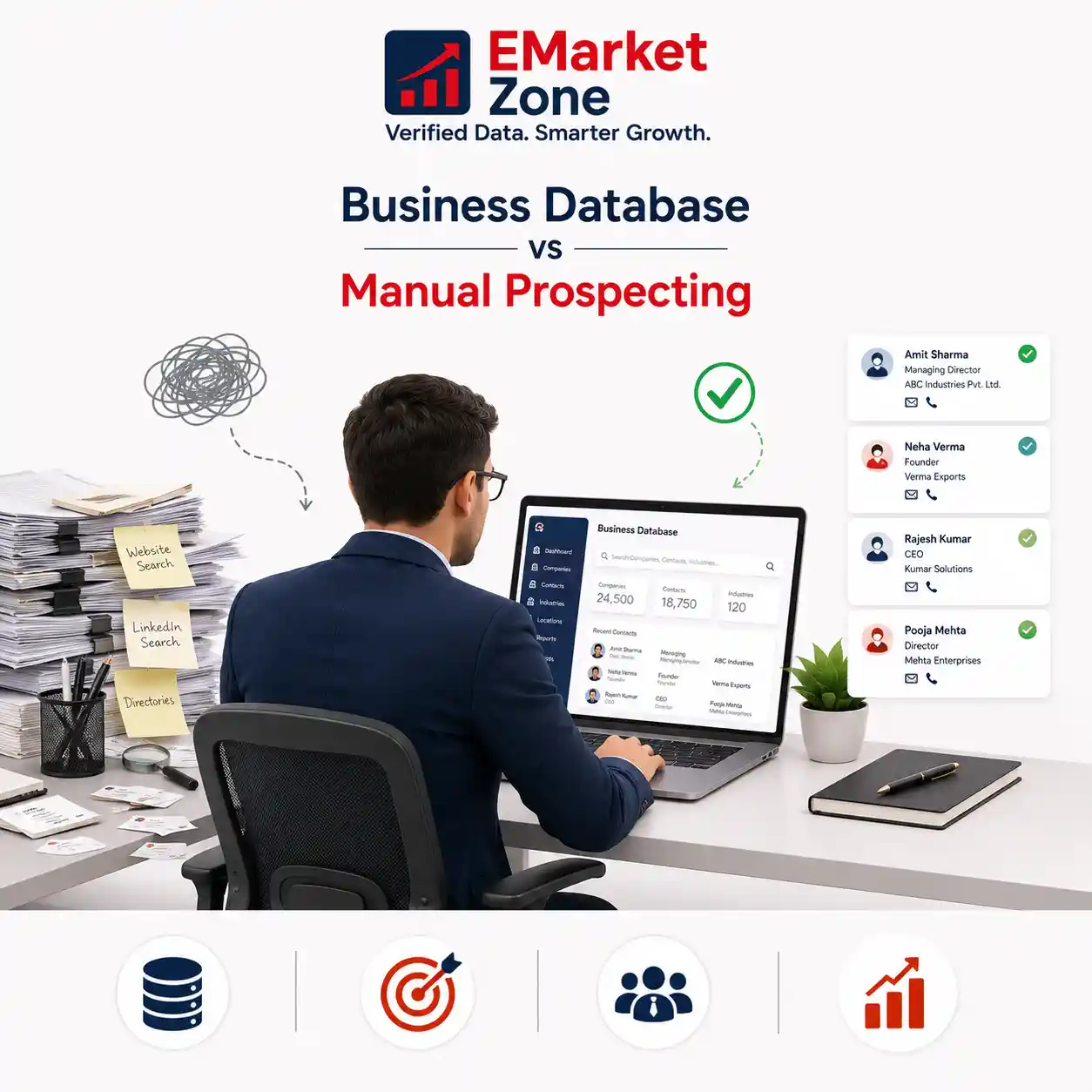
For years, sales teams relied on manual prospecting.
They searched websites, business directories, LinkedIn profiles, and industry listings one company at a time.
Today, many businesses use databases instead.
This creates a common question:
Should businesses continue manual prospecting or invest in a business database?
The answer depends on your goals, resources, and growth plans.
But understanding the strengths and limitations of both approaches is important before deciding.
What Is Manual Prospecting?
Manual prospecting is the process of identifying potential customers individually.
Sales teams typically use:
• Google search
• LinkedIn
• company websites
• industry directories
• business listings
The objective is to build a prospect list manually.
This method can work.
Many businesses still use it successfully.
However, it requires significant time and effort.
Why Businesses Start With Manual Prospecting
Most companies begin with manual prospecting because it appears inexpensive.
There is no database purchase.
No software investment.
No upfront cost.
A founder or salesperson simply starts searching for prospects.
This works reasonably well during the early stages of a business.
When outreach volume is low, manual prospecting can provide valuable insights into a market.
The Hidden Cost of Manual Prospecting
The biggest problem with manual prospecting is not money.
It is time.
Consider a salesperson spending:
• finding companies
• locating contacts
• verifying emails
• researching decision-makers
before sending a single message.
This often consumes more time than the outreach itself.
As a business grows, this becomes difficult to scale.
What Is a Business Database?
A business database contains structured information about companies and contacts.
Depending on the database, information may include:
• company name
• industry
• location
• phone number
• email address
• decision-maker details
Instead of researching prospects individually, businesses gain access to pre-organized information.
Business Leads India
https://emarketzone.in/business-leads-india/
Why Businesses Use Databases
Businesses usually adopt databases when growth requires scale.
Manual prospecting may work for:
• 20 prospects
• 50 prospects
• 100 prospects
But what happens when you need 5,000 prospects?
The workload increases dramatically.
Databases solve this problem by reducing prospect research time.
Instead of finding prospects one by one, teams can focus on outreach and relationship building.
The Accuracy Question
One criticism of business databases is accuracy.
And it’s a fair concern.
Not all databases are created equally.
Poor-quality databases can contain:
• outdated contacts
• inactive companies
• incorrect information
This is why verified data matters.
Businesses should focus on reliable and regularly updated databases rather than simply choosing the largest list available.
Verified Company Contacts India
https://emarketzone.in/verified-company-contacts-india/
Where Manual Prospecting Performs Better
Manual prospecting still has advantages.
It is often useful when:
• targeting a niche market
• pursuing enterprise accounts
• researching highly specialized industries
In these situations, deeper research can provide valuable context that databases may not contain.
For high-value opportunities, personalization often matters more than volume.
Where Databases Perform Better
Databases usually outperform manual prospecting when:
• scale matters
• outreach volume increases
• multiple industries are targeted
• lead generation systems need consistency
This is why agencies, recruiters, SaaS companies, and B2B service providers frequently rely on databases.
Company Database India
https://emarketzone.in/company-database-india/
The Decision-Maker Advantage
One major challenge in manual prospecting is identifying the correct contact.
Businesses often spend hours trying to determine:
• who owns the company
• who makes decisions
• who should receive outreach
Quality databases simplify this process.
Many provide access to:
• founders
• owners
• directors
• senior management
This can significantly improve outreach efficiency.
Business Owner Contact List India
https://emarketzone.in/business-owner-contact-list-india/
Buy Decision Makers Data India
https://emarketzone.in/buy-decision-makers-data-india/
Why MSMEs Need Efficiency
Most MSMEs operate with limited resources.
They cannot afford to spend weeks researching prospects manually.
This is why many small businesses use targeted databases to accelerate lead generation.
The goal is not replacing outreach.
The goal is reducing research time.
Internal Link:
MSME Business Database India
https://emarketzone.in/msme-business-database-india/
The Best Approach Is Often Hybrid
Many successful businesses combine both approaches.
They use databases to:
• identify prospects
• segment industries
• build target lists
Then they use manual research to:
• personalize communication
• understand business challenges
• improve messaging
This hybrid approach combines scale with relevance.
Why Prospecting Alone Doesn't Generate Leads
Whether businesses use databases or manual prospecting, one truth remains:
Prospecting does not generate customers.
It creates opportunities.
Lead generation still requires:
• outreach
• follow-up
• credibility
• communication
Many businesses blame prospecting methods when the real issue is execution.
Final Thoughts
The debate between business databases and manual prospecting is often framed incorrectly.
One is not replacing the other.
Manual prospecting offers depth.
Business databases offer scale.
Businesses that understand when to use each approach usually achieve better results.
The most effective lead generation systems often combine the efficiency of databases with the personalization of manual research.
FAQs
Not necessarily. Manual prospecting provides deeper research, while databases provide scale and efficiency.
Accuracy depends on the provider. Verified and regularly updated databases generally perform better.
The biggest advantage is reduced prospect research time and faster access to potential customers.
Many MSMEs use databases because they allow businesses to scale prospecting without hiring large sales teams.
No. Databases provide access to prospects, but outreach and follow-up are still required to generate opportunities.

Leave a comment